
Theodore the Studite
Our Venerable Father and Confessor Theodore, Abbot of the Studion
Venerable · Confessor · b. 759 — d. 826
Commemorated 26 January — Translation of the relics from Prince's Island to Constantinople (845), 11 November — Repose
Theodore the Studite (759–826) was the great abbot of the monastery of Stoudios at Constantinople, the foremost monastic reformer and confessor of the Byzantine Church, and the most uncompromising defender of the holy icons in the second iconoclast controversy. Through his Rule, his catechetical instructions, and his vast correspondence he refounded coenobitic monasticism on a footing of common life, manual labour, and daily obedience that shaped Eastern monasticism ever after; the Stoudite typikon governed the worship of Constantinople and passed to Mount Athos, Kiev, and the whole Slavonic world. Thrice exiled and scourged for his resistance to imperial interference in the Church, he died in confession on November 11, 826.

Origins and early life
Theodore was born in 759 at Constantinople into a devout and well-placed family: his father Photinus was an official of the imperial treasury, and his mother Theoctiste a woman of strong piety (she too is venerated as a saint). He received the best education the capital could give, in rhetoric, philosophy, and theology, and was formed from youth in the defence of the icons against the iconoclasm then dominant under the emperor Constantine V. When Theodore was still young his parents, by mutual consent, distributed their wealth to the poor and separated to embrace the monastic life. Theodore, with his brothers Joseph (later archbishop of Thessalonica) and Euthymius, followed his maternal uncle Saint Plato of Sakkoudion into monasticism.
Ascetic struggle and the Sakkoudion community
About 781 the family withdrew to Plato's foundation at Sakkoudion, on the slopes of Mount Olympus in Bithynia, where they built a church of Saint John the Theologian and gathered a community. Theodore embraced the hardest and humblest labours, kept the fasts with rigour, and made daily confession of his thoughts and deeds to Plato as his spiritual father. He was ordained priest, and on Plato's retirement was chosen by the brethren, against his own will, as abbot (igumen) of the monastery.
His public witness began at once. When the emperor Constantine VI put away his lawful wife and married again, and a compliant clergy blessed the union, Theodore and his community refused communion with those who had condoned the adultery — the episode known as the "Moechian controversy." For this he and ten of his monks were exiled to Thessalonica in 796. The empress Irene, on regaining sole power, recalled him.
Abbot of Stoudios and monastic reformer
About 799, with the Arab raids making Sakkoudion unsafe, Irene installed Theodore and his monks in the ancient but nearly deserted monastery of Stoudios (the Stoudion) within Constantinople, dedicated to Saint John the Baptist, where he found only a handful of monks. Under his government it grew into the greatest monastery of the empire, numbering — the Life says — around a thousand brethren, and became the model and school of Byzantine coenobitism.
Here Theodore carried through his life's chief work. He composed a monastic Rule, the "Stoudite" typikon, and a body of catechetical instructions (the Great and Small Catecheses) delivered to his monks. He restored the full common life: personal poverty without exception, obedience to the abbot and confession of thoughts, ordered manual labour and the copying of manuscripts, and a disciplined round of liturgical prayer. His liturgical ordering of the services — the shaping of the Lenten Triodion, to which he and his brother Joseph contributed many of the hymns still sung — and his organisation of the daily office became normative: the Stoudite typikon was carried to the Great Lavra and Mount Athos, and through Kiev to the whole Church of Rus'. For his dogmatic and hymnographic labours a later writer called him "a fiery teacher of the Church."
Confessor for the icons
Theodore's readiness to suffer for the Church's freedom was tested again and again. Under the emperor Nikephoros I, who by his own authority reinstated a priest the Church had excommunicated (a renewal of the Moechian dispute), Theodore resisted, was tortured, and was sent into exile for more than two years, until freed by the pious emperor Michael I.
His greatest struggle came with the revival of iconoclasm under Leo V the Armenian (reigned 813–820). When Leo moved to abolish the veneration of icons, Theodore became the leader of the resistance. On Palm Sunday of 815 he had his monks carry the icons aloft in solemn procession around the Stoudios, chanting in open defiance of the imperial prohibition. He wrote three Antirrhetics — refutations of the iconoclasts — that are among the profoundest theological defences of the image: the honour paid to the icon, he argued, passes to its prototype, and the very possibility of depicting Christ follows from the reality of his Incarnation. For this he was exiled once more, to Metopa and then to Boneta in Anatolia, where he was imprisoned in harsh conditions, deprived of food, and scourged almost to death, yet continued to direct the confessors of Orthodoxy by a stream of letters smuggled from his cell.
Repose
On the accession of the more tolerant Michael II, Theodore and the other confessors were released, though icon-veneration was still not permitted in the capital. Unwilling to return to a compromised Constantinople, he settled on the promontory of Akritas in Bithynia, near the church of the martyr Tryphon, and there, though gravely ill, celebrated the Liturgy daily and taught his brethren to the end. Foreseeing his death, he gathered the monks, charged them to hold fast to Orthodoxy and the veneration of the icons and to keep the monastic rule, and had them sing the canon for the departure of the soul; as they reached the verse "I will never forget Thy precepts, for by them Thou hast given me life," he reposed, on November 11, 826. The tradition relates that at that hour Saint Hilarion of Dalmatia beheld a vision of light and heard that the soul of Theodore, who had suffered even to blood for the holy icons, was passing to the Lord. The final triumph of the icons at the Synod of 843 vindicated his cause within a generation.
Relics and translations
Theodore was buried on Prince's Island (Prinkipo). After the restoration of the icons, his relics, together with those of his brother Joseph, were translated to the Stoudios monastery at Constantinople in 845; this translation is kept as a second feast on January 26.
Feast and commemoration
His principal feast is November 11 (church date; Old Calendar civil November 24), the day of his repose, on which he is commemorated together with the great-martyr Menas and the martyrs of the day. A second feast on January 26 keeps the translation of his relics. He is styled "the Confessor" for his sufferings under the iconoclast emperors, and "the Studite" from his monastery.
Hymns
Troparion — Tone 8
Guide of Orthodoxy, teacher of piety and holiness, luminary of the world, God-inspired adornment of monastics: O wise Theodore, by thy teachings thou hast enlightened all, O lyre of the Spirit. Intercede with Christ God that our souls may be saved.
Original translation from the Greek
Kontakion — Tone 2
Thy ascetic life, equal to the angels', thou didst make radiant by the struggles of a confessor, and thou wast shown, O God-blessed Theodore, to be a dweller with the angels. Together with them, cease not to pray to Christ God for us all.
Original translation from the Greek
Iconography
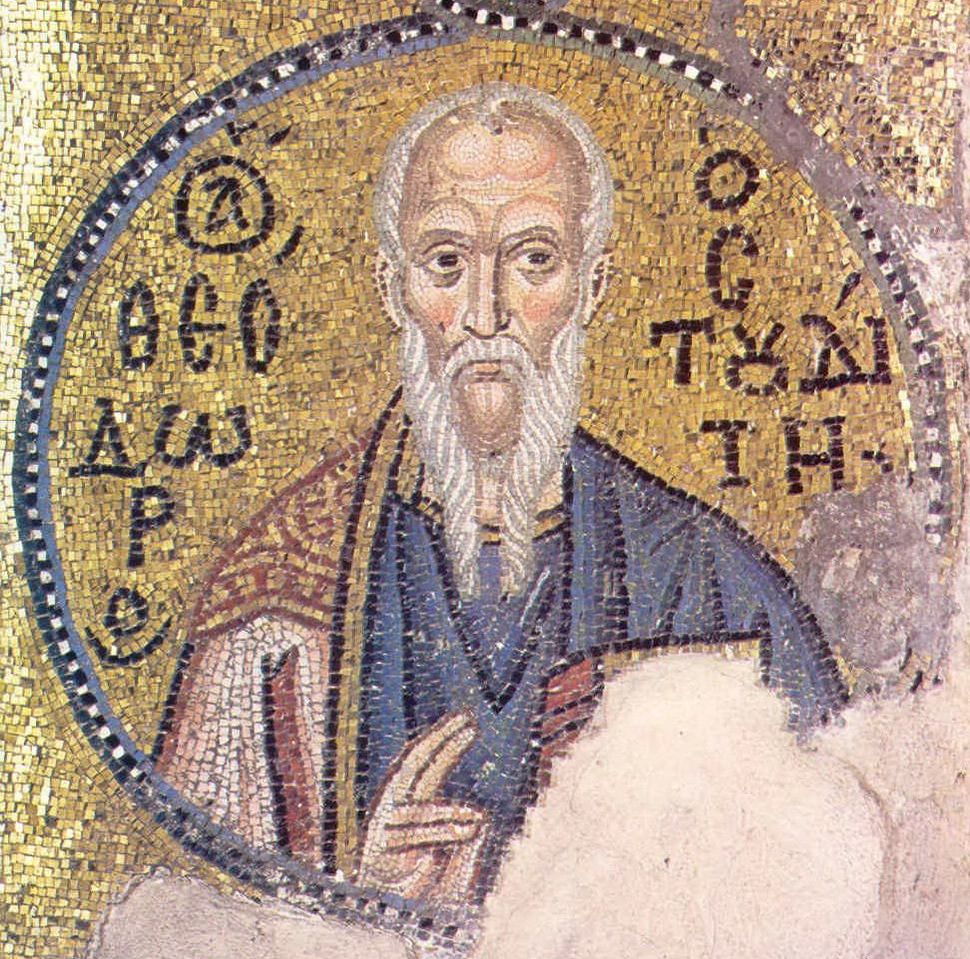
Theodore is depicted as an abbot in monastic habit, of middle age, with a short rounded or slightly pointed dark beard receding at the temples, holding a scroll or a book and giving a blessing; he is often shown in the company of other Studite fathers and confessors. The stored image is an eleventh-century Byzantine mosaic of the saint from the Nea Moni monastery on Chios.
Disputed questions
- Not to be confused with Theodore the Branded (Graptos, †c. 840/841, kept December 27), the Palestinian monk-confessor of the same second iconoclasm, branded on the face with his brother Theophanes: a distinct saint of the same cause and age. This Theodore is the abbot of the Stoudios, "the Studite."