
Polyeuctus of Melitene
The Holy Martyr Polyeuctus of Melitene in Armenia
Martyr · b. Melitene in Armenia, early 3rd century — d. c. 259, at Melitene — beheaded
Commemorated 9 January — Martyrdom at Melitene — the first martyr of that city
Polyeuctus (†c. 259) was a Roman soldier of Melitene in Lesser Armenia and the first martyr of that city — one of the most celebrated martyrs of the early Church in both East and West. A pagan of upright life, he was brought to Christ by his fellow-soldier and bosom friend Nearchus and by a vision in which Christ stripped off his soiled military cloak and clothed him in a shining garment. Enkindled with zeal, he tore down the imperial edict commanding sacrifice and smashed the idols carried in procession; neither the pleadings of his father-in-law the magistrate Felix nor the tears of his wife Paulina could move him, and he went to his beheading rejoicing — baptised in his own blood, for he died before receiving the water of Baptism. A great church rose over his tomb under Constantine, and his fame spread so far that the West made him the patron of vows and oaths and Pierre Corneille built his tragedy Polyeucte (1642) upon his memory. He is kept on January 9.
.jpg)
Melitene and the friendship with Nearchus
Polyeuctus was a citizen and a soldier of Melitene, the chief city of Lesser Armenia (Armenia Secunda) on the upper Euphrates and the garrison-town of one of the empire's frontier legions — by tradition the Legio XII Fulminata, the "Thundering Legion" long stationed there. The Church remembers him as the first of the martyrs of Melitene, the one who opened the roll of that city's witnesses to Christ. He was, the accounts agree, a man of virtuous and honourable life — brave, just, generous — but a pagan, not yet enrolled among the Christians even as a catechumen.
His closest companion in the ranks was Nearchus, a soldier of the same legion and a firm and fervent Christian. The two were bound in a friendship the sources dwell upon as the human hinge of the whole story: they were, in the words of the passion, of one soul in two bodies. When the persecution broke out — under an imperial edict compelling all to sacrifice to the gods — Nearchus fell into grief, not for fear of death but at the thought that the coming slaughter would part him from Polyeuctus for ever: he, dying for Christ, would pass into the company of the saints, while his beloved friend, a pagan, would be shut out. When Polyeuctus pressed him to say what troubled him, Nearchus opened his heart, and Polyeuctus answered that he too had long been drawn to the God of the Christians, and would not be separated from his friend in the age to come.
The vision and the conversion
What sealed his resolve was a vision. Polyeuctus recounted to Nearchus that Christ had appeared to him, taken from him the soiled military cloak he wore, and clothed him instead in a radiant, shining garment, setting him upon a winged horse. He read the vision at once for what it was: the stripping-away of his old life and the robing of the soul in the incorruption of Christ. From that hour he was, in will and longing, a Christian, though he had not yet been baptised — and events moved too swiftly for the water ever to be poured.
The edict, the idols, and the arrest
The persecution reached Melitene in the form of an imperial edict, publicly posted, commanding sacrifice to the gods on pain of death. Inflamed with the zeal of the newly-converted, Polyeuctus went into the public square, seized the edict, and tore it to pieces before the people. Then, meeting a procession that bore twelve idols of the city's gods through the streets, he dashed them to the ground and trampled them underfoot, casting them down one after another. It was an act of open and deliberate confession, and it could end only one way.
Felix, Paulina, and the sentence
The magistrate charged with enforcing the edict was Felix, and — the tragedy of the story turns on this — Felix was Polyeuctus's own father-in-law. He confronted his son-in-law with a mixture of official duty and family alarm, begging him to think of his life, his rank, and his household, and to comply, if only outwardly. Polyeuctus refused, answering in the words of the Apostles that "we must obey God rather than men" (Acts 5:29), and declaring that he would not exchange the eternal for the temporal. Felix, seeing him immovable and bound by the edict he was sworn to uphold, pronounced the sentence of death.
There remained the hardest trial of all. Felix summoned Polyeuctus's wife — Felix's own daughter — Paulina, who came weeping and threw herself before her husband, imploring him with tears to spare himself and her, to renounce the Christ he had confessed and live. It is the scene the tradition remembers most vividly, and the one Corneille would later make the centre of his play: the convert torn between the love of his wife and the love of Christ, and choosing Christ. Polyeuctus was not moved. He comforted her, commended her to God, and went to his death with joy.
Martyrdom — the baptism of blood
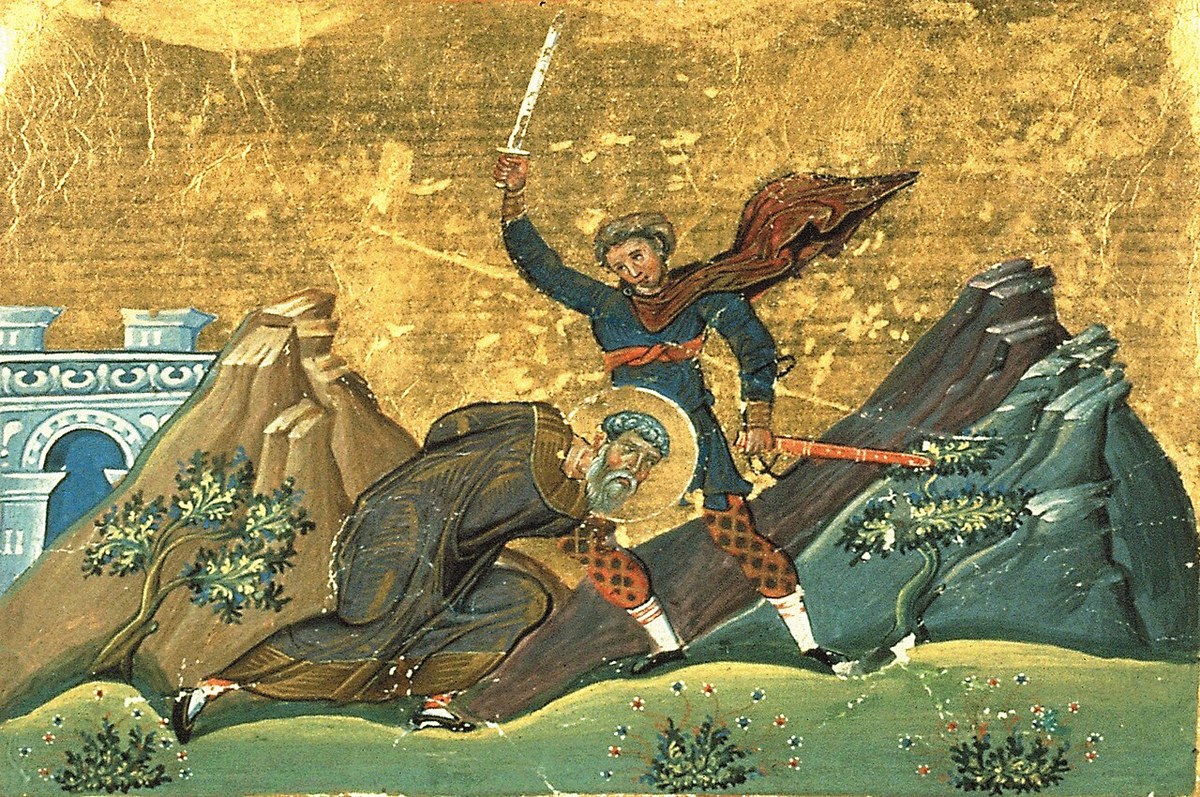
Polyeuctus was beheaded. Because he died still unbaptised in water, the Church honours his death as a baptism of blood (βάπτισμα δι' αἵματος): the martyrdom itself was his baptism, the shedding of his blood for Christ standing in the place of the font he never reached — the classic patristic doctrine that the witness of blood supplies what water would have given. The tradition adds that Nearchus gathered his friend's body as a treasure; and that the very soldiers and bystanders who watched him die were struck by his constancy, some coming to the faith through it.
The date the calendars keep is January 9 (some reckonings, and the Latin tradition, mark the beheading on January 10). The year is uncertain and the sources name the persecution inconsistently: the OCA life sets his conversion under the edict of Decius (249–251) but places his death in the reign of Valerian (253–259); the common Greek reckoning gives c. 259, which this entry follows. The disagreement is over the year and the emperor, not over the substance of the martyrdom.
The church of Polyeuctus and the spread of his cult
A church was raised over his tomb at Melitene, the tradition says already in the reign of Constantine the Great — an early and prominent shrine at which many miracles were reported. The Church remembers one family in particular who prayed there: the parents of Euthymius the Great, childless and grieving, kept vigil at the martyr's shrine and there received the promise of the son who would become one of the fathers of Palestinian monasticism (born at Melitene in 377). The detail fixes the cult of Polyeuctus at Melitene firmly in the fourth century, a living centre of pilgrimage within a lifetime of Constantine.
From Melitene the veneration of Polyeuctus spread across the whole Church. In Constantinople the noblewoman Anicia Juliana built him a magnificent church (Hagios Polyeuktos, 524–527), for a time the largest in the capital and a deliberate rival in splendour to the imperial foundations — its sculptured peacock-arches and inscribed poem survive in fragments in the archaeological museum of Istanbul, and it stood as the great architectural monument of his name until Justinian's Hagia Sophia eclipsed it. In the West, where his passion was early translated into Latin, Polyeuctus became — precisely because of the scene with Felix and Paulina and his refusal to break faith — the patron of vows, oaths, and treaties: men swore by Saint Polyeuctus, and his name guaranteed a promise. Gregory of Tours records his relics and miracles in Gaul, where a basilica at his name served as a place for the taking of oaths.
Literary afterlife
Polyeuctus is one of the few saints of the Byzantine synaxarion to become the hero of a masterpiece of Western literature. Pierre Corneille made his martyrdom the subject of the tragedy Polyeucte (1642–43), one of the great works of French classical theatre, which fixes the drama on the new convert's zeal, the anguish of Pauline (Paulina) and her former suitor Sévère, and the conversion of Pauline and Félix (Felix) at the martyr's death. Through Corneille the saint entered the Western imagination far beyond the Church, and his name was given in turn to Charles Gounod's opera Polyeucte (1878) and Paul Dukas's concert overture Polyeucte (1892). Few early martyrs have so long a shadow in art.
Feast and commemoration
Polyeuctus is kept universally on January 9 (church date; Old Calendar civil January 22), within the afterfeast of the Theophany — and the coincidence is not merely calendrical but is woven into his proper hymnography, which sets the severed head of the martyr beside the head of Christ bowed beneath the Baptist's hand in the Jordan (see the Kontakion below). The Greek, Slavic, and Antiochian calendars agree on the day; the Latin West keeps him too (long on the day of the beheading), and made him the patron of oaths. His is the principal commemoration of January 9.
Hymns
Troparion — Tone 4
Thy Martyr Polyeuctus, O Lord, in his contest received from thee our God the crown of incorruption; for, possessed of thy strength, he cast down the tyrants and shattered the impotent insolence of the demons. By his intercessions, O Christ our God, save our souls.
Original translation from the Greek
Kontakion — Tone 4
The Master, bowing his head in the Jordan, crushed the heads of the dragons; and the head of the Prize-winner, being struck off, put the deceiver to shame.
Original translation from the Greek
Iconography
Polyeuctus is depicted as a soldier-martyr: a young or middle-aged man, beardless or lightly bearded, in the tunic and cloak (chlamys) of a Roman soldier, sometimes with a martyr's cross in his hand, and — in the narrative type — at the moment of his beheading. His vision, in which Christ exchanges his soiled cloak for a shining robe, is the theme the hymnography loves and is occasionally shown.
The stored image is the miniature for January 9 from the Menologion of Basil II (Constantinople, c. 985; Vatican, Vat. gr. 1613): the martyr at the moment of his death, the executioner's sword above him — the visual form of his passion (source, public domain, pd-old-work).
Disputed questions
- The emperor and the year. The passion and the later calendars do not agree whether Polyeuctus suffered under Decius or Valerian; the OCA life keeps both (edict of Decius, death under Valerian), while the Greek tradition settles on c. 259. The uncertainty is recorded, not resolved.
- The day. East and West divide between January 9 (the Byzantine feast, followed here) and January 10 for the beheading; the difference is one of local reckoning.
- Nearchus. The friend whose grief began the whole story is himself venerated as a martyr in some calendars (commemorated in the Roman martyrology with Polyeuctus). This entry treats him as he appears in Polyeuctus's own passion — the Christian soldier and instrument of his conversion — and does not mint a separate feast for him under the Byzantine calendar, where he has none of his own on this day.
- Not to be confused with Polyeuctus, Patriarch of Constantinople (†970), the hierarch who crowned John Tzimiskes — a wholly different and much later figure; nor with the martyr Polyeuctus kept with the deacon Timothy on December 19 (a separate commemoration). "Of Melitene," the soldier and first martyr of his city, belongs to this Polyeuctus.