
Polyeuctus of Constantinople
Our Father among the Saints Polyeuctus, Patriarch of Constantinople
Patriarch · Bishop · b. late 9th century — d. February 5, 970, at Constantinople
Commemorated 5 February — Repose at Constantinople
Polyeuctus (died 970) was Patriarch of Constantinople from 956 to 970, a monk of famed asceticism and learning raised to the see in old age, and one of the boldest defenders of the Church's freedom against the imperial power in the tenth century. A eunuch from childhood and a monk of rigorous life, he was chosen patriarch by the emperor Constantine VII. He is remembered above all for compelling the emperor John I Tzimiskes to do public penance for the murder of his predecessor Nikephoros Phokas — refusing him entry to Hagia Sophia until he had cast out the guilty, repented, and repealed Nikephoros's laws against the Church — and for resisting Nikephoros's own attempt to have soldiers fallen in battle venerated as martyrs. For his fearless liberty the tradition likened him to a second Chrysostom. He reposed on February 5, 970, and is commemorated on that day in the Greek synaxaria.

Monk and patriarch
Polyeuctus was born in the later ninth century and was, the sources say, a eunuch from his youth and a monk of exceptional asceticism, learning, and strictness of life, long before any thought of high office. His reputation for holiness and for theological knowledge was such that, on the death of the patriarch Theophylact (the young son of the emperor Romanos I), the emperor Constantine VII Porphyrogennetos drew him from his monastery and had him consecrated Patriarch of Constantinople in April 956. He governed the Great Church for close on fourteen years, through the reigns of Constantine VII, Romanos II, Nikephoros II Phokas, and John I Tzimiskes — a period of military glory and political violence in the empire, in which the patriarch's firmness was repeatedly tested.
The confessor of the Church's freedom
Polyeuctus's episcopate is remembered chiefly for a series of collisions with the imperial power in which he defended the independence and the canons of the Church against the emperors themselves.
Against Nikephoros II Phokas (963–969) — the great soldier-emperor — he stood on two matters that the tradition preserves. When Nikephoros proposed that soldiers who fell in battle against the infidel should be honoured as martyrs, Polyeuctus and the hierarchs resisted, holding that a man who dies in war cannot by that alone be numbered among the martyrs of Christ, and citing the canon of Basil the Great that counsels even a soldier who has shed blood to abstain a season from the Mysteries. And when Nikephoros issued a law restricting gifts and bequests to monasteries and the founding of new houses — aimed at the Church's growing wealth — Polyeuctus opposed it as an encroachment upon the Church's liberty.
John Tzimiskes and the penance for blood
The gravest of his stands came at the very end of his life. In December 969 Nikephoros Phokas was murdered in his own palace in a conspiracy led by his nephew and general John Tzimiskes, in league with the empress Theophano. When Tzimiskes came to be crowned emperor, Polyeuctus barred him from Hagia Sophia and refused to set the crown upon a man stained with his predecessor's blood. He laid down conditions before he would admit him: that Tzimiskes should name and expel the actual murderers, should banish Theophano from the palace, should repeal the law of Nikephoros against the Church, and should do public penance for the deed. Tzimiskes submitted — putting the blame on his accomplices, sending Theophano into exile, and revoking the offending law — and only then was he crowned. The episode became a byword for the patriarch's liberty; and by the same firmness Polyeuctus is remembered for restoring the good order of the diptychs and the discipline of the clergy. For all this the historians and the tradition compared him to John Chrysostom in his fearless speech before the powerful.
Repose
Polyeuctus reposed on February 5, 970, only weeks after the coronation of Tzimiskes, having named as his own successor the monk Basil (Basil I Skamandrenos). He was buried at Constantinople and honoured as a holy and confessing hierarch.
Feast and commemoration
Polyeuctus is commemorated on February 5 (church date; Old Calendar civil February 18), the day of his repose, within the afterfeast of the Meeting of the Lord. His memory is kept chiefly in the Greek tradition and the Synaxarion of Constantinople; the Slavic calendars and the OCA do not carry him on this day, where the same date is led by the virgin-martyr Agatha of Sicily and, for the Russian Church, by Theodosius of Chernigov. The difference in the day's commemorations between the Greek and the Slavic books is recorded here rather than resolved.
Iconography
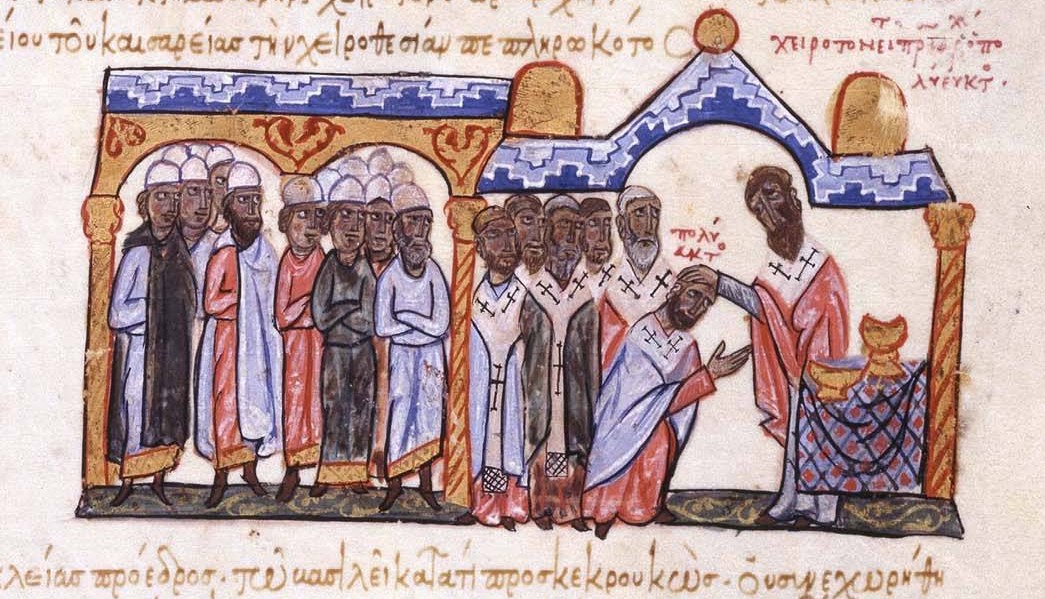
Polyeuctus is depicted in the settled type of a Byzantine patriarch: an elderly, white-bearded hierarch vested in the polystavrion (the cross-figured phelonion) or the sakkos and the omophorion, wearing no crown but the episcopal insignia, blessing with his right hand and holding the Gospel-book. The stored image is the Madrid Skylitzes miniature of his consecration (956), the new patriarch kneeling beneath the consecrating hand, his name ΠΟΛΥΕΥΚΤ(ΟΣ) written in red beside his head and the chronicle's caption above the frame.
Disputed questions
- Not to be confused with Polyeuctus of Melitene (kept January 9), the Roman soldier and protomartyr of his Armenian city under Decius or Valerian — a wholly different and far earlier saint. This Polyeuctus is the tenth-century patriarch, the antagonist of the emperors; "of Melitene," the soldier-martyr, is the other.