
Proclus of Constantinople
Our Father among the Saints Proclus, Archbishop of Constantinople
Bishop · d. 446 or 447
Commemorated 20 November — Repose as Archbishop of Constantinople
Proclus (died 446 or 447) was Archbishop of Constantinople from 434, a disciple and secretary of John Chrysostom whose gifts as a preacher placed him at the centre of the greatest doctrinal crisis of the fifth century. His homily on the Mother of God, delivered in the great church before the patriarch Nestorius, became a public defence of the title Theotokos and helped open the controversy that the Council of Ephesus (431) would settle. As archbishop he brought the relics of his master Chrysostom home to Constantinople in triumph, governed with a gentleness that quieted the divided city, and left a body of homilies and doctrinal letters — above all the Tome to the Armenians — that made him a teacher of the Church. He is commemorated on November 20.
.jpg)
Origins and formation under Chrysostom
Proclus was a Constantinopolitan, or came young to the capital, and from his early years, the tradition relates, gave his whole time to prayer and the study of the Scriptures. His formation was providential: he became a disciple of John Chrysostom, who ordained him first deacon and then presbyter and took him as his secretary. The bond between them is the making of Proclus, and the later Church remembered it in a famous story — that Proclus, waiting one night outside Chrysostom's chamber as he wrote his commentary on the Epistles, saw through the door the Apostle Paul himself standing at the archbishop's shoulder and speaking into his ear. From Chrysostom, whom he never ceased to venerate, Proclus took both a deep understanding of Scripture and the polished, rhythmical style of preaching that would become his own signature.
Bishop of Cyzicus and the sermon on the Theotokos
After Chrysostom's exile and death the see of Constantinople passed through a succession of holders. The patriarch Sisinnius (426–427) consecrated Proclus bishop of Cyzicus on the Sea of Marmara; but the church there, under other influences, would not receive him, and Proclus remained in the capital, a bishop without a resident flock, preaching in its churches.
It was in this interval, about 428–429, that Proclus preached the sermon for which he is best remembered. Nestorius, newly enthroned as archbishop of Constantinople, had begun to teach that the Virgin should be called not Theotokos — "she who gave birth to God" — but only Christotokos, "she who gave birth to Christ," lest the divine and human in her Son be confused. On a feast of the Mother of God, in the great church and in the presence of Nestorius himself, Proclus mounted the ambo and delivered a homily in praise of the holy Virgin that fearlessly defended the contested title, hailing her as the loom on which the garment of the Incarnation was woven and as truly Theotokos. The sermon, one of the most celebrated of Greek patristic homilies, made the brewing quarrel public and irreversible; it stands at the head of the controversy that Cyril of Alexandria would carry to the Council of Ephesus in 431, where the title Theotokos was vindicated and Nestorius condemned.
Archbishop of Constantinople
Proclus did not immediately succeed to the see. When the succession fell vacant again in 434, on the death of the archbishop Maximian, Proclus was chosen and enthroned as Archbishop of Constantinople, and he governed the church of the capital for some twelve years, until his death. His episcopate was marked less by conflict than by reconciliation. He was esteemed by the city for the austerity of his own life, for his care of the poor and the oppressed, and for his preaching; he pursued the healing of the wounds left by the Nestorian and, before it, the Johannine schisms rather than the multiplication of anathemas, and won a wide and lasting affection.
Two acts of his episcopate held the tradition's memory. The first was an act of filial piety toward his master: in 438, by Proclus's efforts and with the assent of the emperor Theodosius II — son of the very Arcadius and Eudoxia who had driven Chrysostom into the exile in which he died — the relics of John Chrysostom were translated from Comana, where he had perished, home to Constantinople and laid in the Church of the Holy Apostles, the schism over his name being thereby finally healed. (The Church keeps that translation on January 27.) The second was liturgical. During his patriarchate the city and the provinces were shaken for months by devastating earthquakes; as the people processed out of Constantinople in supplication, headed by patriarch and emperor, a child was — the tradition relates — caught up out of the crowd into the air and brought back to report that he had heard the angels singing "Holy God, Holy Mighty, Holy Immortal." The whole people took up the hymn, adding "have mercy on us," the earthquakes ceased, and the Trisagion has been sung in the Church's services ever since. The account is traditionally attached to Proclus's tenure.
Repose and writings
Surrounded by the love and respect of his people, Proclus reposed as archbishop in 446 or 447. A considerable body of his work survives — homilies, and doctrinal letters, of which the most important is the Tome to the Armenians (Tomus ad Armenios), a lucid statement of the Church's teaching on the one Christ in two natures, written to guard the Armenian church against Nestorian and, incipiently, other errors, and long reckoned a landmark of Christological exposition. His homilies on the Mother of God and on the Nativity of Christ set out the same orthodox doctrine of the Incarnation, and secured his standing not only as a saintly bishop but as a teacher of the Church.
Feast and commemoration
November 20 (church date; Old Calendar civil December 3), kept universally in the Byzantine rite, his service joined in the Menaion to that of Gregory the Decapolite and sung under the Forefeast of the Entry of the Theotokos. It is fitting that Proclus — the great herald of the Theotokos — should be commemorated on the forefeast of one of her feasts. He is closely associated in the calendar with his master John Chrysostom, whose principal feast falls a week earlier on November 13 and whose relics Proclus brought home (translation kept January 27).
Hymns
Kontakion — Tone 4
Worthily this day doth the most honoured of all cities keep high festival at thy precious repose, O father of fathers, wise Proclus.
Original translation from the Slavonic
Troparion — Tone 4
O God of our Fathers, who ever dealest with us according to Thy forbearance: take not Thy mercy from us, but by their supplications govern our life in peace.
Original translation from the Greek
Iconography
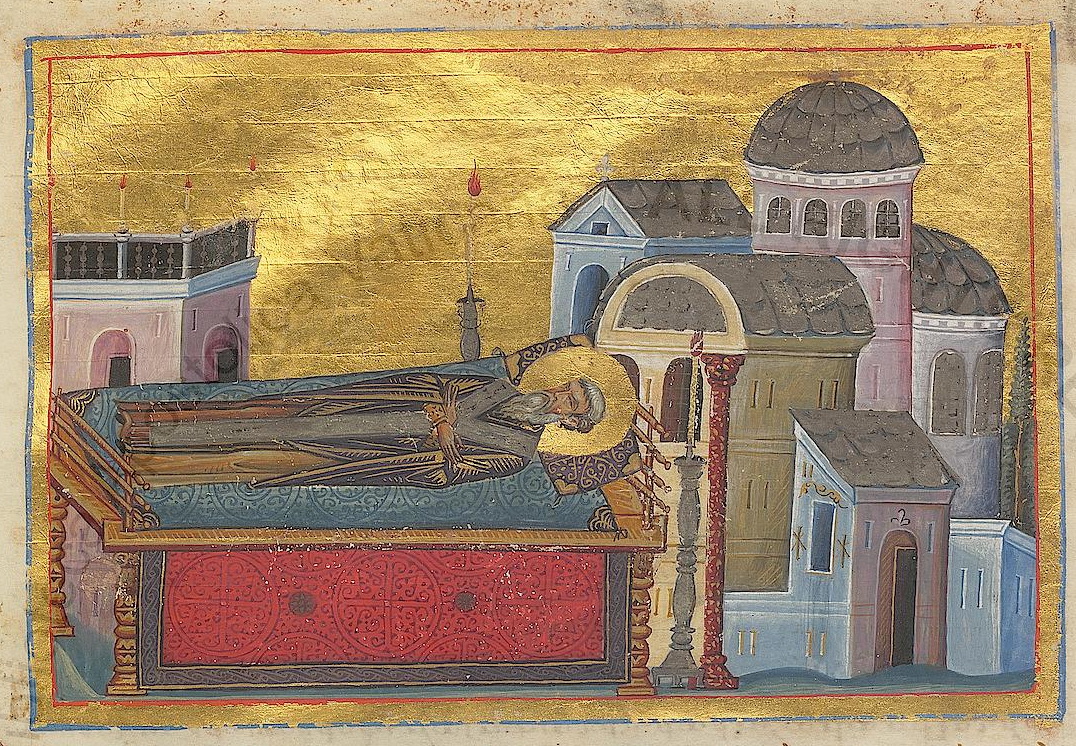
Proclus is depicted as a bishop and hierarch: vested in the omophorion over the sticharion and phelonion (or the later sakkos), holding the Gospel book, his hair and beard grey, in the manner of the great archbishops of Constantinople. The stored image is his miniature from the Menologion of Basil II (c. 1000), which shows not a standing portrait but the scene of his repose: the archbishop lies in death upon a draped bier, his body wrapped and his nimbed head at the right, a tall lighted candle beside him, set against the domes and roofs of a Byzantine city — the imperial capital he governed. The image answers directly to the day's kontakion, which sings of "thy precious repose."
Disputed questions
- The succession. Some synaxaria (the OCA's among them) telescope the sequence, making Proclus the immediate successor of Sisinnius. In fact Sisinnius was followed by Nestorius (428–431) and then by Maximian (431–434), and Proclus came to the see only in 434, on Maximian's death.
- Year of repose. The calendars give 446 or 447; the length of his episcopate is reckoned accordingly at about twelve years from 434.
- Not to be confused with the martyr Proclus of Ancyra, put to death with his nephew Hilary under Trajan about 115 and commemorated on July 12 — a Galatian layman of the second century, unrelated to this archbishop of the fifth.