
John Chrysostom
Our Father among the Saints John Chrysostom, Archbishop of Constantinople, one of the Three Holy Hierarchs and Ecumenical Teachers
Bishop · b. c. 347, Antioch — d. September 14, 407, at Comana in Pontus
Commemorated 27 January — Translation of his relics from Comana to Constantinople (438), 30 January — Synaxis of the Three Holy Hierarchs, with Basil the Great and Gregory the Theologian, 14 September — The actual day of his repose at Comana (407), yielded to the Great Feast of the Cross, 13 November — Principal feast (his repose, transferred from September 14 off the Elevation of the Cross)
John Chrysostom (c. 347–407) is the golden-mouthed preacher of Antioch and Archbishop of Constantinople, reckoned with Basil the Great and Gregory the Theologian as one of the Three Holy Hierarchs and Ecumenical Teachers of the Church. Born and formed at Antioch — trained in rhetoric under the pagan Libanius, in Scripture in the Antiochene school of Diodore of Tarsus, and in asceticism in the mountains above the city — he was ordained deacon and then priest by his bishops Meletius and Flavian, and for twelve years preached the homilies that made his name: the great cycle On the Statues, and the running expositions of Genesis, the Psalms, Matthew, John, Acts, and the whole of Paul that remain the fullest patristic commentary on the New Testament. Taken to Constantinople as archbishop in 398, he reformed the clergy and spent the Church's wealth on the poor, and for it was hounded by the empress Eudoxia and by Theophilus of Alexandria, condemned at the Synod of the Oak, and twice exiled; he died on the forced march to Pityus, at Comana in Pontus, with the words "Glory to God for all things." His relics were brought back to Constantinople in 438, and the normal eucharistic service of the Orthodox Church bears his name — the Divine Liturgy of St John Chrysostom.
.jpg)
Origins and early life
John was born at Antioch on the Orontes about the year 347 — the great metropolis of the Roman East, third city of the empire, the see where the disciples were first called Christians and where Ignatius and Babylas had been bishops. His father Secundus held high military rank (the sources make him a magister militum of the East, or an officer of that staff) and died while John was still an infant. His mother Anthusa, widowed at about twenty, refused to remarry and gave herself wholly to her son's upbringing and to the management of his patrimony — a Christian widowhood so conspicuous that the pagan rhetorician Libanius, told of it, is said to have exclaimed, "Heavens, what women these Christians have!" To her, and to the Scriptures she taught him from childhood, John owed the piety that his later ascetic conversion only deepened.
For his education Antioch could offer the best in the empire. John studied rhetoric under Libanius himself, the last great master of pagan eloquence and the friend of the emperor Julian — a training that gave the preacher his command of the Greek period and his ear for the spoken word. The much-repeated anecdote that Libanius, asked on his deathbed who should succeed him in his chair, answered, "John, had the Christians not stolen him from us," is late and probably legendary, but it fixes a true memory: the golden mouth was schooled in the finest rhetoric of the age and then turned wholly to the Gospel. He read philosophy under Andragathius. But the decisive turn was toward the Church: he was catechized and, about 368, baptized by Meletius, the confessor-bishop of Antioch, who made him a reader and drew him into the circle of the city's Christian teachers.
Formation in the school of Antioch
At Antioch John entered the asketerion — the school of ascetic and biblical study — of Diodore, later bishop of Tarsus, and Carterius, the heirs of the Antiochene exegetical tradition that the martyr Lucian's didaskaleion had planted a century before. Here John received the method that would mark all his preaching: attention to the letter, the history, and the plain intended sense of the sacred writers, against the thoroughgoing allegorism of the Alexandrians. He read the Scriptures beside the men who would carry the Antiochene name into the next generation's controversies — Theodore, the future bishop of Mopsuestia and John's lifelong friend (to whom he addressed the two treatises To Theodore, Fallen), and Maximus, later bishop of Seleucia. Diodore's insistence on the true humanity of Christ and on the sober reading of the text stayed with John all his life; unlike Theodore and Diodore, whose names were later entangled in the Nestorian and Three-Chapters disputes, John kept the school's exegetical instinct without its speculative excess, and the Church has never counted his Antiochene formation against him.
The ascetic years
Drawn to the monastic life then flourishing in the hills around Antioch, John would have withdrawn at once but for his mother's tears — the scene he himself recalls in On the Priesthood, where Anthusa begs him not to widow her a second time. He stayed with her until her death, living meanwhile in strict continence and study at home. Then, about 371, he went up into the mountains south of the city and placed himself under an aged Syrian ascetic, and for some four years lived the common ascetic discipline. Afterwards he withdrew alone into a cave for two years more, in which — the tradition transmits — he scarcely slept, kept upright day and night, and committed the whole of the Old and New Testaments to memory. The rigor broke his health: the cold and the deprivation permanently damaged his stomach and kidneys, and the ruined digestion that tormented him for the rest of his life, and made him abstemious at every table, began here. Unable to continue in the cave, about 378 he returned to Antioch — carrying back to the city both an unrivalled knowledge of the Scriptures and a body that would never again be well.
Deacon and priest of Antioch
Restored to the service of his church, John was ordained deacon by Meletius about 381 — the year Meletius presided over the opening sessions of the Second Ecumenical Council at Constantinople, where he died. As deacon John served the poor and the sick and began to write: the early treatises belong to these years, among them the Exhortations to Theodore, the address To a Young Widow, the books On the Priesthood, and the tracts on the monastic life and on virginity. In 386 the new bishop of Antioch, Flavian — Meletius's successor, and the patriarch whose penitential embassy would soon save the city (see below) — ordained John priest and set him to the ministry that would give him his name: the preaching of the word to the great congregation of Antioch. For twelve years, from 386 to 397, John was the preacher of Antioch, and in those twelve years he created the body of homily that the Church has never ceased to read.
The great Antioch preaching
The first and most famous test came at once. In the winter of 387 the people of Antioch, enraged by the announcement of a heavy new tax, rioted, and in the tumult overthrew and dragged through the streets the statues of the emperor Theodosius, his late wife Flacilla, and his sons — an act of treason for which the whole city, once the emperor's anger was known, expected massacre and the loss of its status, perhaps its very existence. The aged bishop Flavian set out in the depth of winter on the long journey to Constantinople to plead for mercy; and through the terrible Lent of waiting, while the imperial commissioners held hearings and executions and the frightened city hung between hope and despair, the priest John mounted the ambo day after day and preached the twenty-one homilies On the Statues (De statuis) — consoling, exhorting, turning the public terror into repentance, teaching the fear of God in place of the fear of man, and pleading against the oaths and the theatre and the vanities that (he told them) had brought the judgment near. When Flavian returned at Easter with the emperor's pardon, John's reputation as the voice of Antioch was made.
The homilies on the Statues were only the beginning. From the ambo of Antioch John expounded book after book of the Scriptures in continuous series, taking his hearers verse by verse through the sacred text and turning every passage to the moral and spiritual reform of their lives: homilies on Genesis (sixty-seven of them, and a separate Lenten set), on the Psalms, on Isaiah, and above all his running expositions of the New Testament — ninety homilies on Matthew, eighty-eight on John, fifty-five on Acts, and the great sequence on the whole Pauline corpus, from Romans through the Pastoral Epistles, which remains to this day the fullest commentary on Saint Paul that the ancient Church produced. He preached against the excesses of the wealthy and for the cause of the poor, against the races and the theatre, against the swearing of oaths, against the drift of Christians to the synagogue for its feasts and its oaths and its reputed cures — the eight homilies Against the Judaizers (Adversus Judaeos) belong to these Antioch years, and their violent rhetoric, aimed in its own context at Christians tempted to Judaize rather than at the Jewish people as such, was later torn from that context and pressed into the service of a Christian antisemitism the preacher never contemplated; the entry records this honestly (see Disputed questions). It was in this Antioch decade, above all, that John earned the title posterity gave him: Chrysostom, ho Chrysostomos, "the golden-mouthed" — not a name he bore in life (it is first attested in the sixth century) but the Church's verdict on the greatest preacher she has known.
Archbishop of Constantinople
On the death of Nectarius, archbishop of Constantinople, in 397, the emperor Arcadius — or rather his powerful minister, the eunuch Eutropius, who had heard John preach at Antioch — resolved to have him for the capital. Knowing that the people of Antioch would never willingly give up their preacher, the authorities had John brought out of the city almost by stealth, conducted under escort to Constantinople, and there consecrated Archbishop of Constantinople on 26 February 398. The consecration was performed, at the emperor's command, by Theophilus of Alexandria, who had come intending to press his own candidate and yielded only under pressure — the first seed of the enmity that would destroy John.
As archbishop of the imperial city John lived and governed exactly as he had preached. He cut back the luxury of the episcopal household — selling off the costly furnishings his predecessor had kept, refusing the great banquets, eating alone and sparingly (his ruined health required it, and his enemies made his solitary table a reproach) — and turned the saved revenues to the founding and endowing of hospitals and hostels for the sick and the stranger. He preached to the capital as he had to Antioch, sparing neither the wealth and vanity of the court nor the abuses of the clergy: he disciplined idle and grasping priests, moved against the syneisaktoi (the "spiritual sisters" who shared clergy households), and deposed simoniac bishops — most dramatically on his visitation of Asia in 401, when at Ephesus he removed a whole cluster of bishops who had bought their sees. He cared for the Church beyond the city's walls: he supported the mission to the Goths, giving the Arian-descended Gothic community of the capital an orthodox church and clergy in their own tongue, and sent missionaries into Phoenicia (where paganism still held the countryside), into Persia, and to the Scythians of the lower Danube. He was a bishop wholly given to his charge, and the common people of Constantinople loved him for it — which was itself, before the end, held against him.
The gathering storm: Eudoxia and Theophilus
Two enmities converged to bring John down. The first was the court. The empress Aelia Eudoxia, wife of the weak Arcadius and the real power behind the throne, took John's plain preaching against the luxury, the vanity, and the rapacity of the great as aimed at herself — and not always wrongly, for John did not spare the powerful. The breach widened over the erection of a silver statue of the empress on a porphyry column near the Church of Hagia Sophia, dedicated with public games and dancing whose noise disturbed the services; John denounced the spectacle from the ambo, and a sermon reported (though its authenticity is disputed) to have opened "Again Herodias rages, again she is troubled, again she dances, again she demands the head of John on a platter" sealed the empress's hatred.
The second enmity was Theophilus of Alexandria, who had never forgiven John's elevation and who saw in the archbishop of the upstart imperial see a rival to the ancient primacy of Alexandria. The occasion came with the affair of the Tall Brothers — four learned Nitrian monks whom Theophilus had condemned in the Origenist controversy and driven out of Egypt, and who fled to Constantinople to appeal to John and the emperor. John received them with charity, lodged them, and (cautiously, without admitting them to communion) took up their cause; Theophilus, summoned by Arcadius to Constantinople to answer for his treatment of them, came instead with a fleet, a war-chest, and a party of Egyptian bishops, determined not to be judged but to judge.
The Synod of the Oak and the two exiles
In the summer of 403 Theophilus, joined by the bishops John had offended and backed by the court, convened not in the city but across the Bosphorus, at a suburban estate called the Oak (Drys) near Chalcedon, a synod of some thirty-six bishops — most of them Egyptians in Theophilus's train — and cited John before it on a sheaf of trumped-up charges. John, refusing to acknowledge a tribunal packed with his declared enemies, would not appear though summoned four times; the Synod of the Oak deposed him in absentia, and on its sentence Arcadius ordered him into exile. But scarcely had he been taken from the city when an earthquake shook Constantinople in the night; the terrified Eudoxia, reading in it the wrath of God, begged her husband to recall him, and the people rose in such tumult for their archbishop that within days John was brought back in triumph and restored to his church.
The peace did not last. Within months the old quarrel reignited over the silver statue and its games, John's preaching against them was reported to the empress in its harshest form, and his enemies — invoking a canon of an Arian council that forbade a deposed bishop to resume his see without a synod's leave — declared his return uncanonical. At Pascha of 404 the breach became violence: on Holy Saturday imperial troops broke into the churches and baptisteries and scattered the great paschal baptism by force, driving the newly-illumined, still in their white garments, bleeding from the font. In June 404 the emperor's final sentence came, and John was led out of Constantinople into exile for the last time. The night of his departure a fire broke out that destroyed the cathedral and the senate-house nearby; his persecuted supporters, the "Johannites," were blamed and hunted, and the West — Pope Innocent I of Rome foremost — refused to recognize the deposition and broke communion with the sees that had carried it out.
Exile and repose
John was banished first to Cucusus, a remote and wretched town in the Taurus mountains of Armenia, hard by the country of the marauding Isaurians. From there, sick and cold and often in danger, he carried on across three years an astonishing correspondence — some two hundred and forty letters survive, seventeen of them to the deaconess Olympias, his devoted friend at Constantinople, others to Pope Innocent, to bishops, to the missions in Phoenicia he still directed from exile — the letters of a pastor who governed a church from his banishment and whose serenity his enemies could not break; from Cucusus comes the treatise That No One Is Harmed But by Himself.
Precisely because that voice would not be silenced, his enemies procured a harsher sentence: he was to be removed to Pityus (Pitiunt), the farthest outpost of the empire on the north-eastern shore of the Black Sea, at the foot of the Caucasus. The soldiers charged with the transfer were ordered — so the tradition holds — to make the march kill him, driving the sick old man on foot through heat and rain and refusing him rest. At Comana in Pontus he could go no farther. There, at the shrine of the martyr Basiliscus outside the town, the martyr (the account transmits) appeared to him in the night and said, "Take courage, brother John; tomorrow we shall be together." In the morning John asked to remain, and when the soldiers forced the march on he collapsed and was carried back to the martyrium; he asked for white baptismal garments, put off his own, received the Holy Mysteries, and — sealing a lifetime's teaching with a last confession of thanksgiving — said, "Glory to God for all things" (Doxa tō Theō pantōn heneken), sealed it with the "Amen," and gave up his soul. It was 14 September 407.
Relics, rehabilitation, and translation
The West never accepted his condemnation, and Rome held Constantinople, Alexandria, and Antioch out of communion until John's name was restored to the diptychs — the sacred lists of the honoured dead read at the Liturgy. Under his successors Atticus and then Proclus — John's own disciple, whom he had ordained (commemorated November 20) — his name was restored at Constantinople and the schism healed. In 438, thirty-one years after his death, Proclus as archbishop obtained from the emperor Theodosius II — the son of the very Arcadius and Eudoxia who had exiled him — the translation of John's relics from Comana to the capital. Received with an immense throng of torches and boats across the Bosphorus, the relics were laid in the imperial mausoleum within the Church of the Holy Apostles, among the tombs of the emperors; and Theodosius, the tradition relates, laid his face upon the coffin and publicly implored the saint's pardon for the sins of his parents. The Church keeps the day of this translation on 27 January. When the relics arrived, the people are said to have cried out with one voice, "Receive thy throne, O Father!" — and the tradition tells that the dead lips of the saint moved to answer, "Peace be unto all."
Veneration and the return of the relics
John Chrysostom's cult was universal from the moment of his rehabilitation, in the West as in the East — Rome kept him from early times, and the medieval West numbered him among the four great Doctors of the Eastern Church. His relics rested in the Holy Apostles until the sack of Constantinople by the armies of the Fourth Crusade in 1204, when — with the relics of Gregory the Theologian — they were carried off to Rome and enshrined in the Basilica of Saint Peter. There they remained for eight centuries, until on 27 November 2004 Pope John Paul II returned the relics of John Chrysostom and Gregory the Theologian to the Ecumenical Patriarch Bartholomew I, and they were enshrined in the Patriarchal Cathedral of Saint George in the Phanar at Constantinople, where they rest today — a partial homecoming after eight hundred years, some fragments of both hierarchs remaining also in the West.
The Three Holy Hierarchs
By the eleventh century the veneration of John, of Basil the Great, and of Gregory the Theologian had grown into a rivalry: in Constantinople the faithful divided into parties, the "Johannites," "Basilians," and "Gregorians," each exalting its own hierarch above the others. The dispute was settled, the tradition relates, about the year 1084, when the three great hierarchs appeared together to John Mauropous, metropolitan of Euchaita, and declared that they were equal in the sight of God, with no division or rivalry among them, and asked that their contending devotees be reconciled in a single common feast. Mauropous accordingly established the Synaxis of the Three Holy Hierarchs and Ecumenical Teachers on 30 January, joining the three whose separate feasts fall earlier that month (Basil on 1 January, Gregory on 25 January, John on 27 January, the translation) — a feast kept ever since as the patronal day of Christian learning and of schools.
The corpus and the Liturgy
John Chrysostom left the most voluminous literary remains of any of the Greek Fathers. Besides the vast homiletic corpus — the continuous expositions of Genesis, the Psalms, Matthew, John, Acts, and the whole of Paul, and hundreds of occasional and festal sermons — he wrote the six books On the Priesthood (De sacerdotio), the classic Eastern treatise on the pastoral office; the catechetical instructions for the newly baptized; On Vainglory and the Right Way for Parents to Bring Up Their Children, an early treatise on Christian education; the homilies On the Incomprehensibility of God against the Anomoeans; the consolatory works of the exile; and the great body of letters. His theology is not that of the speculative dogmatician but of the pastor and exegete: the moral application of the plain sense of Scripture, the dignity and peril of the priesthood, the duty of almsgiving and the sin of wealth hoarded while the poor starve, the reality of Christ's Body in the Eucharist and in the poor man at the gate.
Above all his name is joined, in the living use of the Church to this day, to the Divine Liturgy of Saint John Chrysostom — the ordinary eucharistic service of the Orthodox Church, served on the great majority of the days of the year (the longer Liturgy of Basil the Great being reserved to some ten days). The tradition ascribes to John the shaping of this liturgy — an abbreviation and ordering of the older Antiochene and Constantinopolitan rite he inherited — and the anaphora that bears his name shows kinship with the Syrian anaphora of the Twelve Apostles he would have known at Antioch. Modern liturgical scholarship treats the attribution as later and the received text as the fruit of centuries of development, while allowing that the core prayers of the anaphora may genuinely descend from him; the Church, in any case, has prayed the central act of her worship under his name for a millennium and a half. (This repository has as yet no schema home for the liturgies themselves; see the standing note on liturgical-rite entries in the project's record of open questions, and the parallel prose treatment from James the Brother of the Lord for the Liturgy of St James.)
One text of his is heard by every Orthodox Christian once a year, at the very summit of the year. The Paschal Homily — the Catechetical Oration read at Matins of Pascha in every church of the Byzantine rite — with its overflowing welcome to the feast ("If any be a devout lover of God, let him partake of this fair and radiant festival… let no one mourn his poverty, for the universal Kingdom has appeared") and its ringing close over the empty tomb ("O Death, where is thy sting? O Hades, where is thy victory? Christ is risen, and thou art overthrown"), is the Church's paschal proclamation in his voice. Its ascription to John is traditional and is questioned by scholars, but the Church reads it as his, and through it the golden mouth still preaches the Resurrection to the whole Orthodox world each spring.
Feast and commemoration
John Chrysostom reposed on 14 September 407, and that is the true day of his death; but 14 September is the Great Feast of the Elevation of the Cross, which displaces all other commemorations, and so his feast was transferred to 13 November — as the Menaion's own synaxarion explains, "on this day he reposed, but on account of the feast of the precious Cross his memory was transferred to the month of November." 13 November (church date; Old Calendar civil 26 November) is therefore his principal feast throughout the Byzantine rite, kept universally — Antiochian, Greek, Slavic, and OCA calendars agree — with a full festal service; in Greek use it ranks among the great hierarch-feasts of the year, and the Divine Liturgy served on the day is his own. The Menaion of 14 September still names his repose in its synaxarion, and some calendars note it there as a secondary memory yielded to the Cross (see the September 14 entry). 27 January commemorates the translation of his relics to Constantinople in 438 (Old Calendar civil 9 February), and 30 January the Synaxis of the Three Holy Hierarchs, in which he is honoured with Basil the Great and Gregory the Theologian. The 2004 return of his relics from Rome, though it falls on 27 November, is a historical event rather than a fixed liturgical feast, and is kept where local usage appoints.
Hymns
Troparion — Tone 8
The grace that shone forth from thy mouth like a beacon of fire hath enlightened the whole world; it hath laid up for mankind the treasures of freedom from avarice, and shown us the height of humility. And as thou dost instruct us by thine own words, O Father John Chrysostom, so intercede with the Word, Christ our God, for the salvation of our souls.
Original translation from the Greek
Kontakion — Tone 6
From the heavens hast thou received divine grace, and by thy lips thou dost teach all men to worship the one God in Trinity, O John Chrysostom, all-blessed and venerable one. Rightly do we acclaim thee, for thou art a teacher who makest plain the things of God.
Original translation from the Greek
Appointed readings
Epistle — Hebrews 7:26–8:2
26For such an high priest became us, who is holy, harmless, undefiled, separate from sinners, and made higher than the heavens; 27Who needeth not daily, as those high priests, to offer up sacrifice, first for his own sins, and then for the people’s: for this he did once, when he offered up himself. 28For the law maketh men high priests which have infirmity; but the word of the oath, which was since the law, maketh the Son, who is consecrated for evermore. 1Now of the things which we have spoken this is the sum: We have such an high priest, who is set on the right hand of the throne of the Majesty in the heavens; 2A minister of the sanctuary, and of the true tabernacle, which the Lord pitched, and not man.
Gospel — John 10:9–16
9I am the door: by me if any man enter in, he shall be saved, and shall go in and out, and find pasture. 10The thief cometh not, but for to steal, and to kill, and to destroy: I am come that they might have life, and that they might have it more abundantly. 11I am the good shepherd: the good shepherd giveth his life for the sheep. 12But he that is an hireling, and not the shepherd, whose own the sheep are not, seeth the wolf coming, and leaveth the sheep, and fleeth: and the wolf catcheth them, and scattereth the sheep. 13The hireling fleeth, because he is an hireling, and careth not for the sheep. 14I am the good shepherd, and know my sheep, and am known of mine. 15As the Father knoweth me, even so know I the Father: and I lay down my life for the sheep. 16And other sheep I have, which are not of this fold: them also I must bring, and they shall hear my voice; and there shall be one fold, and one shepherd.
Iconography
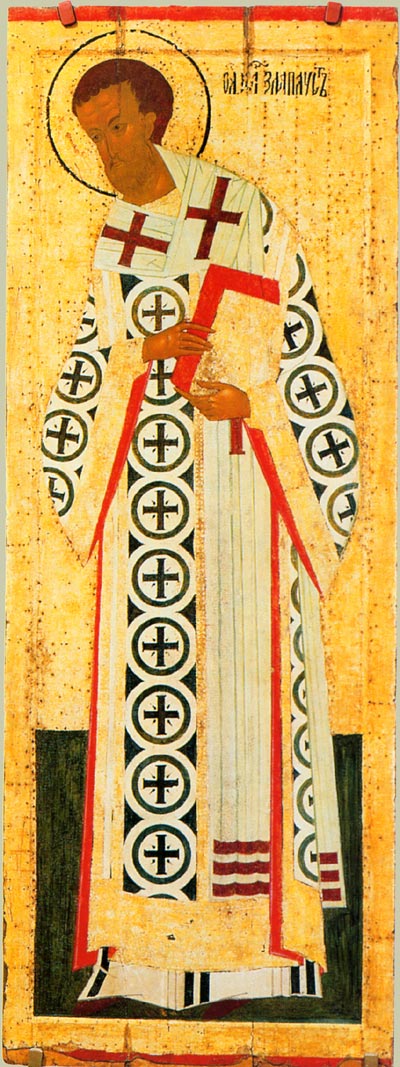
John Chrysostom is among the most frequently depicted of all the hierarch-saints, and his type is fixed and unmistakable: a lean, ascetic face, a high domed and balding forehead, a short dark (sometimes greying) beard, hollow cheeks — the worn features the tradition drew from his ruined health — vested as a bishop in the phelonion or the cross-figured polystavrion, wearing the omophorion and holding a jewelled Gospel-book or a scroll; frequently he is shown with his right hand raised in blessing. In this he is set beside his fellow hierarchs and distinguished from them by build and beard: Basil the Great tall and dark with a long tapering beard, Gregory the Theologian with a rounded grey beard and balding brow, and John lean and short-bearded between or beside them. Three narrative and liturgical types recur: John celebrating his Liturgy at the altar, or receiving the scroll of the anaphora — sometimes with the Apostle Paul whispering at his ear, the tradition that Paul himself dictated the commentaries to him; John enthroned as archbishop teaching; and the scenes of his passion — his exile, and the translation of his relics to Constantinople.
The stored primary image is a full-length icon of the hierarch by Dionisius (1502), from the festival tier of the great iconostasis he painted for the Ferapontov Monastery — John standing in episcopal vestments, the Gospel in his veiled hands, in the tall attenuated elegance of the Moscow school at its height (source, public domain, pd-old-work).
A second stored image is a Novgorod icon of the Three Holy Hierarchs of the late fifteenth / early sixteenth century (a two-sided tabletka), showing John in the centre between Basil the Great and Gregory the Theologian, each named by inscription — the visual form of the 30 January feast (source, public domain, pd-old-work).
A third stored image is a miniature from the Menologion of Basil II (Constantinople, c. 985; Vatican, Vat. gr. 1613) depicting the translation of the relics of John Chrysostom to the Church of the Holy Apostles — the coffin borne in procession, illustrating the feast of 27 January (source, public domain, pd-old-work).
Disputed questions
- How is he classified — martyr, confessor, or hierarch? The calendars style John simply a hierarch and Ecumenical Teacher; they do not number him among the martyrs. He was not put to death for confession of Christ but died of the deliberate hardship of his exile — which places him at the border of the categories: not a martyr in the strict sense, yet more than a confessor, since the tradition holds that his death was contrived and that he died of his banishment rather than merely surviving it. The Church has resolved the question by honouring him under neither title but under the higher one her usage reserves for him and his two peers: Ecumenical Teacher and Hierarch. This entry follows that usage, typing him bishop (the taxonomy's term for the office the calendars style "hierarch"), and records here that the note of martyrdom is not absent from his memory — the hymns and synaxaria dwell on his exile and his sufferings, and speak of a crown won by them. (This repository's taxonomy has as yet no term for the calendars' category of "hierarch," "Ecumenical Teacher," or "Father and Doctor of the Church"; the gap, which he shares with Basil, Gregory, Athanasius, and the other great teaching bishops, is noted for a taxonomy decision.)
- Archbishop, not patriarch. John governed Constantinople before the see was formally raised to patriarchal rank (the primacy "after Rome" was defined only at Chalcedon in 451, canon 28, after his death). The calendars accordingly style him "Archbishop of Constantinople," and this entry follows them: bishop, not patriarch.
- The Adversus Judaeos homilies. The eight homilies "Against the Judaizers," preached at Antioch, are the most troubling of his works. Their target in context was Christians of Antioch who frequented the synagogue for its feasts, fasts, oaths, and reputed cures; but their invective against Judaism, cast in the harshest rhetorical convention of the age, was in later centuries lifted out of that setting and made to serve a Christian antisemitism the preacher did not intend and could not have foreseen. The entry records both the polemical occasion and the grievous afterlife honestly, as the sources require.
- The Divine Liturgy and the Paschal Homily. The attribution to John of the Liturgy that bears his name and of the Catechetical Oration read at Pascha is traditional and is questioned by modern scholarship (see The corpus and the Liturgy above); the Church uses both under his name, and this entry follows her usage while noting the scholarly caution.
- Not to be confused with the other Johns of Constantinople — above all John the Faster (John IV, Patriarch of Constantinople, †595, kept 2 September), nor with the many other Johns of the calendar (the Theologian, the Forerunner, of Damascus, of Rila); nor with John I, Patriarch of Antioch (†441), his contemporary and a party to the Nestorian dispute at Ephesus, a wholly different man. "Chrysostom" — the golden-mouthed — belongs to this John alone.