
Publia of Antioch
The Holy Publia the Confessor, Deaconess of Antioch
Confessor · Deaconess · d. c. 361–363
Commemorated 9 October
Publia (Poplia) was an aged deaconess of fourth-century Antioch, a widow who raised her son John to the priesthood and gathered in her house a community of virgins and widows vowed to God. When the emperor Julian the Apostate, resident at Antioch on his way to Persia (362–363), passed her house, she and her choir sang against him the psalms that mock the idols — "the idols of the nations are silver and gold" — and, ordered to be silent, sang the louder, "Let God arise, and let his enemies be scattered." Beaten about the ears at the apostate's command, the old woman held her confession, outlasted his rage, and reposed in peace not long after. She is commemorated on October 9.
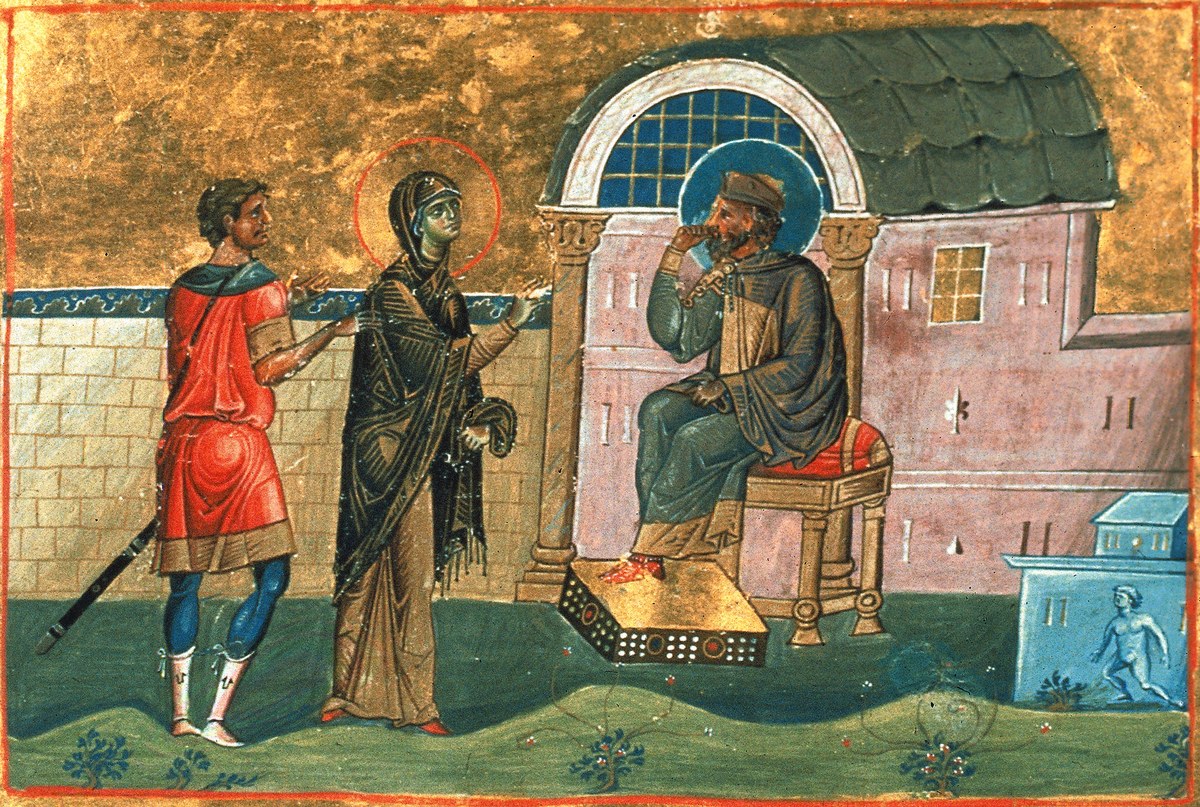

The widow-deaconess and her house
What is known of Publia rests on the near-contemporary witness of Theodoret, bishop of Cyrrhus in the province of Antioch, who devotes to her a chapter of his Ecclesiastical History and calls her "a woman famous at that time," of high repute in the city. Widowed young, she gave herself to the Church: her son John she raised in piety — he became a presbyter of Antioch, and Theodoret adds that he was more than once put forward for the apostolic (episcopal) throne of the city and declined it — and she herself, "for the brief time of her marriage having yielded its fruit," was found worthy of the order of deaconess. Around her she gathered a company (χορός) of virgins and widows vowed to perpetual virginity and the praise of God, keeping in her own house what the later sources describe as a domestic monastery, whose rule was the unceasing singing of the psalms.
The confession before Julian
In 362 the emperor Julian, Constantine's nephew who had renounced the faith, wintered at Antioch preparing his Persian campaign and labouring to restore the worship of the gods. When his procession passed the house of Publia, the old deaconess and her choir struck up the psalms against the idols — "The idols of the nations are silver and gold, the work of men's hands" — raising their voices at the verse, "Let them that make them be like unto them, and all they that trust in them" (Psalm 113 LXX / 115). Julian, stung, commanded them to keep silence while he passed; Publia, holding his laws in contempt, the next time he passed had the choir sing, "Let God arise, and let his enemies be scattered" (Psalm 67 LXX / 68). The emperor in wrath ordered the leader of the choir brought to him and had her struck about the ears by one of his guards until her cheeks ran with blood — an old woman bloodied for a psalm. She counted the outrage the highest honour, Theodoret says, and went back to her house and her singing, harrying the apostate, as the historian puts it, with the spiritual songs that David aimed at demons.
Repose
Julian left Antioch in March 363 for Persia, where he perished; the persecution he was expected to unleash on his return never came. Publia did not long survive her confession: the accounts agree that she reposed in peace shortly after, her death placed c. 361–363. The Greek synaxarion seals her memory with a distich in the image of the psalms she sang: delivered from the error of the world, Poplia flies like a sparrow to her nest in heaven — the escape of the soul "as a bird out of the snare of the fowlers" (Psalm 123 LXX / 124).
Feast and commemoration
October 9 (church date; Old Calendar civil October 22), among the commemorations of the day headed by the Apostle James son of Alphaeus; the Constantinople synaxarion lists her with a distich, and the Greek and Slavic calendars keep her on this same day. She has no proper hymns in the received Menaion and is commemorated within the service of the day. Her memory belongs to the great Antiochene cycle of resistance to Julian, alongside the martyrs Juventius and Maximus, soldiers punished at Antioch in the same months, who are kept on this day in the Slavic calendars.
Iconography
Publia has no established independent icon type. Where she is shown — chiefly in modern calendar illustrations — she appears as an aged deaconess or abbess in dark monastic dress, sometimes with a scroll or psalter for the psalms of her confession, among her choir of virgins. The stored image is the miniature of the Menologion of Basil II (Constantinople, 985): the aged deaconess, veiled in the maphorion, stands confessing before the enthroned Julian, who bites his hand in the manuscript's gesture of thwarted rage — the very scene of her defiance of the Apostate.
Disputed questions
- Martyr or confessor. The Greek synaxaria style her "the holy Martyr Poplia," honouring the blood of her beating, though she was not put to death; the Russian and OCA calendars style her, more precisely by the received definitions, a confessor. This entry follows the confessor classification while recording the Greek usage — a divergence of style, not of substance, since all sources agree she reposed in peace.
- Name-form. Ποπλία (Poplia) is the Greek form of the Latin Publia; both circulate in English, the OCA using "Publia," the transliterated Greek sources "Poplia."
- Date of repose. Given variously within c. 361–363, in relation to Julian's residence at Antioch (362–363); Theodoret's "a short time after" the beating is the only anchor.