
Quadratus of Athens
The Holy Apostle Quadratus of the Seventy, Bishop of Athens, Martyred at Magnesia
Apostle · Apostle of the Seventy · Hieromartyr · Bishop · d. c. 130
Commemorated 4 January — Synaxis of the Seventy Apostles, 21 September — Martyrdom at Magnesia
Quadratus (Kodratos), numbered among the Seventy Apostles, preached Christ at Athens and at Magnesia, served as bishop of Athens, and died a martyr's death around 130 — stoned by a pagan mob and left to perish of hunger in prison. He is the author of the earliest surviving Christian apology, a defence of the faith presented to the emperor Hadrian, of which one luminous fragment is preserved by Eusebius: that those whom Christ healed and raised remained alive as witnesses "even to our own times." His feast is kept on September 21, the leavetaking of the Elevation of the Cross.
.jpg)
Origins and apostolic ministry
The Byzantine tradition counts Quadratus among the Seventy Apostles sent out by the Lord (Luke 10), and remembers him as an evangelist of Athens and of Magnesia, and as bishop of Athens. The earliest witnesses, more cautiously, make him a man of the generation immediately after the apostles: Eusebius, who prized his writing, records the tradition that he was a hearer of the apostles, and the argument of his own apology — that some of those healed and raised by Christ survived "to our own times" — fits precisely such a man, whose youth touched the last living witnesses of the Gospel miracles.
His hymnography praises him as a light rising on a pagan world: planted in Athens, the citadel of Greek philosophy and idolatry alike, he taught the knowledge of God, drew many from the worship of idols, and governed the church there as its bishop. The tradition merged in the synaxaria (see Disputed questions) makes him the restorer of the Athenian church after the martyrdom of its bishop Publius, gathering the scattered faithful and rekindling their faith.
The Apology to Hadrian
Quadratus's chief title to remembrance in the written record is the Apology he addressed to the emperor Hadrian — the earliest apology for Christianity of which anything survives, earlier than Aristides and a generation before Justin Martyr. Eusebius (Church History 4.3) says it was presented because certain wicked men were harassing the Christians, that the work was still in circulation in his own day, and that it displayed both the author's intelligence and his apostolic orthodoxy. The presentation is most commonly placed during Hadrian's sojourn in Athens in 124–125 (some prefer a later visit, c. 129, or the year 126). Eusebius preserves a single fragment, the only surviving sentence of the first Christian apologist:
But the works of our Saviour were always present, for they were true: those who were healed, those who rose from the dead — who were seen not only in the moment of their healing and their rising, but were always present; and not only while the Saviour sojourned here, but after his departure also they remained for a long time, so that some of them have reached even to our own times.
(Eusebius, Church History 4.3.2; translated for this collection from the Greek.)
The argument is characteristic of the sub-apostolic age: the miracles of Christ are not tales but public facts, whose beneficiaries lived on as walking evidence. Later tradition — Jerome states it directly — credited the apology, together with that of Aristides presented at the same period, with moving Hadrian toward leniency: the emperor's rescript to Minucius Fundanus, proconsul of Asia, directing that Christians not be condemned on mere clamour without formal accusation and proof, is linked by Eusebius to these apologies.
Martyrdom
The synaxaria relate that Quadratus's preaching enraged the pagans of the region of Magnesia, where he laboured in his last years. A mob fell upon him with stones; he survived the stoning, was cast into prison, and there died of starvation, around the year 130. He was buried at Magnesia, where the Greek Menaion locates his memory ("Kodratos, he of Magnesia"). The verses of the Synaxarion of Constantinople fix on the stoning: the fools cast stones at him who would give no reverence to stones.
Feast and commemoration
September 21 (church date; Old Calendar civil October 4), the leavetaking of the Elevation of the Cross, on which the Menaion joins the apostle's service — stichera and canon — to the repeated service of the feast. He is also commemorated with the whole company of the Seventy at their synaxis on January 4. The Greek, Antiochian, and Slavic calendars agree on September 21; because of the apodosis, some typika direct that the saint's service be chanted on another day when the feast is kept in full.
Hymns
Troparion — Tone 3
O holy Apostle Quadratus, intercede with the merciful God, that he may grant our souls forgiveness of offences.
Original translation from the Greek
Kontakion — Tone 8
As an honoured hierarch and most steadfast sufferer the whole world offers unto thee, O Lord, Quadratus the apostle, and with songs it honours his revered memory, entreating always that forgiveness of offences be granted through him to those who hymn him, O compassionate One.
Original translation from the Greek
Magnification
We magnify thee, O apostle of Christ Quadratus, and we honour thy pains and labours, wherewith thou didst toil in the good tidings of Christ.
Original translation from the Slavonic
Iconography
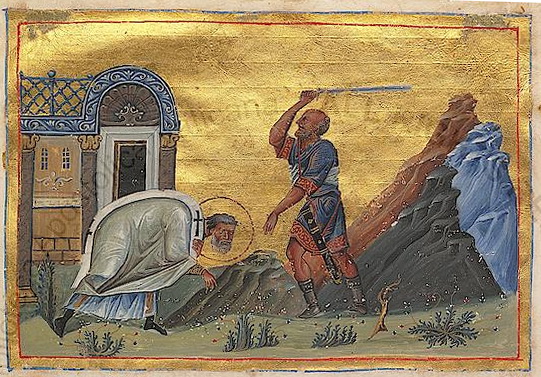
Quadratus is depicted as an aged apostle-bishop, grey-bearded, in phelonion and omophorion or in apostolic tunic and himation, holding a scroll or Gospel book — the scroll fittingly recalling the first of the apologists. The stored image is the miniature of the Menologion of Basil II (Constantinople, c. 985), which shows instead his martyrdom: the bowed, haloed apostle struck down before a city gate by a man raising a club, the hillside scattered with the stones of the mob.
Disputed questions
- One Quadratus or three? The sources transmit, under one name, what modern scholarship generally distinguishes as two or three men: (1) the apologist who wrote to Hadrian (Eusebius, Church History 4.3); (2) the prophet Quadratus, renowned in Asia Minor together with the daughters of Philip for the prophetic gift (Eusebius 3.37, cf. 5.17); and (3) the bishop of Athens who succeeded the martyred Publius and regathered the Athenian church, known from the letter of Dionysius of Corinth to the Athenians (Eusebius 4.23.3) — a notice that belongs a generation later, under Marcus Aurelius. Jerome (On Illustrious Men 19) fused the apologist with the Athenian bishop; the Byzantine synaxaria fused all three and numbered the composite figure among the Seventy. The chronology strains every stage of the identification: one of Luke's Seventy would have been far over a century old when the apology was presented, and the bishop of Dionysius's letter flourished some forty years after it. Eusebius himself appears to distinguish the apologist from the Athenian bishop. Many modern scholars accept apologist = prophet as possible and apologist = Athenian bishop as unlikely; the Church's calendar commemorates the one Quadratus in whom the tradition gathered all these threads.
- Which Magnesia? The Greek Menaion says only "in Magnesia." Most accounts understand Magnesia on the Maeander in Asia Minor (which suits the Asian prophet Quadratus); the Slavic-tradition lives, followed by the OCA, take the Thessalian Magnesia. The sources do not permit a decision.
- Manner of death. The Slavic account (stoned, then starved in prison) is followed above; some Greek notices speak more generally of his perfection "through contests," and a few later compilations let him die in peace. The synaxarion verses witness to the stoning.
- The lost apology. A minority scholarly proposal (P. Andriessen) would identify the lost Apology with the anonymous Epistle to Diognetus; the suggestion has found little acceptance.
- Not to be confused with Quadratus (Codratus) of Corinth, the wilderness-born physician martyred under Decius and commemorated March 10, nor with Quadratus (Codratus) of Nicomedia, the Bithynian martyr of the same day; the identity questions above concern only the second-century bearers of the name.