
Quadratus of Corinth and Companions
The Holy Martyrs Quadratus of Corinth and Those with Him
Martyr · d. c. 251–258, at Corinth
Commemorated 10 March — Martyrdom at Corinth
Quadratus of Corinth (third century) was a physician and confessor of Christ whose life began with a wonder: his mother Rufina, fleeing the persecution while great with child, gave birth to him on a lonely mountain and died there, and the infant — the tradition holds — was preserved and nourished by the providence of God, sheltered by a cloud and fed with a sweet dew, until Christians found and raised him. Grown to be a physician who healed body and soul, he gathered about him a company of the faithful — chief among them Cyprian, Dionysius, Anectus, Paul, Crescens and Victorinus — and led them in the confession of Christ when the persecution under Decius and Valerian came upon Corinth. Seized by the governor Jason and cruelly tortured, they were at the last beheaded together, about the middle of the third century. The Church keeps them on March 10.

The birth in the wilderness
The story of Quadratus opens in flight. In the persecutions that fell upon the Christians of Corinth in the third century, a pious woman named Rufina, who was with child, fled the city into the mountains to save the life within her. There, in the solitude of the wilderness, she gave birth to her son — and, worn out by hardship and by the labour of childbirth, she died, leaving the newborn alone in the wild with no human hand to tend him. The tradition of the Church, as the synaxaria and the OCA life transmit it, sees in what followed the direct care of God for one who would be his own: a cloud is said to have overshadowed the infant and let fall into his mouth a sweet dew in place of his mother's milk, so that he was fed and kept alive until, some while later, Christians of the region found the child and took him to raise. The name he was given — Quadratus (Greek Kodratos, "squared," foursquare) — the tradition does not explain; but the whole of his later life was read in the light of this beginning, as of a man whom God had saved in the wilderness for himself.
Physician and teacher
Raised among Christians, Quadratus was educated in letters and then in the art of medicine, and became a skilled physician. Yet the record remembers him less for the practice of the city than for a love of the wilderness in which he had been born: he is said to have withdrawn often into the solitary places, giving himself to prayer, and to have drawn others after him, so that a company of young men formed about him whom he taught both the healing of bodies and, above all, the faith of Christ and the way of a virtuous life. Chief among these companions the tradition names Cyprian, Dionysius, Anectus, Paul, Crescens and Victorinus — the roll with which the calendars most often keep the feast — though the fuller synaxarion tradition adds many more who suffered with them (see below). Quadratus stands in the memory of the Church as a shepherd of this little flock: the wilderness-child who became a father to others.
Persecution, torture, and martyrdom
The peace was broken when the imperial persecution — the tradition sets it in the reigns of the emperors Decius (249–251) and Valerian (253–259), the two great mid-century persecutions being remembered together — reached the province. A magistrate named Jason came to Corinth to enforce the sacrifices to the idols, and Quadratus, unwilling to see his companions falter, went forward as their spokesman and confessed Christ openly on behalf of them all, answering the governor's questions for the whole company and steadying the younger men in their resolve.
For this the martyrs were given over to a succession of torments meant both to break their will and to make a spectacle of them: they were beaten and scourged, dragged through the streets of the city while the mob abused them, given to wild beasts (which, the account says, would not touch them), and cast into fire — and through all of it they were preserved, encouraging one another and confessing the more boldly. When neither torture nor terror moved them, the sentence fell: they were led out and beheaded together with the sword, bowing their necks as one. Their martyrdom is placed about the middle of the third century; the day the Church keeps is March 10.
The wider company
Beyond the six companions with whom the feast is usually kept, the fuller synaxarion tradition transmits a longer roll of those said to have suffered at Corinth with Quadratus or in the same persecution — among the men Victor, Nicephorus, Claudius, Diodorus, Serapion, Papius (Papias) and Leonidas, and among the women Chariessa, Nunechia, Basilissa, Nike, Galla, Galina and Theodora — several of whom are said to have been drowned in the sea, others burned, crushed, or beheaded. The names vary between the witnesses, and some of this company (notably a group of women martyrs of Corinth drowned in the sea) are also commemorated on other days of the calendar; the roll is therefore given as the tradition transmits it, not asserted as a fixed and closed list, and the feast is led by Quadratus and the six named with him.
Feast and commemoration
Quadratus of Corinth and his companions are kept universally on March 10 (church date; Old Calendar civil March 23). Because this church date falls, in most years, within Great Lent — on whose weekdays the full Liturgy is not celebrated — no proper Epistle and Gospel are appointed to the saints of the day, and their commemoration is kept at the Lenten services with the hymns of the Menaion sung together with those of the Triodion. The Greek Menaion leads the day with "the holy Martyr Quadratus of Corinth, and those with him" (τοῦ Ἁγίου Μάρτυρος Κοδράτου τοῦ ἐν Κορίνθῳ, καὶ τῶν σὺν αὐτῷ). The same day keeps a distinct company of martyrs at Nicomedia under the same name Quadratus (see Disputed questions).
Hymns
Troparion — Tone 4
Thy Martyrs, O Lord, in their contest received from Thee our God crowns of incorruption; for armed with Thy might, they cast down the tyrants and broke the powerless insolence of demons. By their supplications, O Christ our God, save our souls.
Original translation from the Greek
Kontakion — Tone 3
As bright stars did ye enlighten all creation, O athletes who cannot be vanquished; ye brought the deceit of the idols to nothing and, contending lawfully, ye were crowned. Wherefore, unceasingly intercede with Christ for us all.
Original translation from the Greek
Iconography
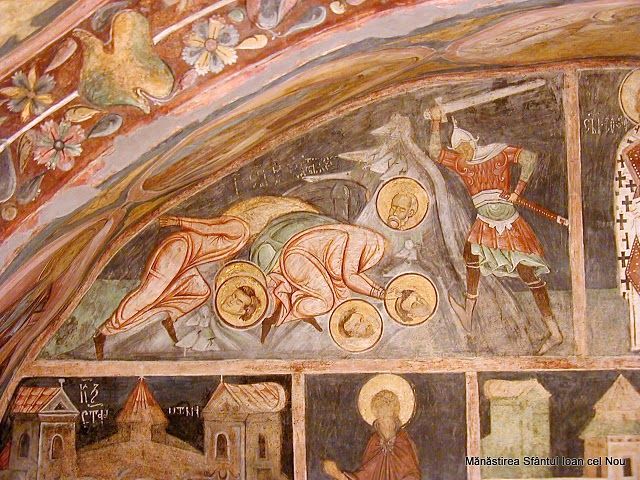
Quadratus and his companions are depicted in the manner of the martyrs — young men in the tunic and cloak, holding the cross of martyrdom — most often as a group rather than a single portrait, since the feast is that of a company. The characteristic narrative image is the martyrdom itself: the confessors led out and beheaded together, or subjected to the torments the account records — cast before beasts that will not harm them, or dragged through the city. In the menologion cycles that illustrate the fixed year, the March 10 miniature shows the martyr Codrat "and those with him" at the moment of their death.
The stored image is a sixteenth-century menologion fresco (c. 1550) from the narthex of the Monastery of Saint John the New at Suceava in Moldavia, part of the painted calendar of saints that covers the church's walls: the panel for 10 March, inscribed for "Saint Martyr Codrat and those together with him," the martyrs gathered for their confession and crown (source, public domain, pd-old-work).
Disputed questions
- Not to be confused with Quadratus of Athens (Codratus, †c. 130, kept September 21) — the Apostle of the Seventy and bishop of Athens (and Magnesia), the early Christian apologist who addressed a defence of the faith to the emperor Hadrian. That Quadratus is an apostolic-age hierarch and writer; this Quadratus is a third-century physician and lay martyr of Corinth. The two share only the common Greek name Kodratos.
- The Nicomedian namesake. The same March 10 keeps Quadratus (Codratus) of Nicomedia and his companions Saturninus and Rufinus — a distinct company of martyrs of the same name and the same day, from Bithynia rather than Corinth and of a wholly different story (a wealthy well-born confessor who sustained the imprisoned). The coincidence of name and date has led some witnesses to run details of the two together; the calendars, and this reference, keep them apart.
- Date and reign. The sources place the martyrdom variously under Decius (so the OCA life, giving c. 250–251) and under Valerian (so other reckonings, giving c. 258); the two mid-century persecutions are often remembered together, and the year is given here as "c. 251–258."