
Raphael of Brooklyn
Our Father among the Saints Raphael (Hawaweeny), Bishop of Brooklyn
Bishop · Wonderworker · b. November 8, 1860, at Beirut — d. February 27, 1915, at Brooklyn, New York
Commemorated 27 February — Repose at Brooklyn in 1915; principal feast as kept by the Orthodox Church in America
Raphael Hawaweeny (1860–1915) was the first Orthodox bishop consecrated on North American soil and the shepherd of the scattered Arab Orthodox faithful of the New World — "the Good Shepherd of the Lost Sheep in America." Born in Beirut to Damascene refugees, formed in Damascus, at Halki, and at the Theological Academy of Kiev, and a priest of the Church of Antioch serving in Russia, he was sent in 1895 to gather the Syrian Orthodox immigrants of the United States and Canada. From his cathedral of Saint Nicholas in Brooklyn he travelled the continent without rest, founding some thirty parishes, printing the first Orthodox service-books in America, and in 1904 receiving episcopal consecration at the hands of the future Patriarch Tikhon of Moscow. He reposed in 1915, worn out in the service of his people, and was glorified in 2000 by the Orthodox Church in America and the Antiochian Archdiocese together. He is kept on February 27, the day of his repose.

Origins and formation
He was born on November 8, 1860, at Beirut, and given at baptism the name Raphael. His parents were Damascene — refugees from the great massacre of the Christians of Damascus that had erupted that same year, in which his family, like thousands of others, had fled the city for the safety of the coast. His father, Michael Hawaweeny, was a subdeacon and cantor; the household was poor, devout, and steeped in the life of the Church of Antioch. When the danger passed the family returned to Damascus, and there the boy was raised in the shadow of the patriarchal cathedral.
His gifts were marked early. He was educated first in the patriarchal school at Damascus, then — the Church of Antioch in that century being largely dependent on Greek and Russian institutions for higher learning — at the Theological School of Halki near Constantinople, and finally, on a scholarship, at the Theological Academy of Kiev in the Russian Empire, where he completed his formal theological education and was formed in the Russian Orthodox tradition that would shape the rest of his life. He was ordained deacon in 1885 and priest, rising to the dignity of archimandrite, and served the Patriarch of Antioch as a preacher and representative; for a time he taught Arabic at the Theological Academy of Kazan in Russia, a bridge between the Antiochian and the Russian Churches whose union in his own person would prove providential.
The call to America
By the last decades of the nineteenth century a great migration had carried tens of thousands of Arab Orthodox Christians from Syria and Lebanon to the cities and mill-towns of the United States and Canada. They arrived without priests, without churches, without a bishop of their own tongue — scattered, exposed to proselytism, and in danger of losing the faith of their fathers in a strange land. At that time the whole of Orthodox North America lay under the single omophorion of the Russian Orthodox Mission, and it was to Russia and to Antioch together that the immigrants' appeals were addressed.
In 1895 Archimandrite Raphael was sent to New York to serve this community — the Syro-Arab Orthodox faithful — under the Russian Mission. He found them "as sheep having no shepherd," and the phrase that would become his title was the plain truth of his ministry: he was the Good Shepherd of the Lost Sheep in America. He gathered the first Arab Orthodox congregation of New York, established the cathedral of Saint Nicholas in Brooklyn as its centre, and made it the mother-church of Arab Orthodoxy in the New World — today the primatial cathedral of the Antiochian Orthodox Christian Archdiocese of North America.
Bishop of Brooklyn
The community grew beyond what one priest could serve, and the Russian Mission, under its far-sighted head Archbishop Tikhon (Bellavin) — the future Patriarch of Moscow and confessor — resolved to give the Arab faithful a bishop of their own blood. On March 12/13, 1904, in the cathedral at Brooklyn, Archimandrite Raphael was consecrated Bishop of Brooklyn by Archbishop Tikhon and Bishop Innocent (Pustynsky) — the first Orthodox episcopal consecration ever performed on the soil of North America, and a foundation-stone of Orthodoxy on the continent. As auxiliary to Tikhon he governed the Syro-Arab Mission, and he threw himself into a labour that never let him rest.
He travelled the length and breadth of the continent — a bishop perpetually on the road, seeking out the smallest and most isolated communities of his people, from the eastern seaboard to the western territories and into Canada, consecrating churches, ordaining priests, catechising, reconciling. He founded, by the reckoning of his biographers, some thirty parishes. He laboured for the whole Orthodox mission and not only for his own: he helped Saint Tikhon to organise the American Church, took part in the founding of Saint Tikhon's Monastery at South Canaan, Pennsylvania (1905), and supported the seminary and the missionary work among all the peoples the young Church served — Russians, Syrians, Greeks, and the newly-converted.
He was, besides, a man of the printed word. Knowing that his scattered flock needed the services in their own hands, he produced at Brooklyn the first Orthodox liturgical books published in America in Arabic — among them a service-book of the divine offices — and he founded and edited the periodical al-Kalimat ("The Word") to bind his people together in faith and news across a continent. What he could not reach in person he reached in print.
Repose
The unremitting toil of two decades broke his health. Bishop Raphael reposed on February 27, 1915, at Brooklyn, in the fifty-fifth year of his age, mourned by a people who had known no other bishop. His funeral drew a great multitude of the Orthodox of every nation in America, and he was buried at the cathedral; his relics were afterward translated to the grounds of Saint Tikhon's Monastery in Pennsylvania, where they rest. The Church he had planted — a single struggling mission of immigrant congregations — has grown into the flourishing Antiochian Archdiocese and is woven into the whole fabric of American Orthodoxy; and the memory of the tireless bishop who gathered its first generation never faded among his people.
Glorification
In 2000 Bishop Raphael was glorified as a saint — canonised jointly by the Orthodox Church in America (the successor of the Russian Mission under which he had served) and the Antiochian Orthodox Christian Archdiocese (the heir of the Church of Antioch that had sent him), the two Churches whose union in his own life he had embodied. The Holy Synod of the OCA proclaimed his sainthood in the spring of 2000, and the solemn glorification services were celebrated in May 2000 at Saint Tikhon's Monastery, where his relics lie. He is honoured as Saint Raphael of Brooklyn, the first-fruits of Orthodox sanctity on the North American continent among its bishops.
Feast and commemoration
Raphael is commemorated on February 27 (church date; New Calendar civil February 27; Old Calendar civil March 12), the day of his repose — his principal feast as kept by the Orthodox Church in America. The Antiochian Archdiocese keeps his principal commemoration on the first Saturday of November, a movable date tied to his glorification, when it honours him as the Good Shepherd of its founding generation; some parishes and calendars observe both days. (The November commemoration is a movable observance outside the fixed-date system of this collection and is noted here in prose rather than carried as a dated feast; it is not governed by any of the controlled movable-feast rules.) Because his glorification is recent, the fixed civil date and the church date coincide on the New Calendar that both his Churches keep.
Appointed readings
Epistle — Hebrews 13:17–21
17Obey them that have the rule over you, and submit yourselves: for they watch for your souls, as they that must give account, that they may do it with joy, and not with grief: for that is unprofitable for you. 18Pray for us: for we trust we have a good conscience, in all things willing to live honestly. 19But I beseech you the rather to do this, that I may be restored to you the sooner. 20Now the God of peace, that brought again from the dead our Lord Jesus, that great shepherd of the sheep, through the blood of the everlasting covenant, 21Make you perfect in every good work to do his will, working in you that which is wellpleasing in his sight, through Jesus Christ; to whom be glory for ever and ever. Amen.
Gospel — John 10:9–16
9I am the door: by me if any man enter in, he shall be saved, and shall go in and out, and find pasture. 10The thief cometh not, but for to steal, and to kill, and to destroy: I am come that they might have life, and that they might have it more abundantly. 11I am the good shepherd: the good shepherd giveth his life for the sheep. 12But he that is an hireling, and not the shepherd, whose own the sheep are not, seeth the wolf coming, and leaveth the sheep, and fleeth: and the wolf catcheth them, and scattereth the sheep. 13The hireling fleeth, because he is an hireling, and careth not for the sheep. 14I am the good shepherd, and know my sheep, and am known of mine. 15As the Father knoweth me, even so know I the Father: and I lay down my life for the sheep. 16And other sheep I have, which are not of this fold: them also I must bring, and they shall hear my voice; and there shall be one fold, and one shepherd.
Iconography
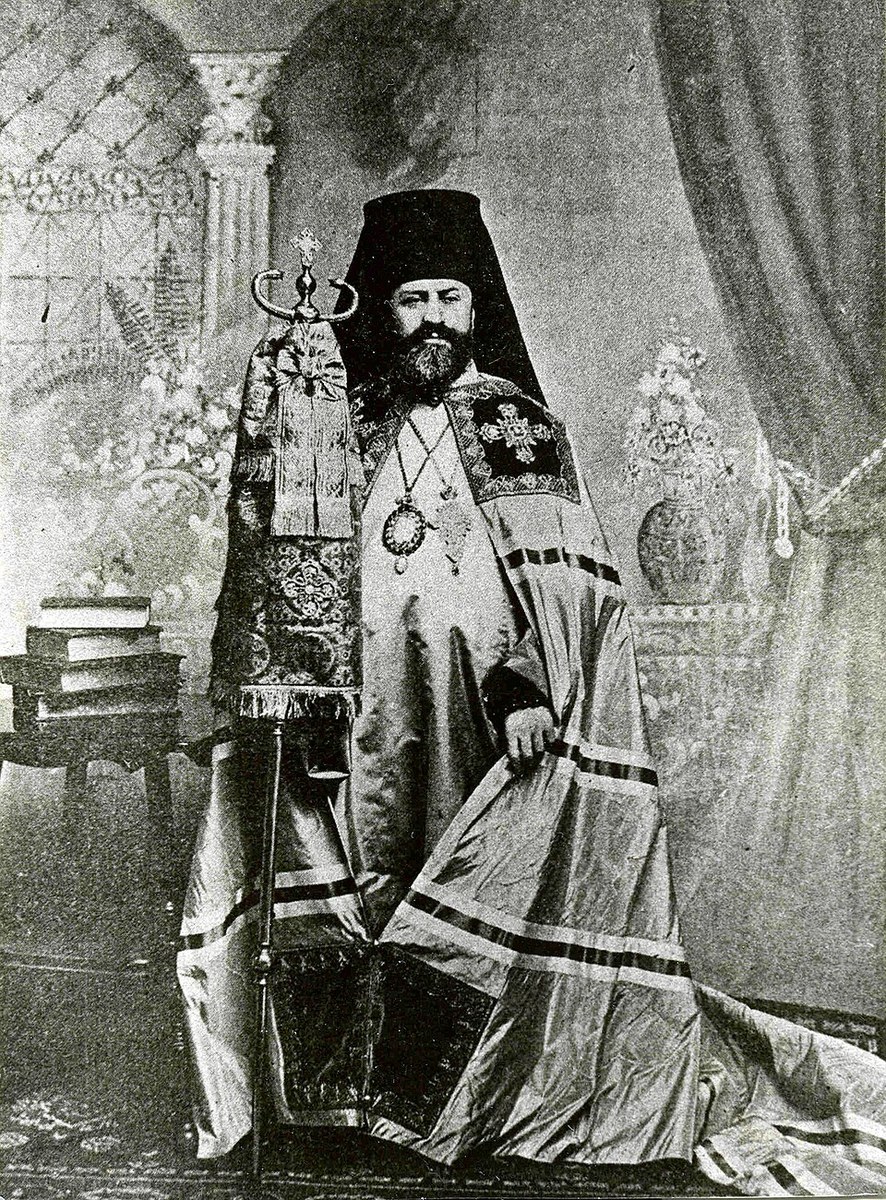
As a saint of the twentieth century, Raphael is depicted from life: an Arab bishop in the prime of middle age, dark-bearded, vested in the sakkos and omophorion and the mitre of a hierarch, holding the Gospel-book or the bishop's crozier and blessing — his features drawn from the photographs taken in his lifetime. He is frequently shown with the cathedral of Saint Nicholas or a scroll naming him the Good Shepherd of the Lost Sheep in America. The modern icons written since his glorification in 2000 are living artists' copyrighted works and are not stored here.
The stored image is instead a photograph of Bishop Raphael taken in his lifetime (not later than 1915), showing him vested as Bishop of Brooklyn — a public-domain historical portrait of the saint himself, from which his iconographic likeness derives (source, public domain, pd-old-work).