
Razhden the Persian
The Holy Protomartyr Razhden the Persian, First Martyr of Georgia
Protomartyr · Martyr · d. c. 457, crucified and shot with arrows at Tsromi in Kartli
Commemorated 3 August — Martyrdom at Tsromi; the protomartyr of Georgia
Razhden was a Persian nobleman who came to Kartli (eastern Georgia) in the retinue of the Persian princess Balenduxt when she was given in marriage to King Vakhtang Gorgasali, was converted there and baptised, and received lands and a military command in his adopted country. When the Persians invaded, he fought against his own nation for the kingdom that had made him a Christian; taken prisoner, and known to the Persian king as an apostate of noble blood, he was beaten, had his teeth drawn out, was dragged over rocks and kept in chains. Ransomed by the Georgian nobles, he went back of his own accord rather than buy his life with a denial, and was crucified and shot to death with arrows at Tsromi about the year 457. He is honoured as the protomartyr of Georgia, the first of that nation to die for Christ, and his relics were laid by King Vakhtang at Nikozi.
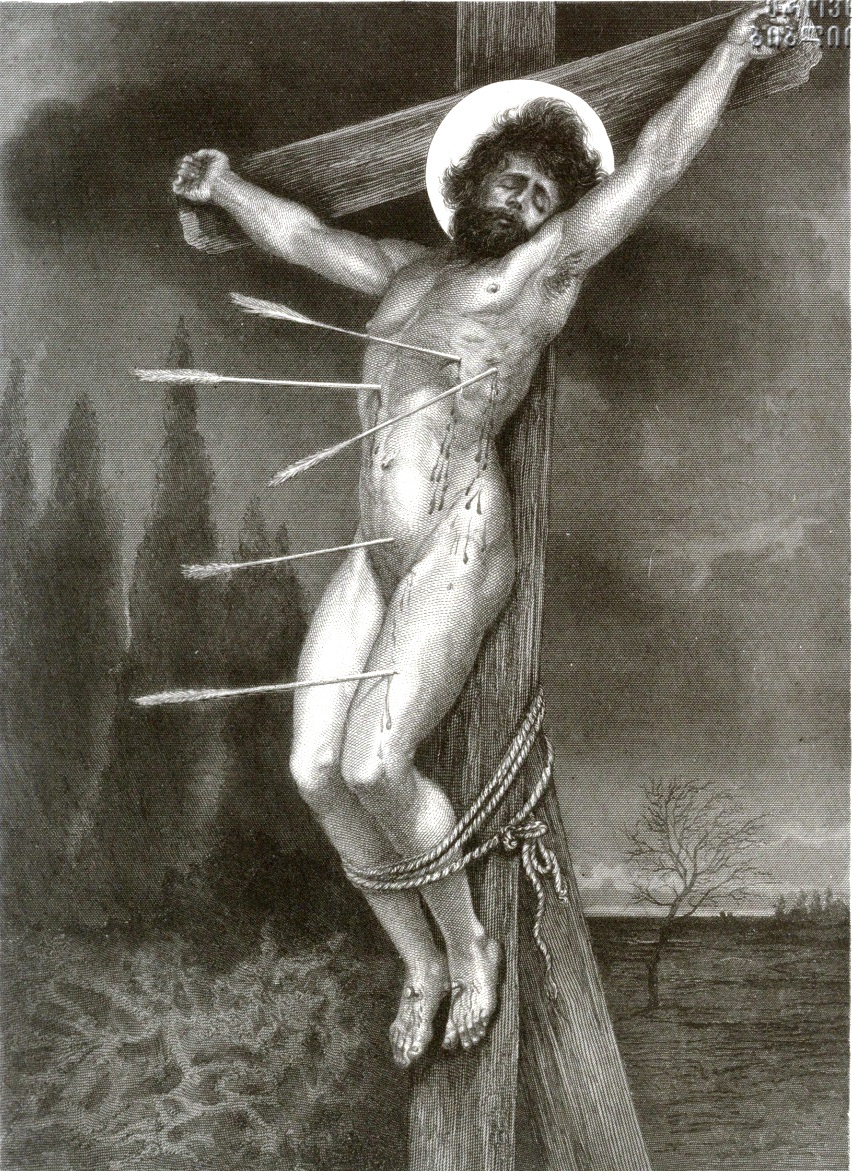
.jpg)
A Persian at the court of Kartli
Razhden was born into the Persian nobility in the middle of the fifth century, when the Sasanian empire held the Caucasus in a grip that was religious as much as political: the kings of kings required the fire-worship of Zoroaster of their subject aristocracies, and the Christianity of Kartli — established since the preaching of Nina in the fourth century — was the standing point of conflict.
He came into Georgia by a dynastic marriage. Vakhtang I Gorgasali, king of Kartli — the great figure of early Georgian kingship, founder of Tbilisi and organiser of the Georgian Church — took to wife Balenduxt, daughter of the Persian king Hormizd III, and Razhden accompanied the princess to her new country as a member of her household. He was, on the Georgian account, her tutor or guardian.
Conversion
What happened next is the whole of the man. Living in a Christian kingdom, Razhden was persuaded of the truth of the faith and was baptised. The king received him with honour, gave him estates and a command in the army, and he became by adoption a Georgian noble; the Georgian sources describe him as a soldier of exceptional courage and as a devout Christian, generous to churches and to the poor.
For a Persian aristocrat this was not a change of opinion but a capital offence, and Razhden appears to have understood that from the beginning.
War, capture, and the first torments
In the campaigns of the Persian king Peroz (reigned 457–484) against Kartli, Razhden took the field with the Georgians and distinguished himself. He was taken prisoner. When it was discovered who he was — a Persian noble who had abandoned the fire — he was brought before the king and required to return to the religion of his fathers.
He refused. The account of what followed is circumstantial in the Georgian tradition: he was flogged, his teeth were drawn out, he was dragged over cliffs and stony ground, and he was thrown into prison in chains. The Georgian nobles negotiated his release, and he was set free and returned to Kartli.
The return, and the cross at Tsromi
Razhden did not stay. Knowing that his liberty had been bought and that his confession was unfinished, he went back to the Persians of his own will. Peroz tried him once more with promises and once more with threats, and once more he refused the fire.
He was then sent under guard to the Persian military camp at Tsromi, in Shida Kartli, with a secret order to the commander that if he persisted he should be put to death. He persisted. The commander is remembered for the sentence he passed, which has the bitter symmetry the martyr-acts prize: if he hopes in the Crucified, then let him also be fit to suffer crucifixion. Razhden was nailed or bound to a cross, and the Persian archers were set to shoot at him as he hung. His last words were the Lord's own from the Cross: Into Thy hands, O Lord, I commit my spirit. The year is given as about 457.
Relics and veneration
The Christians of the place took the body away secretly and buried it. When the country was again in Georgian hands, King Vakhtang Gorgasali had the relics translated to Nikozi, where he built a church over them; Nikozi afterwards became an episcopal see, and its cathedral of the Protomartyr Razhden — rebuilt many times over fifteen centuries — remains the centre of his cult. Churches were also raised at Tsromi, the place of the martyrdom.
Razhden's title in the Georgian Church is პირველმოწამე, pirvelmots'ame, "protomartyr" — not the first Christian to die in the Caucasus in an absolute sense, but the first martyr whom the Georgian nation names as its own, standing at the head of a calendar that would grow very long: the hundred thousand of Tbilisi, the children of Kola, the Nine Kherkheulidze Brothers and the martyrs of Marabda, and the rest. He is invoked in Georgia as the pattern of the soldier who chooses his baptism over his birth.
Feast and commemoration
August 3 (church date; New Calendar civil August 3, Old Calendar civil August 16), kept by the Georgian Orthodox Church as the feast of its protomartyr, and carried into the Russian and American calendars from the Georgian. The Greek synaxaria do not keep him. The day falls within the Dormition fast (August 1–14). At Nikozi, where the relics lie, and at Tsromi, the day is the patronal feast.
Hymns
Troparion — Tone 4 (common of a martyr)
Thy martyr Razhden, O Lord, in his contest received an incorruptible crown from Thee, our God; for possessing Thy strength, he cast down the tyrants and shattered the feeble insolence of the demons. By his intercessions save our souls.
Original translation from the Georgian
Kontakion — Tone 2
Thou didst leave the fire of the Persians and be baptised into the fire that does not consume, and being loosed from thy chains thou didst go back to them of thine own will; wherefore, lifted upon the cross and pierced with arrows, thou wast made the first fruits of the martyrs of Georgia, O Razhden, and dost intercede for our souls.
Original translation from the Georgian
Iconography
Razhden is painted in Georgian churches in two ways. As a standing figure he is a soldier saint: a middle-aged man with a short dark beard, in the cloak and tunic — sometimes in armour — of a fifth-century Iranian noble, holding the martyr's cross in his right hand, with the inscription naming him pirvelmots'ame, protomartyr. The scene proper to him is the martyrdom at Tsromi: the saint bound or nailed to a cross with the Persian archers drawing on him, the arrows already in his body. He appears in the great composite icons of All Saints of Georgia, standing at the head of the martyrs.
The stored image is the plate of the martyrdom from Mikhail (Gobron) Sabinin's Sakartvelos samotkhe — "The Paradise of Georgia" — published at St Petersburg in 1882, the illustrated corpus of Georgian hagiography that fixed the modern iconography of most of the Georgian saints. It shows the saint hanging on a rough wooden cross in a Georgian landscape of cypresses, the head fallen to the shoulder within a plain white nimbus, the body pierced by five arrows and the legs bound to the shaft with rope; the Georgian inscription stands at the upper right. The plate is an engraving in the academic manner of its date rather than a canonical icon, and is reproduced here as the earliest licence-clean depiction of this saint that could be found; a Byzantine-style panel of him remains wanted.
Disputed questions
- The date. The traditional year is 457, the first year of Peroz. Since the same tradition puts the martyrdom during Peroz's campaigns and the marriage of Vakhtang to Balenduxt, and the chronology of Vakhtang Gorgasali's own reign is itself disputed among historians (proposals for his dates range across most of the second half of the fifth century), the year should be treated as approximate. Some Georgian sources place the martyrdom in the 460s or later.
- The sources. No contemporary passion survives. The martyrdom is transmitted in the Georgian chronicles — the Kartlis Tskhovreba cycle around the Life of Vakhtang Gorgasali — and in the later Georgian synaxaria; the detailed torments have the shape of a developed hagiographic account rather than of a court record. The core — a Persian convert of rank executed by the Persians in Kartli under Peroz, and buried at Nikozi — is not seriously doubted.
- The name. Razhden is Persian, not Georgian, and its survival unaltered is itself a small confirmation of the story: the tradition never assimilated him.
- Not to be confused with Salome the Georgian and the other saints of the Vakhtang cycle, nor with the later Georgian martyrs of the Persian wars.