
Nina of Georgia
Our Holy Mother Nina, Equal-to-the-Apostles and Enlightener of Georgia
Equal to the Apostles · b. c. 280, Cappadocia — d. c. 335, at Bodbe in Kakheti (Georgia)
Commemorated 14 January — Repose at Bodbe; her principal commemoration, kept on the leavetaking of the Theophany, 19 May — Her entrance into Georgia, the beginning of her apostolate
Nina (Nino, c. 280 – c. 335) is the Enlightener of Georgia, the Equal-to-the-Apostles whose preaching converted the kingdom of Iberia (eastern Georgia) to Christ in the first quarter of the fourth century. A Cappadocian by birth, kinswoman of the Great-martyr George and, by the Georgian tradition, niece of the Patriarch of Jerusalem, she came to Iberia a lone captive maiden, bearing a cross of grapevine twigs bound with her own hair. By healing, prayer, and the quiet witness of her ascetic life she won first the poor and the sick, then Queen Nana, whom she cured, and at last King Mirian, struck blind and lost in a sudden darkness while hunting and restored to sight when he called upon "the God of Nina." Iberia was declared a Christian kingdom about the year 326; a bishop and clergy were sought from Constantine the Great, and the first cathedral rose at Mtskheta over the buried Robe of Christ, at the Life-giving Pillar (Svetitskhoveli). Nina withdrew to Bodbe in Kakheti, where she reposed and is buried. Her grapevine cross is the emblem of Georgian Christianity, and she is one of the few women the Church honours as Equal-to-the-Apostles.

Origins in Cappadocia and Jerusalem
The received Life makes Nina a native of Cappadocia, of a noble Christian household of the town of Kolastra. Her father, Zabulon (Zebulon), was a Roman army officer of Cappadocia, kinsman of the Great-martyr George; her mother, Susanna (Sosana), was sister to the Patriarch of Jerusalem, named in the tradition Juvenal (Iobenal). She was their only child. When Nina was about twelve the family removed to Jerusalem, where — by the tradition — Zabulon received the blessing to take up the ascetic life in the wilderness of the Jordan, and Susanna was appointed a deaconess in the service of the Holy Sepulchre. Nina herself was given into the care of a pious Armenian elder-woman, Sara Niaphor (Nianfora), who instructed her in the faith and in the sacred history.
From this instruction came the vocation that shaped her life. Nina learned that the seamless Robe of Christ (the Chiton for which the soldiers cast lots at Golgotha, John 19:23–24) had been carried off, at the Crucifixion, by a Jew of Mtskheta in the far country of Iberia, and was hidden there; and she was seized with longing to find the land that guarded the Lord's garment and to venerate it. Praying before the icon of the Mother of God for guidance, she received in a dream the commission on which the whole tradition turns: the Virgin appeared to her, gave her a cross woven of the twigs of the grapevine, and said, "Go to the country that was allotted to me, and preach there the Gospel of my Son; I will be thy shield." Waking, Nina found the vine-cross in her hands; she bound it with strands of her own hair and set out. (The grapevine cross of Saint Nina, its arms characteristically drooping, is preserved to this day in the Sioni cathedral of Tbilisi and is the enduring emblem of the Georgian Church.)
The road to Iberia and the martyrdom of the virgins
The tradition brings Nina westward first, and joins her story for a time to that of a company of consecrated virgins fleeing the persecution of Diocletian. In their number were Rhipsime and her eldress Gaiana, whom Nina is said to have accompanied as far as Armenia. There, when the virgins refused the importunity of King Tiridates (Trdat), they were put to death — the virgin-martyrs Rhipsime and Gaiana, whose blood watered the conversion of Armenia through Gregory the Illuminator. Nina alone escaped, hidden (the account says) in a rose-bush, and made her way north over the mountains into Iberia, coming down at last to Lake Paravani and thence, with a company of shepherds, to the royal city of Mtskheta at the meeting of the Kura and the Aragvi.
Mtskheta: the captive maiden and her first works
At Mtskheta Nina found a pagan kingdom that worshipped the idols Armaz and Zaden and served fire after the Persian manner. She lodged humbly — the tradition sets her in the garden of the royal keeper, in a little hut against the wall — and began not with disputation but with prayer, healing, and the witness of her life. It is told that as the king and people gathered on a feast to worship the great idol Armaz upon its height, Nina prayed, and a sudden tempest of wind and hail broke over the place and dashed the idol to pieces — the fall of the gods of Iberia before the coming of the Gospel, as at the entry of the Christ-child into Egypt. The wife of the royal gardener, long barren, bore a child through Nina's prayers and became her first disciple; and Nina's healing of the sick, done in the name of Christ with the sign of her vine-cross and without payment or sorcery, drew the poor of the city to her.
Queen Nana and King Mirian
The turning of the kingdom came through its rulers. Queen Nana fell grievously ill, and when no remedy availed she was carried to the foreign woman of whom the whole city spoke. Nina laid her upon her own bed of leaves, prayed over her with the vine-cross, and the queen rose up healed. Nana confessed Christ and was secretly numbered among the believers.
Her husband, King Mirian III — of the Chosroid house, a client-king within the Roman and Persian orbit — was slower, and for a time inclined, at the urging of the Persian party, to stamp out the new teaching. The tradition tells that the change came upon him in a single hour. Hunting in the forest of Mtskheta (or on Mount Thoti), the king was overtaken by a sudden and total darkness, blinded and lost, his own gods deaf to his cries. In his terror he called at last upon "the God of Nina", vowing that if he were delivered he would confess Christ; and at once the darkness lifted and the day returned. Mirian came back to the city a Christian, sought out Nina, and — with Queen Nana — gave the kingdom to the faith. The conversion of Iberia is conventionally dated to about the year 326.
The Robe of Christ and the Life-giving Pillar of Mtskheta
The building of the first church at Mtskheta gathered up the oldest of the Georgian traditions, that of the Robe of Christ. The Chiton, said the tradition, had been brought from Jerusalem by a Mtskhetan Jew, Elioz (Elias), who was present at the Crucifixion; on his return his devout sister Sidonia took the garment from him, and, embracing it, died at once of holy joy — and the Robe could not be prised from her arms, so that she was buried with it, and over her grave grew a great cedar. When Mirian resolved to raise a church on that spot, the cedar was felled and made into seven pillars for the new basilica. Six were set in place, but the seventh — hewn from the trunk that had grown over the buried Robe — could by no means be raised: it hung suspended in the air. Nina kept vigil in prayer through the night, and toward dawn the pillar, of itself, settled upon its base, streaming a fragrant, healing myrrh. From this wonder the cathedral of Mtskheta takes its name — Svetitskhoveli, "the Life-giving Pillar" — and the myrrh-gushing column, raised over the Robe of the Lord, became the holiest shrine of the Georgian Church.
Mission from Constantine, and the ordering of the Church
Nina would not herself administer the mysteries, being a woman and unordained, and she counselled the king to seek clergy from the emperor. Mirian sent envoys to Constantine the Great and the empress Helen, who received them with joy and sent back a bishop, John, with priests and deacons — and, the tradition adds, gifts and a portion of the relics of the true Cross for the young Church. With their coming the people were baptized in the waters of the Kura and the Aragvi, and the kingdom of Iberia was set in order as a Christian land, in communion with the Church of the empire. Nina did not rest in the capital, but went out to preach in the mountain districts — to the highlanders of the north and east, and into Kakheti, where she brought Queen Soja (Sophia) of the Kakhetians and her people to the faith.
Repose at Bodbe
Her apostolic labours finished, Nina withdrew to the hillside of Bodbe in Kakheti, and there, foretelling her end, she reposed — by the common reckoning about the year 335 (some sources give 338, 340, or 347). King Mirian and all Iberia came out to her, and the king would have carried her body to the cathedral at Mtskheta; but the bier could not be moved from the place, and, understanding this as her will, they buried her where she died. Over her grave Mirian built a church in honour of her kinsman Saint George, and the place became the Bodbe monastery, which guards her relics to this day and is among the chief places of pilgrimage in Georgia.
Feast and commemoration
Nina is commemorated on January 14 (church date; New Calendar civil January 14, Old Calendar civil January 27), the day of her repose, which falls on the leavetaking of the Theophany — so that the Enlightener of a nation is honoured on the day the Church seals the feast of the Enlightenment of the world. Her veneration is universal in the Byzantine churches; she is naturally the first of saints in the Georgian Church, whose calendar keeps her with an all-night vigil and observes further Georgian commemorations of her (the arrival of Saint Nina in Georgia, and the memory of the myrrh-streaming Pillar). The Antiochian, Greek, Russian and OCA calendars all keep her on January 14 as Equal-to-the-Apostles and Enlightener of Georgia. The Church numbers her among that small company of missionary saints — with Constantine and Helen, Vladimir of Kiev, and the apostles of nations — whose work is likened to the Apostles' own, and she is one of only a handful of women given the title Equal-to-the-Apostles.
Hymns
Troparion — Tone 4
O handmaid of the Word of God, who in the apostolic preaching didst imitate Andrew the First-called and the rest of the Apostles, O enlightener of Iberia and reed-pipe of the Holy Spirit: holy Nina, equal to the Apostles, entreat Christ God that our souls may be saved.
Original translation from the Slavonic
Kontakion — Tone 2
Come, all ye, let us praise the preacher chosen by Christ, equal to the Apostles, the God-wise Nina, who enlightened the land of Iberia with the light of the Gospel and interceded for it before the Saviour…
Original translation from the Slavonic
Magnification
We magnify thee, O holy Nina, equal to the Apostles, who didst enlighten all the land of Iberia with the light of the Gospel and lead its people unto Christ.
Original translation from the Slavonic
Iconography
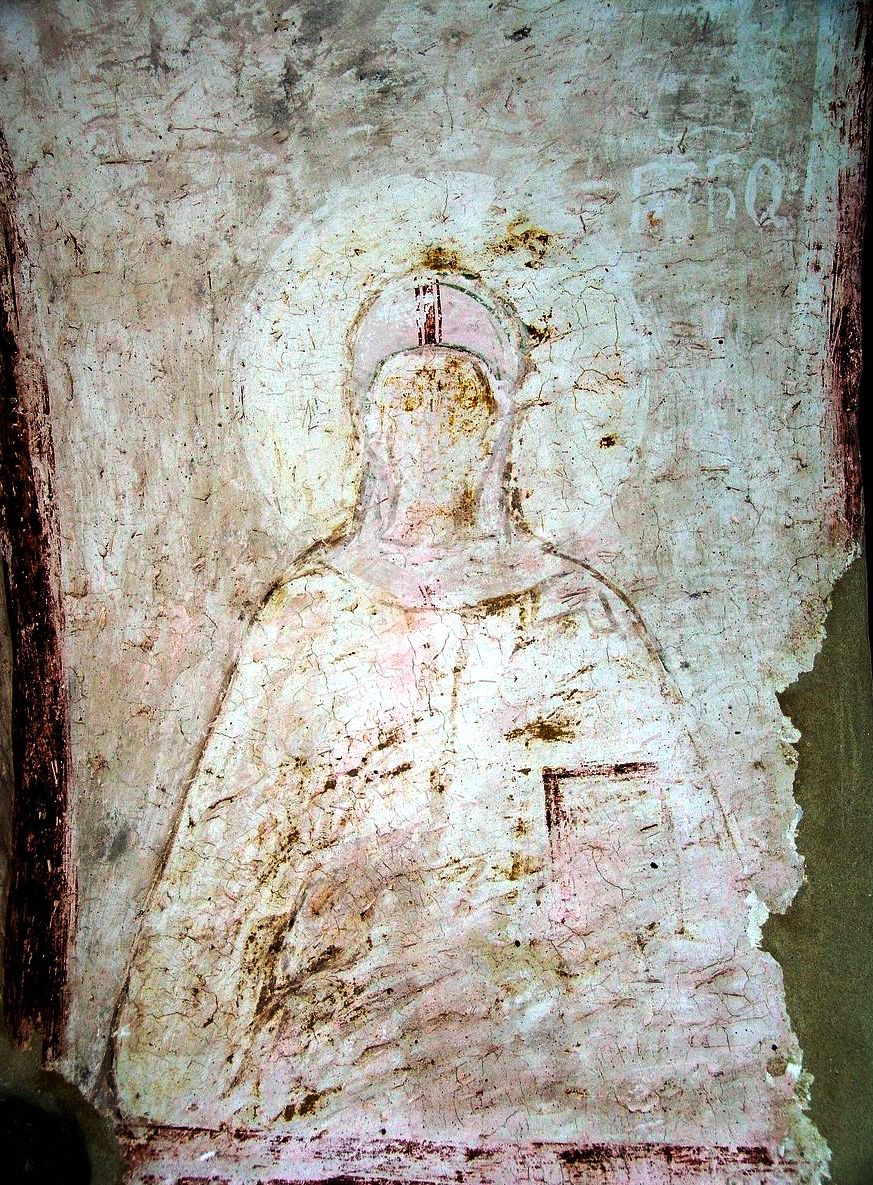
Nina is depicted as a young ascetic woman, veiled and in a dark mantle, holding her proper attribute — the cross of grapevine twigs with its two arms characteristically drooping or bent downward, unmistakable and hers alone; often she also holds a Gospel-book or a scroll. She is shown standing full-length as an Equal-to-the-Apostles, or enthroned; narrative cycles set her among the scenes of her Life — the vision of the Mother of God who gives her the vine-cross, the fall of the idol Armaz, the healing of Queen Nana, the raising of the Life-giving Pillar at Mtskheta streaming myrrh, and her repose at Bodbe. In Georgian churches her image is everywhere, frequently paired with that of King Mirian and Queen Nana, the royal converts.
The stored image is a fourteenth-century fresco (1384–1396) from the Cathedral of the Saviour at Tsalenjikha in western Georgia, the work of the Byzantine master Cyrus Manuel Eugenikos, and identified by its Georgian inscription: Saint Nina stands veiled and haloed, in the grave beauty of the Palaiologan style, among the saints of the cathedral's programme.
Disputed questions
- The chronology and the numbers. The Georgian sources (the Life of Saint Nino preserved in the medieval chronicles, the Moktsevai Kartlisai, "The Conversion of Kartli," and the Life of the Kings) and the Greek and Armenian witnesses (Rufinus, who heard the story in the fourth century from the Georgian prince Bakur, tells it of an anonymous "captive woman") differ in detail and in date. The year of the conversion is variously placed between about 320 and 337, and the year of Nina's repose between 335 and 347; her age and the length of her mission are given differently. The entry follows the mainstream reckoning (conversion c. 326, repose c. 335) and marks the range.
- "The captive woman." The earliest external witness, Rufinus of Aquileia (Ecclesiastical History I.10, late fourth century), does not name Nina but speaks only of a captive Christian woman whose holiness and healing won the Iberians; Socrates, Sozomen and Theodoret repeat him. The name Nino/Nina and the fuller narrative — the Robe, the Pillar, the vine-cross — belong to the Georgian tradition, which the Church has received. The two streams are complementary: the Roman historians attest the fact of a woman's mission to Iberia within living memory; the Georgian sources preserve her name and her acts.
- Not to be confused with the several later Ninas of the calendar, nor with Rhipsime and Gaiana, with whose martyr-company her early journey is joined but whose deaths she survived.