
Ripsimia, Gaiana and the Virgin-Martyrs of Armenia
The Holy Virgin-Martyrs Ripsimia, Gaiana the Eldress, and the Virgins with them who suffered in Armenia
Martyr · Virgin · Venerable Martyr · d. c. 300
Commemorated 30 September — Martyrdom at Vagharshapat; commemorated with Gregory the Illuminator
Ripsimia (Hripsime), the eldress Gaiana (Gayane), and the company of consecrated virgins with them (†c. 300) fled the emperor Diocletian — who had sought the beautiful Ripsimia for his wife — from the Roman world to Vagharshapat in Armenia, where King Tiridates III desired her in turn. Resisting the king by God's strength, Ripsimia was put to death with dreadful tortures, Gaiana and the other virgins after her; days later Tiridates was struck with madness, healed only by Gregory the Illuminator, drawn from the pit of Khor Virap — so that the blood of these women became the seed of the conversion of Armenia. Their martyria stand around Etchmiadzin to this day. They are commemorated on September 30, together with Gregory.

The flight from Diocletian
The tradition, given at length in Agathangelos and followed by the Greek and Slavic synaxaria, tells of a community of consecrated virgins living in ascetic seclusion under an eldress, Gaiana, who had reared the maiden Ripsimia from childhood — at Rome in the Armenian account, in Asia Minor according to the OCA's synaxarion. When the emperor Diocletian sought throughout the empire a bride of surpassing beauty, his agents found Ripsimia, and a portrait of her was painted and sent to him. The emperor was captivated and sought her in marriage; but Ripsimia, betrothed to Christ, refused, and the whole community fled eastward beyond the empire's reach. Enduring hunger and hardship on the way, they came at last to Armenia and settled in the wine-presses on the edge of Vagharshapat, near Mount Ararat, supporting themselves by day-labour in the city.
Tiridates and the contest of Ripsimia
Diocletian wrote to his ally King Tiridates III of Armenia: let him find the fugitive and send her back — or, if he wished, take her for himself. The king's men found the virgins; and when Tiridates heard of Ripsimia's beauty he sent her royal gifts and raiment, that she might come to him as a queen. Counselled by Gaiana, she refused everything: the virgins, the eldress told the messengers, were betrothed to Christ, and earthly marriage was impossible for them. Enraged, the king had Ripsimia brought to the palace by force. In the royal chamber she prayed — remembering, the account says, Israel delivered from Pharaoh, Jonah from the deep, the Three Children from the furnace — and when the king closed with her, God's strength was hers: Tiridates, a man whose bodily strength was legendary, could not overcome her. Gaiana, brought to persuade her ward, exhorted her instead through the door to keep faith with her Bridegroom. The humiliated king struggled with her again and again in vain, until, worn and trembling, he desisted. That night Ripsimia escaped the palace and rejoined the sisters, telling them how she had been kept undefiled.
Martyrdom
At dawn the king's men took her. She was tortured to death with a cruelty the sources recount unflinchingly: her tongue was cut out, she was stripped and bound to stakes and burned with torches, her body was torn open with sharp stones, her eyes were put out, and she was cut limb from limb. Gaiana and two virgins with her suffered, if anything, worse: pierced through the legs and hung head downward, flayed alive, their necks opened from behind and their tongues drawn out and cut off, their bodies torn with stones, and at last beheaded. The rest of the company of virgins — thirty-two besides in the Greek count, thirty-five in the Slavic books, thirty-seven in all in the Armenian tradition — were slain by the sword and their bodies thrown to the beasts. The Greek synaxarion adds seventy men, hidden in that region, who were put to death with the holy Ripsimia, and commemorates besides two ascetic women (ὅσιαι) who died by the sword.
The seed of Armenia's conversion
Six days after the martyrdoms (so the OCA account; Agathangelos likewise makes the interval short), the wrath of God struck Tiridates and the companions of his crime: a degrading madness in which — after the pattern of Nebuchadnezzar — they seemed changed into wild boars, ranging the country, tearing their clothes and their own flesh. The king's sister Khosrovidukht learned in a vision that only Gregory, the forgotten prisoner of Khor Virap, could heal him. Gregory, drawn alive from the pit after some thirteen years, asked first for the martyrs: their bodies had lain unburied for nine days. He buried them with honour, catechised king and people, and led Tiridates, healed and repentant, to pray before the relics of the women he had murdered. The conversion of the Armenian kingdom followed (traditionally in 301), and the martyria of the virgins were among the first churches of Christian Armenia. The full account of the healing and the national conversion is given in the entry of Gregory the Illuminator.
Relics and veneration
The martyrs' graves at Vagharshapat, marked by martyria from Gregory's own time, are covered today by two of the masterpieces of seventh-century Armenian architecture: the church of Saint Hripsime (618), built over her tomb, and the church of Saint Gayane (630); the church of Shoghakat (1694) marks the traditional site of the other virgins' deaths. Hripsime's tomb remains in the crypt of her church, a place of Armenian pilgrimage continuously since antiquity. In the Armenian Church the whole company — the Hripsimeank and Gayaneank — rank among the chief saints of the national calendar, with feasts in the movable cycle attached to Etchmiadzin's commemorations; in the Byzantine rite their memory is kept on September 30 within the service of Gregory the Illuminator, whose stichera and canon hymn them by name. The Georgian tradition adds that Nina (Nino), the enlightener of Georgia (commemorated January 14), was of their company and escaped the slaughter — a tradition that binds the conversions of Armenia and Georgia together.
Feast and commemoration
September 30 (church date; Old Calendar civil October 13), together with Gregory the Illuminator, whose service dominates the day in the Byzantine books; the virgins are commemorated within it, in the third sticheron of Vespers, the theotokia of the canon, and their own synaxarion notices with verses. The Greek synaxarion styles the thirty-two companions venerable-martyrs (ὁσιομάρτυρες) — nuns as well as virgins — and this entry's classification carries martyr, virgin and venerable-martyr accordingly. The Armenian Apostolic Church keeps the Hripsimian virgins on their own days of its movable calendar, in the week of the feasts of Etchmiadzin.
Hymns
Troparion — Tone 4
Thy martyrs, O Lord, in their contest received incorruptible crowns from thee, our God; for possessing thy strength they cast down the tyrants and broke the feeble insolence of the demons. By their intercessions save our souls.
Original translation from the Greek
Iconography
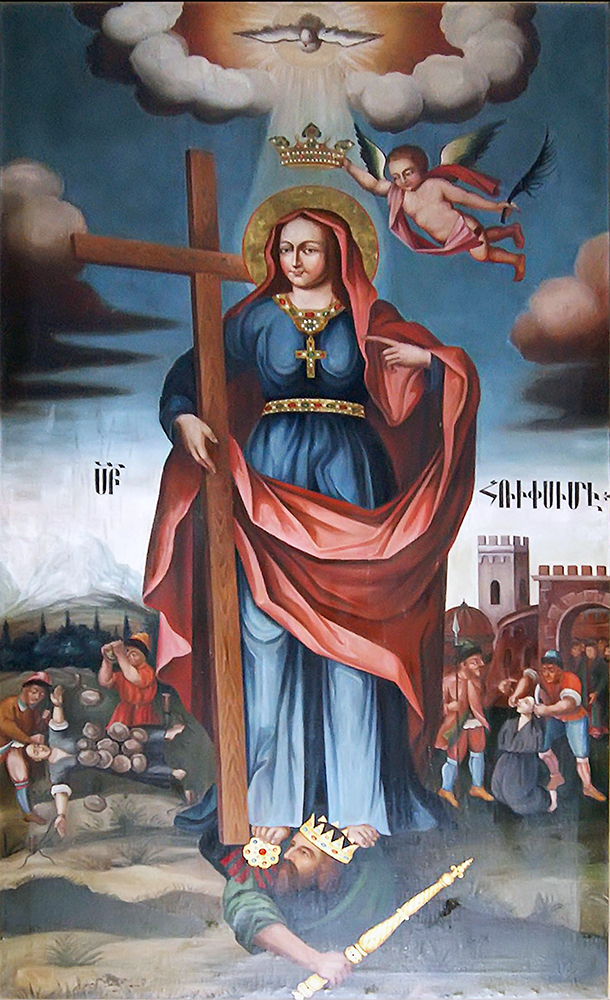
Ripsimia is shown as a virgin-martyr with the cross, often crowned from heaven, and in Armenian art frequently trampling the crowned figure of Tiridates, with scenes of the company's stoning and beheading beside her; Gaiana appears as an aged nun-eldress among her virgins. The great narrative cycle of their martyrdom is painted in the church of Saint Gregory of Tigran Honents at Ani (1215). The stored image is the 18th-century painting of Saint Hripsime by Hovnatan Hovnatanian (1730s–1801/02) in her church at Vagharshapat: the crowned virgin with the cross, Tiridates beneath her feet, the stoning and beheading of the companions in the background. A second image, ripsimia-gaiana-and-companions-2.jpg, is a photograph of the Ani fresco of the beheading of the virgins (fresco of 1215; photograph CC BY-SA 4.0, Dosseman, via Wikimedia Commons).
Disputed questions
- Date of the martyrdom. The OCA gives 292, within Diocletian's reign; the Armenian chronology places the martyrdoms immediately before the conversion of Tiridates, c. 300–301; the Russian calendar prints "beginning of the fourth century." The traditional Armenian sequence (martyrdom → affliction of the king → healing by Gregory → conversion c. 301) is followed here, with the date given as c. 300. Scholarship that redates the conversion to c. 314 (see the Gregory entry) would move the martyrdoms correspondingly later.
- The numbers and names. The Greek synaxarion counts Ripsimia, Gaiana, thirty-two virgin-martyrs styled ὁσιομάρτυρες, two further ascetic women, and seventy men; the Slavic books count thirty-five virgins with the two chief martyrs; the Armenian tradition speaks of thirty-seven in all. No roll of names is transmitted beyond the two leaders; this entry follows the group-commemoration rule and asserts no definitive list.
- Place of the community's origin. Agathangelos and the Armenian tradition bring the virgins from Rome; the OCA synaxarion says they lived "in a community of women in Asia Minor." The flight to Armenia and the martyrdom at Vagharshapat are common to all sources.
- Not to be confused with the martyr Gaiana commemorated with Philemon and Fortunianus among the pending Greek-synaxarion entries of September 27 — a different martyr of a different company.