
Romanus of Antioch and Barulas
The Holy Martyrs Romanus the Deacon and the Child Barulas
Martyr · Deacon · Child Martyr · d. 303
Commemorated 18 November — Martyrdom at Antioch
Romanus (†303) was a deacon of the church of Caesarea in Palestine who, during the Great Persecution, was staying at Antioch and there boldly resisted the demolition of the churches and denounced the pagan sacrifices before the prefect. Tortured, condemned to the fire, saved from it by a sudden rain, and finally deprived of his tongue and strangled in prison, he became one of the most celebrated martyrs of the age, honoured by a homily of John Chrysostom and a long hymn of Prudentius. His memory is inseparable from that of Barulas, a small child who, brought forward in the trial, confessed the one true God, shamed the idolaters, and was beheaded while his mother urged him on. The two are commemorated together on November 18.
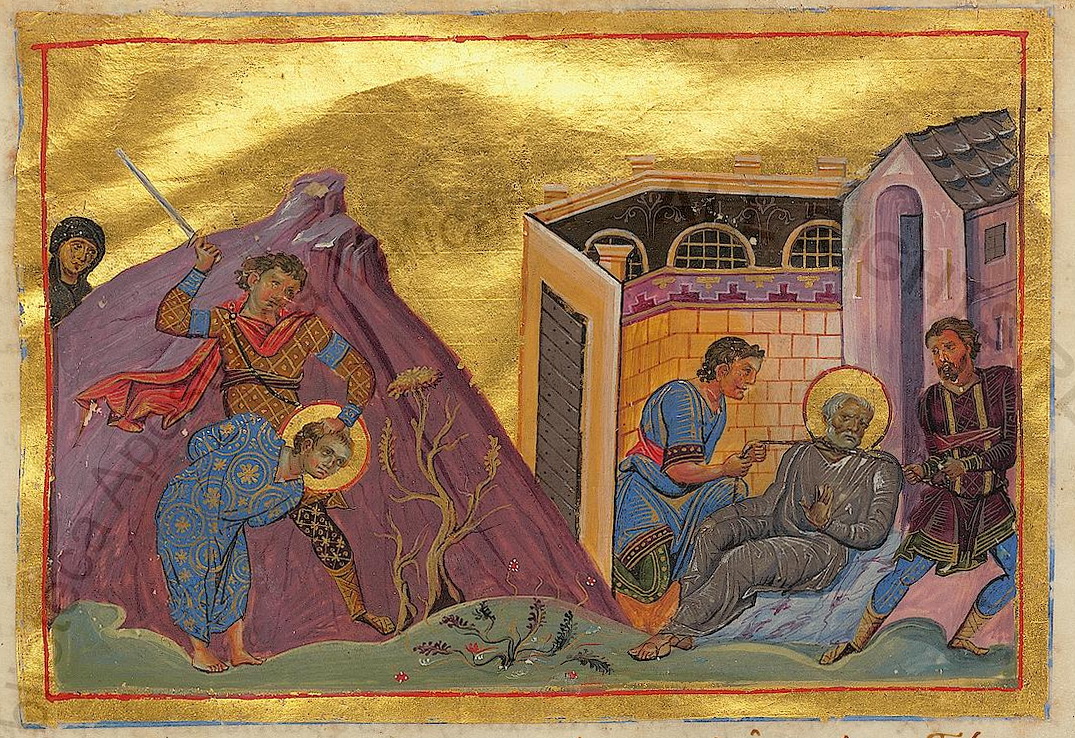
.jpg)
Romanus the deacon
The principal witness to Romanus is the contemporary record of Eusebius of Caesarea, who reports his death among the martyrs of the persecution begun under Diocletian and Galerius in 303. A native of Palestine and a deacon (and, in Eusebius, also an exorcist) of the church of Caesarea, Romanus happened to be at Antioch when the edicts against the Christians were published and the authorities set about pulling down the churches. He went among the faithful and strengthened them to resist the destruction of the house of God, telling them that even should they die in the attempt they would sing a hymn of victory in heaven.
While a festival of the idols was being kept, Romanus went into the temple precinct to reproach the prefect — named in the synaxaria as Asclepiades — and the crowd for their impiety, proclaiming as the prefect approached that the idols were nothing and that Jesus Christ alone was truly God. Asclepiades ordered him beaten and pressed him to recant; when he would not, the martyr was suspended and his sides raked with iron. He was then condemned to be burned alive, but as the pyre was kindled a fall of rain quenched it. The prefect next ordered his tongue cut out, because he still confessed Christ and mocked the idolaters — and the tradition marks it as a wonder that, tongueless, he went on speaking as before. Finally Romanus was fastened in his cell and strangled, completing his martyrdom in the year 303.
Barulas the child
Bound up with Romanus's passion is the confession of a young child, whom the Greek tradition names Barulas. During the interrogation Romanus told the prefect that a little boy in the crowd knew God better than the magistrate did, for the child worshipped the true God while the prefect did not. Challenged as to which gods he served, the boy answered that he worshipped Christ, and that the prefect's gods were demons who had made nothing — and with such words he put the idolaters to shame. Unable to shake him, Asclepiades had the child tortured; his mother stood by and encouraged him, bidding him not to fear death, for he would not die but live for ever and behold the glory of Christ. After the child was beheaded, his mother took up his body and buried it, rejoicing that he had poured out his blood for Christ.
Hymnographic and literary legacy
Romanus's fame in the early Church was extraordinary. John Chrysostom preached a panegyric on the martyr Romanus; and the Latin poet Prudentius devoted to him the tenth and by far the longest hymn of his Peristephanon ("Crowns of Martyrdom"), a work of over a thousand lines that dwells especially on the severing of the martyr's tongue and his continued speech, and that incorporates the episode of the confessing child. Through these two great authors, Greek and Latin, the memory of Romanus of Antioch passed into the common inheritance of East and West.
Feast and commemoration
November 18 (church date; Old Calendar civil December 1), within the Nativity Fast. The feast is kept universally in the Byzantine rite, and the day's service joins Romanus (with Barulas) to the Martyr Plato under a common troparion of martyrs.
Hymns
Troparion — Tone 4
Thy martyrs, O Lord, in their contest received incorruptible crowns from Thee, our God; for, possessed of Thy strength, they cast down the tyrants and shattered the feeble insolence of the demons. By their prayers, O Christ God, save our souls.
Original translation from the Slavonic
Iconography
Romanus is shown as a deacon-martyr, and in the illustrated synaxaria at the scene of his passion. The stored image is his miniature from the Menologion of Basil II (Constantinople, c. 1000), depicting the martyr at his execution; the child Barulas is not included in that miniature. In Western art the pair became the subject of Francisco de Zurbarán's paired canvases of Saint Romanus and Saint Barulas (1638), which show the deacon holding the scroll of his confession beside the young boy — a Baroque painting, not an Orthodox icon.
Disputed questions
- Romanus's see and place of death. He is styled both "of Caesarea" (where he was deacon) and "of Antioch" (where he suffered); Eusebius and the synaxaria agree on both facts. He is not to be confused with Romanus the Melodist, the sixth-century hymnographer of Constantinople (commemorated October 1), nor with Romanos of Cilicia, the fifth-century ascetic (commemorated November 27) — both wholly distinct saints.
- Barulas as a separate commemoration. Some calendars, including the Lives of the Orthodox Church in America, carry Barulas as his own entry; the liturgical tradition treats the child and the deacon as one commemoration, and they are joined here accordingly.