
Sabbatius of Solovki
Our Venerable Father Sabbatius, Wonderworker of Solovki
Venerable · Wonderworker · d. 1435
Commemorated 8 August — Translation of the relics with Zosimas into the Transfiguration cathedral, 1566, 27 September — Repose at the chapel on the Vyg, 1435
Sabbatius of Solovki (†1435) was the first hermit of the Solovki islands in the White Sea and, with Herman and Zosimas, is venerated as a founder of the great Solovetsky monastery, the fortress of monasticism in the Russian far north. A monk of the White Lake monastery of Cyril and then of Valaam on Lake Ladoga, he twice fled the esteem of the brethren, and in old age crossed the harsh sea with the hermit Herman to settle the uninhabited island. After six years of struggle there he reposed on September 27, 1435, at a chapel on the river Vyg, having sought out the Holy Mysteries in his last days; his relics were later carried to the monastery his successors built.

From the White Lake to Valaam
Nothing certain is transmitted of Sabbatius's birth or origins; he first appears as a monk of the monastery of Cyril at the White Lake (Kirillo-Belozersky), which the tradition the OCA follows has him entering in 1396, in the founder's own generation. There he was tonsured and long pursued the ascetic life, distinguished among the brethren by humility, gentle love and strictness of life, and fulfilling every obedience without question. The esteem of monks and laity alike began to weigh on him, and hearing of the rocky island of Valaam on Lake Ladoga he removed there. At Valaam the same renown followed him; and when he learned that far to the north, two days' sail into the White Sea, lay the great uninhabited island of Solovki, he asked the igumen's blessing to go and live there in solitude. The igumen and brethren would not be parted from him, and Sabbatius — the accounts say at the command of God — left Valaam by night.
The crossing with Herman
Reaching the coast of the White Sea, Sabbatius questioned the local people about the island: it was two days off, rich in lakes, and empty of men. To those who marvelled that a grey-haired elder should attempt such a life he answered that his Master gives the frail the fresh strength of youth and feeds the hungry to satiety. For a time he stayed at a chapel at the mouth of the river Vyg, in the district of Soroka; there he met the hermit Herman (Germanus), and the two resolved to settle the island together. In a frail boat, praying, the elders crossed the harsh sea in three days and landed on Solovki, where they set up a cross and built cells by the Sekirnaya hill. This settlement is dated to 1429.
The struggle on the island
The two elders hallowed the empty island with their labours in the severe conditions of the north. The tradition preserves the sign by which the island was kept for monks alone: a fisherman who came over with his wife to settle near the ascetics fled after two radiant youths appeared to his wife and struck her with rods, declaring the place appointed for the dwelling of monks. Sabbatius lived on the island some six years.
Repose
When Herman had gone to the Onega river for supplies, Sabbatius, alone and sensing his end near, prayed that he might partake of the Holy Mysteries before death, and sailed two days to the mainland. Ten versts from the Vyg he met the igumen Nathanael, who was travelling to commune a sick Christian; Nathanael heard his account of the island and communed him, and they agreed to meet at the chapel by the Vyg. There the elder gave thanks for the Mysteries, enclosed himself in a cell by the church, and prepared for death. A Novgorod merchant, John, put in to shore, venerated the icons, and sought the elder's blessing, offering him a share of his wealth and grieving at his refusal; to comfort him Sabbatius bade him stay until morning, promising him a prosperous onward journey, and when the merchant would nevertheless have sailed, an earthquake and a storm on the sea held him. In the morning, entering the cell for a blessing, he found that the elder had reposed in the night — September 27, 1435. Nathanael and John buried him at the chapel.
Relics and translations
The next year Zosimas, who had met Herman on the coast, crossed to Solovki and founded on the island the cenobitic monastery whose igumen he became; he had never seen Sabbatius in the flesh, but venerated him as the island's first ascetic. About 1465 the monastery brought Sabbatius's relics from the Vyg chapel to Solovki and laid them behind the altar of the church of the Dormition. On August 8, 1566, the relics of Sabbatius and of Zosimas together were translated into a chapel of the monastery's new Transfiguration cathedral — the feast the calendar keeps as their joint translation. The two founders were glorified for church-wide veneration at the Moscow council of 1547 under Metropolitan Macarius.
Veneration and later cultus
Zosimas and Sabbatius became one of the most beloved pairs of the Russian calendar, "the adornment of monks" of the far north, invoked by seafarers of the White Sea and painted together across Russia presenting their island monastery to Christ or the Mother of God. The Solovetsky monastery they began grew into one of the greatest houses of Russian monasticism; its patericon opens with their Lives. With Herman they head the synaxis of the Solovki saints (August 9), and the monastery's memory survived even its twentieth-century transformation into the first great Soviet prison camp, whose new martyrs are venerated alongside the founders.
Feast and commemoration
September 27 (church date; Old Calendar civil October 10), the day of his repose in 1435, is the principal feast, kept by the Russian Church and throughout the Russian tradition (OCA and Moscow Patriarchate calendars, both verified live); August 8 commemorates the translation of his relics with Zosimas (1566), and the two founders are also honoured together with Herman in the synaxis of the Solovki saints on August 9. The feast is not part of the Greek calendar for this day, whose sanctoral service belongs to the martyr Callistratus.
Hymns
Troparion — Tone 3
Withdrawing from the world and making thy dwelling in the wilderness, thou didst strive with a good struggle — by suffering hardship, by watchfulness and by prayers; wherefore also after death thou pourest forth healings, O Sabbatius our father. Pray to Christ God that our souls may be saved.
Original translation from the Slavonic
Kontakion — Tone 2
Fleeing the tumult of this life, thou didst make thy dwelling on an island of the sea, O wise one; and taking thy cross thou didst follow Christ, in prayers and vigils and fastings wearing down thy flesh with hard discipline. Wherefore thou wast the adornment of the venerable; and so with love we keep thy memory, O venerable Sabbatius: pray without ceasing to Christ God for us all.
Original translation from the Slavonic
Iconography
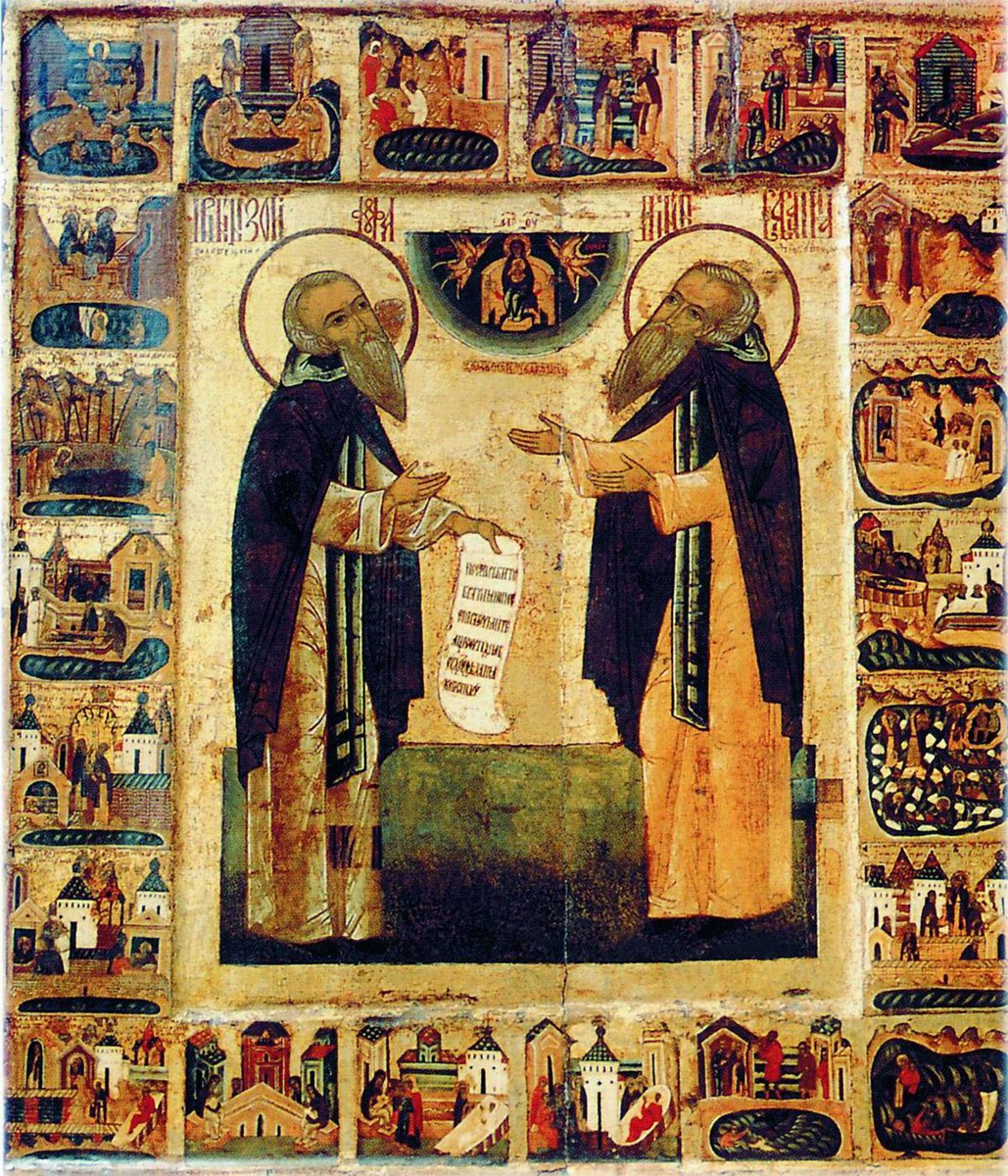
Sabbatius is painted as an aged monastic elder with a rounded grey beard, in schema or mantle, most often side by side with Zosimas, the two presenting a model of the Solovetsky monastery — set on its island in a stylised sea — to Christ or to the Mother of God above. The stored image is a sixteenth-century Russian icon of the two founders together; Sabbatius by convention stands with Zosimas, the pair scarcely ever painted apart.
Disputed questions
- Chronology. The dates rest on the monastery's own tradition, written down in the later fifteenth and sixteenth centuries: 1396 for the arrival at the White Lake, 1429 for the landing on Solovki, 1435 for the repose, c. 1465 for the translation to the island. The early dates in particular are conventional.
- Not to be confused with the martyr Sabbatius of the company of Trophimus and Dorymedon (†c. 276, commemorated September 19, eight days before this feast), an entirely different saint of the early Church; nor with Sabbatius of Tver, the fourteenth–fifteenth-century founder of the Savvatiev hermitage.