
Herman of Solovki
Our Venerable Father Herman, Wonderworker of Solovki
Venerable · Wonderworker · b. Totma, in the Vologda country — d. 1479, at the Antoniev monastery in Novgorod
Commemorated 30 July — Uncovering of the relics, 1484 — his principal commemoration, 8 August — Kept with Zosimas and Sabbatius among the saints of Solovki
Herman was the first of the three founders of Solovki to reach the islands and the last of them to die: an unlettered hermit of the Karelian coast who was living by a chapel on the river Vyg when Sabbatius came north in 1429 looking for a place of solitude, and who told him of the empty island in the White Sea. The two crossed the sea together and settled under the Sekirnaya Hill, and lived there six years. After Sabbatius' repose Herman brought the young Zosimas across in 1436 and stayed with him while the monastery grew up around them; he was on the islands for more than fifty years, and outlived them both. Unable to read or write, he did the one thing that has mattered most to posterity: he called clerics and dictated his memories of Sabbatius and Zosimas, so that the Life of the founders of Solovki rests on the testimony of an eyewitness. He died at Novgorod in 1479 on one of the supply journeys he was still making in old age; when in 1484 his grave was opened to bring him home, the relics were found incorrupt, and that finding is his feast.

The hermit on the Vyg
Nothing certain is known of Herman's birth beyond the tradition that he came from Totma in the Vologda country and was of simple people. He was unlettered — the sources say so plainly and repeat it — and he had gone north, as a certain kind of Russian ascetic did in that century, into the empty Karelian lands along the Vyg, where he lived by a chapel among the fishermen and hunters of the coast. He knew the sea and the islands off it, and among the islands the great uninhabited Solovki, two days' sail out into the White Sea, which the coast people used for summer fishing and left alone in winter.
The crossing with Sabbatius, 1429
In 1429 a monk came north to the Vyg: Sabbatius, an elder of Valaam and before that of Belozersk, who had left both houses because they were too much visited and was looking for a place where no one would come. He and Herman fell into conversation, and Herman told him of Solovki — how large it was, how well watered, how far from men. The two got a boat, crossed the sea, and landed on the great island, and set up a cross and a cell beneath the Sekirnaya Hill (Sekirnaya Gora, the "Hatchet Height") on the northern shore. There they lived six years, the first monks of Solovki: a Greek-trained hesychast and a fisherman's hermit, keeping the rule between them.
Herman was away on the mainland when Sabbatius, feeling his end, crossed to the coast alone and reposed at the chapel on the Vyg on 27 September 1435.
The founding of the monastery with Zosimas
The next year Herman met on the coast a young monk from Novgorod, Zosimas, and told him of the island as he had told Sabbatius; and in 1436 the two crossed over together. The account of what followed — the pillar of light Zosimas saw, the building of the first church of the Transfiguration, the grant of the islands by the Novgorod republic, the gathering of brethren — belongs to Zosimas' Life (his feast is 17 April). Herman's part in it was the part he had played from the beginning: he knew the country, he could handle a boat, and he stayed.
He remained on Solovki, all told, more than fifty years, through the whole formation of the monastery, under Zosimas as abbot and under his successors. Well into old age he went on making the long and dangerous voyages to the mainland for the house's supplies and business — the White Sea crossing in an open boat is not a young man's journey — and it was on one of these that he died.
The books, and what an unlettered man left
The most consequential thing Herman did he could not do himself. Knowing that he alone had seen the beginnings, and that the memory of Sabbatius would perish with him, he summoned clerics and dictated to them everything he could recall — of Sabbatius, of Zosimas, of the crossings and the first years and the events of their lives. Out of those dictated notes the Life of Zosimas and Sabbatius was afterwards composed, the foundation document of Solovki and one of the more solidly attested monastic origin-narratives of northern Russia. The tradition adds that Herman loved to hear edifying books read aloud, and that his last charge to his disciples was that they should gather books for the monastery — the instruction of a man who could not read and knew exactly what he had been denied.
Repose and the finding of the relics
In 1479, on a journey to Novgorod on the monastery's business, Herman fell ill and reposed at the Antoniev monastery in the city. The brethren set out to carry his body home to Solovki, but the season broke against them; the roads and the water were impassable, and they were forced to bury him where they had got to — at a chapel in the village of Khavronino on the river Svir.
Five years later, in 1484, it was determined to move the grave to the place where he had laboured. The coffin was opened and the relics were found incorrupt; they were carried at last to Solovki and laid there, and afterwards enshrined in a chapel of his own. That uncovering, on 30 July 1484, is the day the Church keeps for him.
Veneration
Herman is venerated as the third of the Solovetsky wonderworkers, with Zosimas and Sabbatius, and shares in the honour that made their monastery one of the great centres of the Russian north — the fortress-abbey of the White Sea, its salt and its fisheries, its libraries, and, in the twentieth century, its transformation into the first camp of the Soviet penal system, in which the monastery's own new martyrs suffered. His relics remained at Solovki until that closure; his chapel and his memory were restored with the monastery after 1990.
Feast and commemoration
July 30 (church date; New Calendar civil July 30; Old Calendar civil August 12) — the uncovering of the relics of 1484, and his principal commemoration, since no separate day is kept for his repose. The day stands in the free season immediately before the Dormition Fast, which opens on August 1. He is kept also with Zosimas and Sabbatius on August 8, the day of the great translation of their relics into the Transfiguration cathedral in 1566, and among the Synaxis of the Saints of Solovki in the Russian calendar. The commemoration is Russian rather than universal: the Greek and Antiochian books do not carry it, and the office is the common of a venerable father with the proper Russian troparion and kontakion.
Hymns
Troparion — Tone 8
By a flood of tears thou didst make the barren desert fruitful, and thy longing for God brought forth fruit a hundredfold; thou becamest a beacon on the island of the sea, shining upon the north with signs and wonders. O our father Herman, intercede with Christ God that our souls may be saved.
Original translation from the Slavonic
Kontakion — Tone 2
Thou didst show the desert of the sea to those who sought it, and didst remain there when they had gone to their rest; and having no letters thyself, thou didst leave the memory of the fathers to the Church in written words. Wherefore Solovki honours thee, O Herman, as its first-comer and its faithful servant.
Original translation from the Slavonic
Iconography
Herman is painted as a venerable father of the Russian north: an elderly monk with a long, broad, slightly forked grey or brown beard, in the mantia or in the schema, his head uncovered or in the koukoulion, one hand raised in prayer or blessing and the other holding a scroll. He belongs above all to the group icon of the Solovetsky wonderworkers, where he stands with Zosimas and Sabbatius — the three of them ranged side by side, or the two founders holding a model of the monastery between them with Herman beside — and to the great Solovki panels in which the island, its walls and its churches are painted beneath the saints. He is the least individuated of the three, and is told from them chiefly by his inscription.
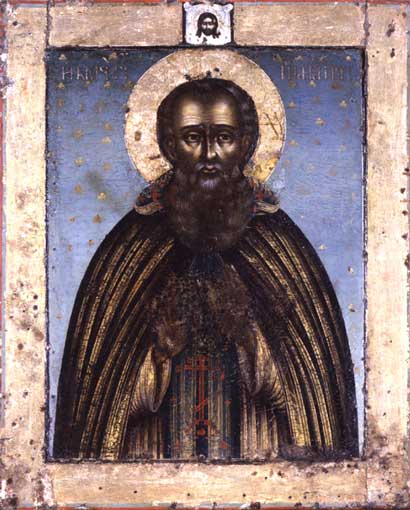
The stored image is a Russian icon of the late 18th or early 19th century, inscribed across the top ПРПБНЫЙ ГЕРМАНЪ — "the venerable Herman": the saint bust-length against a blue ground strewn with gold stars, in the dark ribbed mantia with the schema-cross on his breast, his hands folded before him, a small image of the Saviour Not-Made-by-Hands set in the gilded border above.
Disputed questions
- Which of the three came first? Popular reckoning names the monastery for Zosimas and Sabbatius, whose Life and whose joint feasts carry the cult, and Herman is often described as their companion or servant. Chronologically the order is the other way round: Herman was on the coast before either of them, brought Sabbatius across in 1429 and Zosimas in 1436, and was the only one of the three present at both beginnings. The reason for the imbalance is transparent — he was unlettered and held no office, and the hagiographic tradition attaches to founders and abbots.
- The date of his repose. 1479 is the year given by the Solovki tradition and the Russian calendars; a minority of notices give 1477 or 1484, the last evidently confusing the repose with the uncovering of the relics five years later.
- Not to be confused with the other Hermans of the Russian calendar: Herman of Kazan (†1567), archbishop of Kazan; Herman of Alaska (†1837), the monk of Valaam and Kodiak; and Herman of Valaam, the companion of Sergius and co-founder of Valaam. Reciprocal notes stand in those entries.