
Sabinus of Egypt
The Holy Martyr Sabinus of Hermopolis in Egypt
Martyr · d. c. 287, at Hermopolis in Egypt
Commemorated 13 March — Martyrdom by drowning in the Nile at Hermopolis, 16 March — Greek Menaion commemoration of the martyr of Hermopolis (the same saint kept on March 13 in the Slavic calendar)
Sabinus (†c. 287) was a martyr of Hermopolis in Egypt — a leading citizen, and by some accounts the governor of the city, who in the persecution laid aside his rank and hid himself with a company of fellow-Christians in a house outside the town. Betrayed for two pieces of gold by a beggar whom he had fed in his need, he was seized, brought before the persecutors, tortured for his confession of Christ, and at the last drowned in the waters of the Nile. His memory is a parable of the treachery repaid for kindness and the crown won through it, and the Church keeps him on March 13.

Sabinus belonged to Hermopolis (Hermopolis Magna, in the Thebaid of Upper Egypt), where he was a man of the first rank — the tradition remembers him as a distinguished citizen, and some notices as the governor of the city. When the persecution of Christians was published (the synaxaria set his contest about the year 287, in the age of Diocletian and Maximian), Sabinus, unwilling either to deny Christ or to court arrest, withdrew from the city and hid himself, with a number of like-minded believers, in a house in a village at some distance, where they continued in prayer and fasting, waiting upon God.
His refuge was betrayed by an act of black ingratitude. A certain beggar, to whom Sabinus had often given food and alms in his need, learned where he was hidden, and — for the price of two pieces of gold — went to the persecutors and disclosed the place. Soldiers came and took Sabinus and his companions. Brought before the governor, Sabinus confessed himself a Christian and would not sacrifice to the idols; he was tortured to break his constancy, and, standing firm, was condemned to death. He was cast into the river Nile and drowned, receiving the martyr's crown; his companions, the tradition holds, suffered with or after him. The betrayal by the man he had fed is the detail the Church has never forgotten — the poor man's bread returned as a Judas-price — and it frames the martyr's death as the innocent victory of charity over treachery.
Feast and commemoration
Sabinus is commemorated on March 13 (church date; Old Calendar civil March 26) in the Slavic (Russian) calendar and in the OCA synaxarion, together with the translation of the relics of Nicephorus of Constantinople, the hieromartyr Publius of Athens, and the martyr Christina of Persia. Because March 13 falls within the Great Fast, its commemoration is generally kept on a weekday of Lent, when the full Liturgy is not served and no fixed Epistle and Gospel are appointed; the martyr's office is joined to the Lenten order.
Hymns
Troparion — Tone 3
Thy holy martyr Sabinus, O Lord, through his contest has received an incorruptible crown from thee our God; for having thy strength, he laid low his persecutors and shattered the powerless boldness of the demons. By his intercessions save our souls.
Original translation from the Greek
Iconography
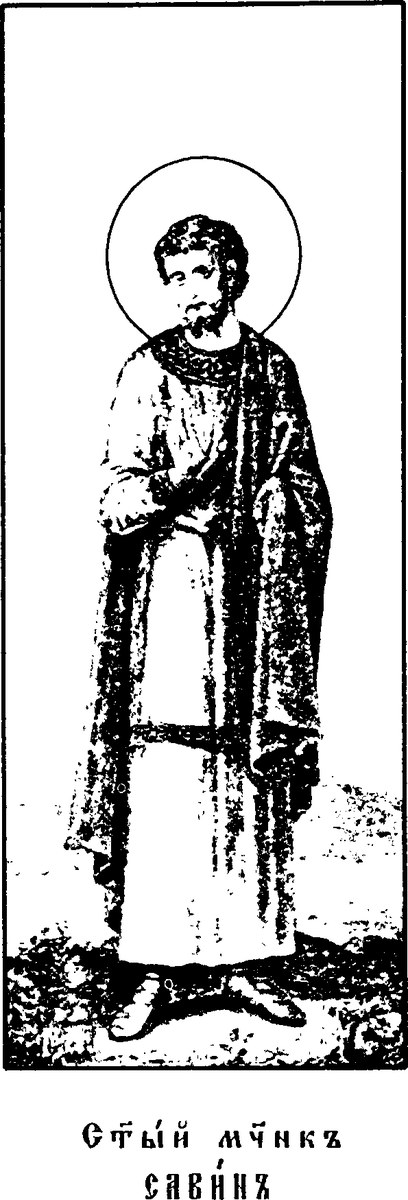
Sabinus is depicted as a lay martyr — a man of middle years in the tunic and cloak of a citizen (or, where his rank is stressed, in the chlamys of a magistrate), holding the cross of martyrdom; in narrative form he is shown cast into the river, or betrayed by the beggar at the door of his refuge. The stored image is the captioned plate of the illustrated Zhitiya Svyatykh (1903–1911).
Disputed questions
- March 13 or March 16. The martyr Sabinus of Hermopolis is kept on March 13 in the Slavic (Russian) calendars and the OCA synaxarion (the day followed here), and on March 16 in the Greek Menaion and synaxaria; the two dates commemorate the one martyr of Hermopolis, a genuine cross-calendar variance rather than two saints. (Where a Greek-tradition entry is authored for March 16, this file is its March 13 counterpart and should be reconciled, not duplicated.)
- Rank and office. The sources differ on whether Sabinus was the governor of Hermopolis or simply a leading citizen; the martyrdom — the flight, the betrayal by the beggar, the torture, and the drowning in the Nile — is constant.
- Not to be confused with the martyr Sabinus of Catania or the several other saints of the name; this Sabinus is the Egyptian martyr of Hermopolis, drowned in the Nile.