
Nicephorus of Constantinople
Our Father among the Saints Nicephorus the Confessor, Patriarch of Constantinople
Confessor · Patriarch · Bishop · b. c. 758, at Constantinople — d. 828, in exile at the monastery of Saint Theodore near Chrysopolis
Commemorated 13 March — Return of his relics from exile to Constantinople under the Empress Theodora (846), 2 June — Repose in exile at the monastery of Saint Theodore
Nicephorus the Confessor (c. 758 – 828) was Patriarch of Constantinople from 806 to 815 and, after Tarasius, the second of the great iconodule patriarchs to lead the Church. Born of a confessing family — his father had suffered exile for the holy icons — he served as imperial secretary, took part in the Seventh Ecumenical Council as a lay commissioner, and was raised from the lay state to the patriarchal throne. When the emperor Leo V the Armenian revived iconoclasm, Nicephorus resisted to his own ruin: refusing to surrender the images, he was deposed in 815 and exiled across the Bosphorus, where for thirteen years he wrote the great refutations of the heresy — and where, with his Breviarium and chronological tables, he left works of history besides. He reposed in exile in 828. After the Triumph of Orthodoxy (843), the Empress Theodora and Patriarch Methodius brought his relics home to the capital on 13 March 846, incorrupt, and laid them among the patriarchs in the Church of the Holy Apostles. He is kept on June 2 (repose) and March 13 (the translation of his relics).

Origins and a confessing house
Nicephorus was born at Constantinople about the year 758, in the very depths of the first iconoclasm, into a family already marked by suffering for the icons. His father, Theodore, was an imperial secretary (ἀσηκρῆτις, asekretis) in the service of the iconoclast emperor Constantine V (Copronymus); a devout venerator of the holy images, he confessed the Orthodox faith openly, was scourged and twice sent into exile for it, and died a confessor in banishment at Nicaea. His mother, Eudokia, shared the confession and the exile. The son thus inherited the cause for which he would one day lose his throne: the household that formed him was one in which the veneration of the icons had already cost a father his liberty and his life.
He received the full education of the capital — grammar, rhetoric, and the sacred letters — and, following his father, entered the imperial chancery, rising to the same rank of imperial secretary. He served the empire in that office through the reign of Leo IV and into the regency of the Empress Irene, under whom the tide against the icons at last began to turn.
The Seventh Council, and the ascetic retreat
When Irene and the Patriarch Tarasius summoned the Seventh Ecumenical Council (Nicaea II, 787) to restore the veneration of the images, Nicephorus was present — not yet a churchman, but a lay commissioner representing the imperial government at the sessions, a young man of learning trusted with the affairs of the council that healed the first iconoclasm. The experience bound him for life to the doctrine the fathers there proclaimed, that the honour paid to the image passes to its prototype.
Not long after, he withdrew from public life. Renouncing the honours of the court, he founded and endowed monasteries on the eastern shore of the Bosphorus, toward the Propontis, and lived in one of them in ascetic retirement — still, remarkably, a layman, unordained, giving himself to prayer, study, and the writing of history. The tradition also sets him for a time over the greatest poorhouse (πτωχοτροφεῖον) of the capital, the charge of the city's destitute — so that when the Church called him, it called a man already tested in learning, in asceticism, and in the works of mercy.
From layman to patriarch (806)
The Patriarch Tarasius reposed on 25 February 806. The choice of a successor fell, by the will of the emperor Nicephorus I and the acclamation of clergy and people, upon the layman Nicephorus — a second elevation straight from the lay state to the patriarchal throne, following the very precedent Tarasius had set a generation before. Ordained in a few days through the intervening grades, he was consecrated Patriarch of Constantinople on 12 April 806 (Holy Pascha).
The promotion did not pass without opposition. The rigorists of the monastery of Stoudios, led by Theodore the Studite, questioned the elevation of a layman over the heads of the monastic clergy; and the quarrel deepened almost at once into the renewed "Moechian" controversy. Under pressure from the emperor, Nicephorus consented to a synod (806/809) that reinstated the priest Joseph — the same who had blessed the unlawful second marriage of Constantine VI, and whom Tarasius had refused to countenance. The Studites broke communion rather than accept the leniency, and for some years (until Joseph was again deposed under Michael I) the Church of Constantinople was troubled by the schism. The tradition honours both men as saints and records the disagreement without resolving it against either: Nicephorus governing by the economy of a peacemaker, Theodore contending for the strict letter of the canons — the very tension that had earlier divided Tarasius from the same monastery.
Patriarch and pastor
For nine years Nicephorus led the Church, under the emperors Nicephorus I, Michael I Rangabe, and then Leo the Armenian. He continued the work of Tarasius: a defender of the icons and of the Church's canons, a corrector of abuses, and a writer whose pen never rested. Where the emperors leaned toward harshness against dissenters, he counselled moderation; where the discipline of the clergy had slackened, he laboured to restore it. But the peace of the icons that his predecessor had won was not to last his lifetime.
The second iconoclasm, and the resistance of the patriarch
The emperor Leo V the Armenian (813–820), a soldier who ascribed the empire's military disasters to the veneration of the images, resolved to revive iconoclasm. He assembled a commission of scholars — chief among them the learned John the Grammarian, later himself an iconoclast patriarch — to comb the fathers for texts against the icons, and moved to reimpose the policy of Constantine V. Against this Nicephorus stood as the wall of the Church. He held all-night vigils with the faithful bishops and monks; he confronted the emperor face to face, defending the images from Scripture and the fathers and refusing to yield a word of the Council of Nicaea; when Leo demanded that the icons hung low be at least raised out of reach — a first concession toward their removal — Nicephorus resisted every compromise. To the emperor's claim to arbitrate the Church's doctrine he answered that matters of faith belong to the Church and her councils, not to the palace.
Leo would not be gainsaid. In March 815 the patriarch was deposed; refusing to sign the iconoclast profession, he was driven from the throne and sent into exile across the Bosphorus — first to the monastery of Saint Theodore, which he himself had founded near Chrysopolis, and afterward to the monastery of Saint Menas, another of his foundations. A packed iconoclast synod met in Hagia Sophia in 815, in the presence of the exiled patriarch's empty throne, and formally renewed the condemnation of the images, undoing the work of the Seventh Council; the second iconoclasm had begun, and would run for a generation.
The theologian in exile
The thirteen years of his banishment (815–828) were the years of his greatest writing against the heresy. From his cell Nicephorus composed the arsenal of iconodule theology of the second period: the Apologeticus Minor and the great Apologeticus Major, defending the making and veneration of the holy images; the three Antirrhetici ("Refutations") against the iconoclast arguments of Constantine V, whom he names only Mamonas and Kopronymos; and the Elenchos kai Anatropē — the "Refutation and Overthrow" — a point-by-point demolition of the definition of the iconoclast synod of 815. In these works he set out, with philosophical rigour, the Christological ground of the icon: that to deny that Christ can be depicted is to deny the reality of his Incarnation, since what has truly been seen and handled in the flesh can truly be portrayed.
To the same author the Church owes works of history, composed chiefly before his patriarchate. His Breviarium (Historia Syntomos, the "Short History") narrates the Byzantine story from the fall of the emperor Maurice in 602 to the year 769 — a spare, valuable, and unusually sober record of the very century of iconoclasm. His Chronographikon Syntomon is a compact chronological handbook, a table of the rulers and patriarchs from Adam to his own day, much copied and much translated in the Middle Ages. The confessor who lost his throne for the icons is thus also one of the significant historians of Byzantium.
Repose in exile
Nicephorus never saw the capital again. He reposed at the monastery of Saint Theodore, in exile, in the year 828, worn by age and banishment, having governed the Church nine years and suffered for it thirteen more. His repose is kept on June 2 — the sources vary on the precise civil day of his death, but the liturgical commemoration of his falling-asleep is fixed on that date. He was buried at the monastery of his exile, and there his body rested until the Church he had defended came at last into her own.
The Triumph of Orthodoxy and the return of the relics
The second iconoclasm outlived Nicephorus by fifteen years. It ended only with the death of the iconoclast emperor Theophilus in 842 and the regency of his widow, the Empress Theodora, for their child Michael III. Theodora, a secret venerator of the icons, deposed the iconoclast patriarch John the Grammarian, raised the confessor Methodius to the throne, and on the First Sunday of Lent, 11 March 843, restored the holy images in a great procession — the "Triumph of Orthodoxy" that the Church keeps to this day.
With the images restored, the relics of the confessors who had died in exile were brought home in honour. On 13 March 846 (some reckonings 847) the relics of Nicephorus were translated from the monastery of Saint Theodore across the Bosphorus back to Constantinople. The tradition dwells on the details: that the body, after some nineteen years in the tomb, was found incorrupt, whole and undecayed, a sign of the sanctity of the exiled patriarch; that the Empress Theodora, her son the young emperor, the Patriarch Methodius, and the whole city went out to meet the returning relics with lamps and hymns; that they were carried first into Hagia Sophia, the Great Church from which he had been driven, and then borne to the Church of the Holy Apostles and laid among the patriarchs of Constantinople. The day chosen for the translation, the tradition notes, fell on the very anniversary of his deposition in March 815 — so that the day of his humiliation became the day of his glory. This return is the feast of March 13.
Feast and commemoration
Nicephorus is commemorated on two days. His principal feast is June 2 (church date; Old Calendar civil June 15), the day of his repose in exile, on which his full office is sung in the Menaion. March 13 (church date; Old Calendar civil March 26) keeps the translation of his relics — their return from the place of his banishment to Constantinople under the Empress Theodora after the Triumph of Orthodoxy — and it is on this March feast that the Church remembers him together with the restoration of the icons for which he suffered. The Antiochian, Greek, and Slavic calendars keep both days. Because March 13 falls within the Great Fast, on most years its commemoration is kept on a weekday of Lent, when the full Liturgy is not served; the confessor's office is then joined to the Lenten order (see the note under Readings). Nicephorus is named besides among the confessors and fathers who defended the holy icons, whose common victory the Church celebrates on the Sunday of Orthodoxy, the First Sunday of Lent.
Hymns
Troparion — Tone 3
Thou didst bear in very deed the victory thy name foretells, O all-blessed Nicephorus: a teacher of the Orthodox faith, a defender of the sacred images, and a pillar unshaken of the Church of Christ. For the honour of the icon of the Lord thou didst endure deposition and long exile; wherefore, crowned as a confessor, intercede that our souls may be saved.
Original translation from the Greek
Kontakion — Tone 1
O initiate of heaven's mysteries and unshaken herald of Orthodoxy, thou didst shine upon the Church as her radiant star, and for the icon of Christ didst gladly bear thine exile; and now thy sacred relics, returning in glory to thy city, pour forth sanctification on them that cry: Rejoice, O Father Nicephorus, boast of the faithful.
Original translation from the Greek
Appointed readings
Epistle — Hebrews 7:26–8:2
26For such an high priest became us, who is holy, harmless, undefiled, separate from sinners, and made higher than the heavens; 27Who needeth not daily, as those high priests, to offer up sacrifice, first for his own sins, and then for the people’s: for this he did once, when he offered up himself. 28For the law maketh men high priests which have infirmity; but the word of the oath, which was since the law, maketh the Son, who is consecrated for evermore. 1Now of the things which we have spoken this is the sum: We have such an high priest, who is set on the right hand of the throne of the Majesty in the heavens; 2A minister of the sanctuary, and of the true tabernacle, which the Lord pitched, and not man.
Gospel — John 10:9–16
9I am the door: by me if any man enter in, he shall be saved, and shall go in and out, and find pasture. 10The thief cometh not, but for to steal, and to kill, and to destroy: I am come that they might have life, and that they might have it more abundantly. 11I am the good shepherd: the good shepherd giveth his life for the sheep. 12But he that is an hireling, and not the shepherd, whose own the sheep are not, seeth the wolf coming, and leaveth the sheep, and fleeth: and the wolf catcheth them, and scattereth the sheep. 13The hireling fleeth, because he is an hireling, and careth not for the sheep. 14I am the good shepherd, and know my sheep, and am known of mine. 15As the Father knoweth me, even so know I the Father: and I lay down my life for the sheep. 16And other sheep I have, which are not of this fold: them also I must bring, and they shall hear my voice; and there shall be one fold, and one shepherd.
Iconography
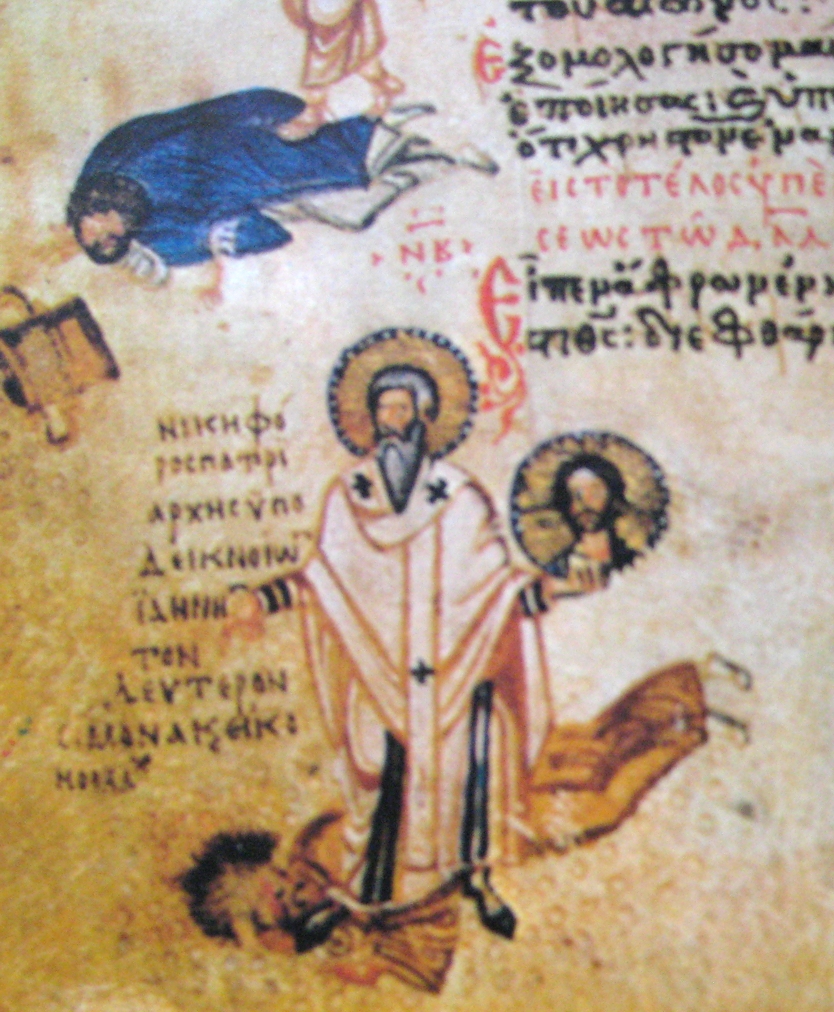
Nicephorus is depicted in the settled type of the great hierarch: an aged bishop, his hair and beard grey, vested in the phelonion or the cross-figured polystavrion, wearing the omophorion, blessing with his right hand and holding the Gospel-book in his left. As a confessor of the icons he is very often shown holding an icon of Christ — the sign of the doctrine for which he lost his throne — and in narrative scenes he appears trampling the iconoclast underfoot, or defending the images before the emperor, or receiving his relics in procession. He is included among the assembled fathers in the composite icon of the Triumph of Orthodoxy.
The stored image is a miniature from the Chludov Psalter (Constantinople, middle of the 9th century — within a generation of the saint), a monument of the iconodule party itself: the Patriarch Nicephorus, vested and haloed, stands holding the icon of Christ and treads upon the fallen iconoclast John the Grammarian, who lies amid scattered coins, while above, in a parallel scene, the Apostle Peter tramples Simon Magus — the visual manifesto of the victory of the icons over heresy, and the very theme of the saint's name. The Greek marginal inscription names him (ΝΙΚΗΦΟΡΟС ΠΑΤΡΙΑΡΧΗС) (source, public domain, pd-old-work).
Disputed questions
- The date and day of his repose. The year of his death is fixed at 828; the precise civil day is given variously in the sources (June 2 being the liturgical commemoration of his falling-asleep, while some catalogues note other days). The entry gives the year and keeps June 2 as the day of commemoration.
- The year of the translation. The return of the relics is dated 846 by most reckonings, 847 by some; the church date, March 13, is constant.
- Not to be confused with the third-century layman-martyr Nicephorus of Antioch (kept February 9), honoured for his forgiveness of the apostate Sapricius — a wholly different saint of an earlier age and no office; nor with the several later hierarchs named Nicephorus. "The Confessor, Patriarch of Constantinople, who suffered under Leo the Armenian" belongs to this Nicephorus alone.