
Salome the Myrrhbearer
The Holy Myrrhbearer Salome, Wife of Zebedee and Mother of the Sons of Thunder
Myrrhbearer · Righteous · d. 1st century, in peace
Commemorated 3 August — Memory of the holy myrrhbearer, who reposed in peace, Pascha offset 14
Salome is the wife of Zebedee and the mother of the apostles James and John, and one of the myrrhbearing women who followed Christ from Galilee, stood at the Cross when the disciples had fled, and came to the sepulchre before dawn with spices to anoint a body that was not there. The Gospels name her twice by name (Mark 15:40; 16:1) and twice more by description — the mother of the sons of Zebedee who asked for the two thrones (Matthew 20:20–21), and one of the women watching the crucifixion from afar (Matthew 27:56). The tradition makes her a kinswoman of the Theotokos, though it has never agreed on the degree. She lived to see her elder son become the first of the Twelve to be killed for Christ, and reposed in peace. She is commemorated on August 3, and with all the myrrhbearers on the movable Sunday of the Myrrhbearers.

Zebedee's wife
Salome (Σαλώμη, from the Hebrew shalom) belonged to the fishing families of the Sea of Galilee. Her husband Zebedee worked the lake with hired servants and with his two sons (Mark 1:20), and it was out of his boat, mending the nets, that James and John were called. That Zebedee could afford hired men, that Salome was afterwards among the women who "ministered unto Him of their substance," and that her son John was known to the high priest's household (John 18:15), together sketch a family of some standing rather than of poverty.
Of Zebedee nothing further is told; the Gospels leave him in the boat. Salome, by contrast, appears at each of the three moments that matter.
With Christ in Galilee, and the request for the thrones
Salome was among the Galilean women who followed Jesus and provided for the company out of their own means. The single scene the Gospels give her from the ministry is not a flattering one, and the Church has never trimmed it. Going up to Jerusalem, she came to Christ with her two sons, worshipped, and asked "that these my two sons may sit, the one on Thy right hand and the other on the left, in Thy kingdom" (Matthew 20:20–21). Mark reports the same request in the sons' own mouths (Mark 10:35–37); the two accounts are usually reconciled by taking the mother as the sons' spokeswoman.
The answer — ye know not what ye ask; are ye able to drink of the cup that I drink of? — is the hinge of her story, because both her sons in the end drank it: James first of all the apostles, beheaded by Herod (Acts 12:2), and John through exile and a life of witness. The fathers read the episode as a mother's love asking for the wrong throne and being given the right one, and it is characteristic of the Gospels that the woman who made the request is also the woman who stood by the Cross when the throne turned out to be a gibbet.
At the Cross and at the tomb
At Golgotha, Mark names her third among the women who beheld from afar — "Mary Magdalene, and Mary the mother of James the less and of Joses, and Salome" (Mark 15:40); Matthew, in the parallel, calls her "the mother of Zebedee's children" (Matthew 27:56). She was therefore present at the death, and knew where the body was laid.
When the sabbath was past she "bought sweet spices, that they might come and anoint Him" (Mark 16:1), and went at the rising of the sun with Mary Magdalene and Mary the mother of James to the sepulchre, asking one another who would roll away the stone. They found it rolled away, and a young man sitting on the right side in a white garment, who said to them: He is risen; He is not here. Salome is thus one of the very small number of human beings to whom the Resurrection was announced before it was preached, and one of those whose testimony the apostles at first refused to believe.
After Pentecost
The synaxarion carries her a little beyond the Gospels: that after the descent of the Holy Spirit she was conspicuous among the women of the Jerusalem church for zeal and for works of mercy, and that she bore the persecution of that church with grief but without wavering — including the execution of her elder son James by Herod Agrippa about the year 44, the first of the apostles to be killed. She reposed in peace, in the hope of the resurrection she had been the first to hear proclaimed. No place of burial and no relics are transmitted.
Feast and commemoration
August 3 (church date; New Calendar civil August 3, Old Calendar civil August 16). On this day Salome is a synaxarion commemoration — she has no proper office, and the day's service is that of the fathers of the Dalmatian monastery — but she is named in the Greek, Slavic, Antiochian and American calendars alike. The day falls within the Dormition fast (August 1–14).
Her principal liturgical honour is the Sunday of the Myrrhbearers, the third Sunday of Pascha, on which she is commemorated with Mary Magdalene, the other Marys, Joanna, and Joseph of Arimathea and Nicodemus. That commemoration is movable — it is fixed to the date of Pascha, not to a day of the month — and belongs to the rule 14 days after Pascha, not to any fixed calendar day.
Hymns
Troparion
The noble Joseph took down Thy most pure body from the tree, wrapped it in clean linen with sweet spices, and laid it in a new tomb; but on the third day Thou didst rise, O Lord, granting the world great mercy — and Thou didst say to the myrrhbearing women, Rejoice, proclaiming peace to Thine apostles and resurrection to the fallen.
Original translation from the Greek
Kontakion — Tone 2
Thou didst ask for a throne for thy sons, and wast taught to ask for the cup; and standing by the Cross thou didst see the kingdom thou hadst not understood. Wherefore, coming with myrrh at the dawn, thou wast the first to hear, He is risen: O Salome, mother of the sons of thunder, pray that we may seek the things above.
Original translation from the Greek
Iconography
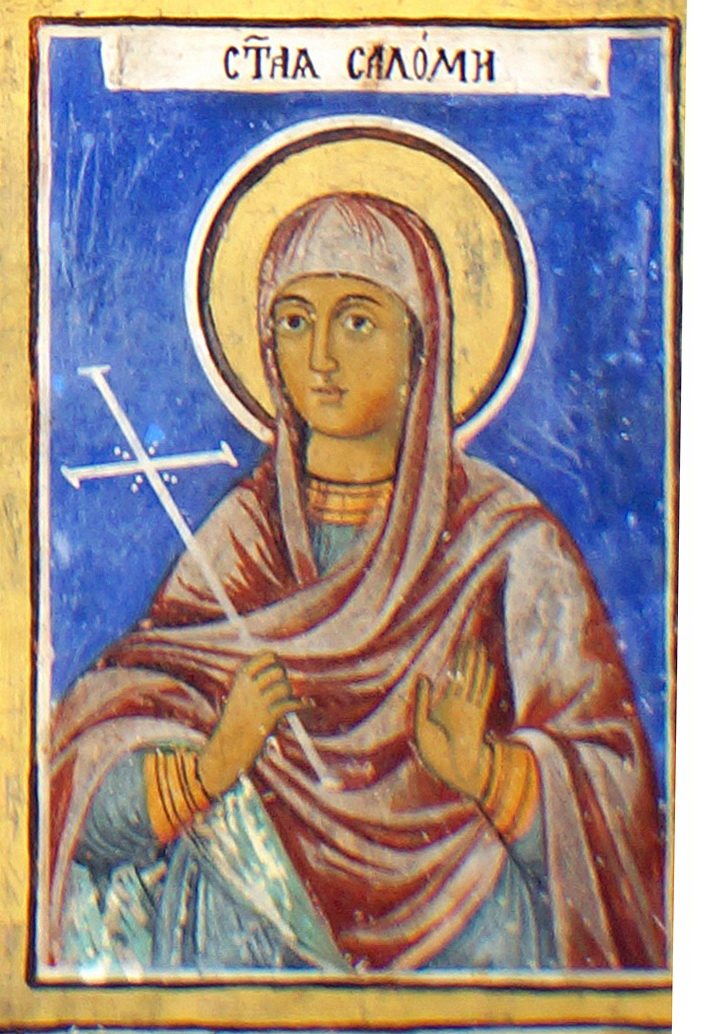
Salome is painted as a mature woman, veiled in the maphorion over a tunic, without the monastic cowl and without the martyr's crown. Two settings account for nearly every image of her. In the icon of the Myrrhbearers at the Tomb she stands with Mary Magdalene and the other Mary before the empty sepulchre and the seated angel, carrying the covered vessel of myrrh — the attribute that names the type. In the Crucifixion and Lamentation she is among the women behind the Theotokos. As a single standing figure — the form she takes in church programmes and on the borders of large festal icons — she is shown frontally with the hand raised in prayer or holding a cross, the general emblem of a saint of the New Testament, and identified by the inscription rather than by an attribute.
The stored image is a Bulgarian fresco-icon of 1843 from the west narthex of the Rila Monastery, painted by Dimitar Hristov and Zafir as part of the great series of saints framing the replica of the monastery's wonderworking icon. The saint is shown half-length against a deep blue ground within a gold border, veiled in a white cap under a red-brown maphorion, the right hand holding a slender white cross and the left raised open before her breast; the inscription in the panel above reads СТАѦ САЛОМИ. Her placement in the series immediately after Mary Magdalene confirms the identification as the myrrhbearer rather than any other Salome.
Disputed questions
- How was she related to the Theotokos? Three answers are current in the tradition, and
the calendars do not agree.
- Daughter of Joseph the Betrothed by his first marriage — the reading most common in the Greek synaxaria and in the older Slavonic tradition, which makes Salome a step-daughter of the Theotokos and a sister of James the Brother of the Lord.
- Sister of the Theotokos — from the identification of Salome with the unnamed woman of John 19:25, "His mother's sister," which would make James and John first cousins of the Lord and would explain both the boldness of the request for the thrones and the commending of the Theotokos to John from the Cross.
- First cousin of the Theotokos — the form given by the modern Greek synaxaristes and followed by the Orthodox Church in America. The three cannot all be true; they are probably successive attempts to account for the same datum, the closeness of the Zebedee family to the Lord's. The repository records all three and asserts none.
- How many women at the tomb, and which Salome. The lists of the myrrhbearers differ between the evangelists and between the synaxaria, which variously number them three, seven or eight. Salome is on every list.
- Not to be confused with Salome the daughter of Herodias, who danced for the head of the Forerunner and is no saint; nor with Salome the midwife of the apocryphal Nativity narratives; nor with Salome the Georgian of Ujarma (fourth century), the disciple of St Nino.