
James the Brother of the Lord
The Holy Apostle James the Brother of God (Adelphotheos), First Bishop of Jerusalem
Apostle · Hieromartyr · Bishop · b. 1st century BC (Judea) — d. c. 62 (Jerusalem)
Commemorated 4 January — Synaxis of the Seventy Apostles (James numbered at their head), 23 October — Martyrdom at Jerusalem, Sunday after nativity
James the Brother of the Lord (died c. 62) — styled by the Greek Church Adelphotheos, "Brother of God," and by the whole tradition "James the Just" — was the first bishop of Jerusalem and head of the mother church of Christendom for some thirty years. The Orthodox tradition knows him as a son of Joseph the Betrothed by an earlier marriage, and so the Lord's brother in the household of Joseph; Paul calls him simply "the Lord's brother" and counts him among the apostles and the "pillars" of the Church. He presided over the Council of Jerusalem (Acts 15), gave his name to the most ancient complete eucharistic liturgy still in use, and by his ascetic holiness and ceaseless prayer for his people earned the surname "the Just." According to Hegesippus he was cast down from the pinnacle of the Temple and clubbed to death; according to Josephus he was stoned by order of the high priest Ananus. His feast is October 23. He is distinct from James the son of Zebedee (April 30) and James the son of Alphaeus (October 9).

The Brother of the Lord
James enters the Gospels among the "brethren of the Lord." When Jesus taught in the synagogue of Nazareth, the townsfolk asked in offence, "Is not this the carpenter's son? … and his brethren, James, and Joses, and Simon, and Judas?" (Matthew 13:55; cf. Mark 6:3, which names the same four and speaks of sisters). John records that "neither did his brethren believe in him" (John 7:5) during the public ministry — a hard saying the tradition reads as belonging to the years before the Resurrection. That James came to faith is certain: Paul's list of the resurrection appearances includes, after Peter and the Twelve, that "he was seen of James" (1 Corinthians 15:7), and by the opening of Acts the brethren of the Lord are gathered with the apostles and the Theotokos in the upper room, awaiting the Spirit (Acts 1:14).
The exact sense of "brother" is one of the oldest questions of Christian prosopography, because it bears directly on the perpetual virginity of the Mother of God. Three constructions have been defended since antiquity, and the honesty of the record requires all three (see Disputed questions for the full analysis). The Orthodox answer — the Epiphanian view, held by the Christian East and enshrined in her calendar and hymns — is that James and the other "brethren" were children of Joseph the Betrothed by a wife who died before he was espoused to the Virgin; thus James was Joseph's son and the Lord's elder step-brother, reared in the same household, without any child being born of Mary but Christ. The Byzantine title Adelphotheos, "Brother of God," carries exactly this: brother not by nature of the Godhead, nor son of the Virgin, but of the Lord's earthly household through Joseph.
The tradition of Hegesippus, an early second-century Palestinian Christian whose memoirs Eusebius preserved, adds that James was "holy from his mother's womb": a Nazirite (Numbers 6) who drank no wine nor strong drink, ate no flesh, let no razor touch his head, took no oil and no baths, and wore linen alone. This ascetic sanctity, remembered from the first, is why the Church keeps him under the epithet "the Just" (ὁ Δίκαιος) and why the same Hegesippus called him also Oblias, interpreted "bulwark of the people."
First Bishop of Jerusalem
When the apostles scattered to their missions, James remained in the holy city as the settled head of its church. Clement of Alexandria (through Eusebius) records that "Peter, James and John, after the Ascension of the Saviour, though they had been preferred by the Lord, did not contend for the honour, but chose James the Just bishop of Jerusalem" — the son of Zebedee, Peter, and John yielding the local primacy to the Lord's brother. From that seat, for roughly thirty years, James governed the mother church, and to it Peter, delivered from prison, sent word: "Go shew these things unto James, and to the brethren" (Acts 12:17).
His authority is written across the record. When Paul went up to Jerusalem three years after his conversion, "other of the apostles saw I none, save James the Lord's brother" (Galatians 1:19). At the Apostolic Council (Acts 15), after Peter and Barnabas and Paul had spoken to the question whether Gentile converts must be circumcised, it was James who summed up and gave the decisive judgment — "Wherefore my sentence is, that we trouble not them which from among the Gentiles are turned to God" — grounding it in the prophet Amos and framing the apostolic decree that went out to the churches (Acts 15:13–29). Paul names him first of the three — "James, Cephas, and John, who seemed to be pillars" — as those who gave him and Barnabas the right hand of fellowship (Galatians 2:9); and it was the coming of "certain from James" to Antioch that occasioned Peter's withdrawal from the Gentile tables and Paul's rebuke of him (Galatians 2:12), a scene that shows how weightily the name of James fell even at a distance. On Paul's last visit to Jerusalem, "Paul went in with us unto James; and all the elders were present" (Acts 21:18), and it was James and the elders who counselled Paul to join in the Nazirite vow of four men and pay their charges, to show that he too "walkest orderly, and keepest the law" (Acts 21:20–24) — a portrait of James as the guarantor of a Jewish-Christian church still at home in the Temple.
Martyrdom
Two independent first- and second-century witnesses record the death of James, and the Church holds both.
Josephus, the Jewish historian, is the earliest and gives the plain fact. When the procurator Festus died in office (c. 62) and his successor Albinus had not yet reached Judea, the newly appointed high priest Ananus (Annas the Younger, a Sadducee) seized the interval: "he assembled the sanhedrin of judges, and brought before them the brother of Jesus, who was called Christ, whose name was James, and some others … and delivered them to be stoned" (Antiquities 20.200). The act was judged illegal — a high priest could not convene the council or inflict death without the Roman governor — and the more equitable citizens complained to Agrippa and to Albinus, for which Ananus was deposed after three months. This notice, undisputed as to the fact, fixes James's martyrdom to about the year 62 and sets it in the lawless gap between two governors.
Hegesippus, in the memoirs preserved by Eusebius, tells the fuller and more dramatic account the Church has loved. The scribes and Pharisees, alarmed that "the Just" was drawing many to faith in Jesus as the Christ, set him at Passover on the pterygion — the pinnacle or parapet — of the Temple and bade him, before the assembled multitude, turn the people away from Jesus. Instead James cried out that Christ is the Son of Man, seated at the right hand of the Great Power, and coming on the clouds of heaven. Enraged, they threw him down from the height; he was not killed by the fall, but rose to his knees and prayed, "Lord, forgive them, for they know not what they do," while they stoned him; and at the last a fuller — a launderer of cloth — struck him on the head with the club with which he beat out garments, and so he died. He was buried on the spot, by the Temple, and Hegesippus adds that "immediately Vespasian besieged them," reading the fall of Jerusalem as the sequel to the murder of the righteous man — as Origen and Eusebius report Josephus himself to have written, in a passage now judged a Christian interpolation.
The Church's iconography and hymnody hold the two accounts together: the casting-down from the Temple, the prayer for his murderers, and the club of the fuller. Hegesippus rounds the memory with the detail that gave James his most tender epithet: from his ceaseless kneeling in intercession for the people his knees had grown "hard like a camel's."
Relics and succession
James was buried where he fell, beside the Temple; Eusebius notes that his episcopal throne (cathedra) was still preserved and venerated at Jerusalem in the fourth century, a tangible link to the apostolic church. He was succeeded as second bishop of Jerusalem by Symeon the son of Clopas (April 27), a kinsman of the Lord, so that the leadership of the mother church passed within the family of Joseph. Portions of relics venerated as James's were dispersed in later centuries; in 1853 the Patriarch Hierotheos of Alexandria sent a part to Moscow, and other fragments are kept in Jerusalem and on the Holy Mountain.
The Liturgy of Saint James
To James, as first bishop and liturgist of the church of Jerusalem, the tradition ascribes the Divine Liturgy of Saint James — the oldest complete eucharistic rite to survive, and the parent from which the classical Byzantine liturgies descend. In its received form it carries later strata, but its core preserves the shape of the Jerusalem eucharist of the fourth century and earlier, described already by Cyril of Jerusalem in his Mystagogical Catecheses; the anaphora of St James is among the fullest and most ancient in Christendom, and its Cherubic Hymn — "Let all mortal flesh keep silence" (Σιγησάτω πᾶσα σὰρξ βροτεία) — has passed, through the Liturgy of the Presanctified and Western use, into the wider Church's worship. The Liturgies of St Basil the Great and St John Chrysostom, which supplanted it in ordinary Byzantine use, are in structure its heirs. The rite fell into near-disuse but was never wholly lost; it survived on the island of Zakynthos and in the Jerusalem Patriarchate, and was widely revived in the twentieth century. It is served pre-eminently on James's own feast, October 23, and in some places on the Sunday after the Nativity, keeping alive the memory of the apostle who first offered it. (The repository has as yet no dedicated liturgical entry to cross-reference; see Feast and commemoration.)
The Epistle of James
The New Testament preserves under his name the Epistle of James, the first of the "catholic" (general) epistles, addressed "to the twelve tribes which are scattered abroad." It is a work of Christian wisdom in the key of the Old Testament and the Sermon on the Mount: on the testing of faith, the bridling of the tongue, the sin of partiality to the rich, and — most famously — that "faith without works is dead" (James 2:20, 26), the text long set against a one-sided reading of Paul and much debated at the Reformation. Its counsel is homely and unforgettable: "Let every man be swift to hear, slow to speak, slow to wrath" (1:19); "Be ye doers of the word, and not hearers only" (1:22); and its charge to "call for the elders of the church" to anoint the sick with oil in the name of the Lord (5:14–15) is a scriptural root of the mystery of Holy Unction. The epistle's authorship was debated in the early Church — Eusebius lists it among the antilegomena, the "spoken-against" books whose canonicity was not everywhere secure, and modern scholarship divides between those who defend it as the work of James himself (or of a secretary writing his mind) and those who take it as a later composition issued under his authority; the Church received it as canonical and apostolic.
The Protevangelium of James
Distinct from the canonical epistle, and expressly pseudepigraphal, is the so-called Protoevangelium of James (the Protevangelion, or "Book of James") — a mid-second-century infancy narrative that falsely presents itself as written by James, "the son of Joseph." It is not received as scripture and its attribution to the apostle is a literary fiction of its unknown author. Yet it is of great importance for Orthodox tradition and liturgy: it is the principal source of the received accounts of the Theotokos's parents Joachim and Anna, of her miraculous birth and Entry into the Temple, and of the espousal of the aged widower Joseph — and it is the earliest witness to the Epiphanian view of the brethren, making them Joseph's sons by a first marriage. The Church has drawn freely on its pious traditions for the feasts of the Mother of God while never treating it as canonical, and it is recorded here as what it is: an ancient and influential but pseudonymous work.
Feast and commemoration
October 23 (church date; Old Calendar civil November 5) is the primary feast of James the Brother of the Lord, kept throughout the Byzantine rite with a full sung service; the Greek Menaion heads the day "Memory of the Holy Hieromartyr and Apostle James the Brother of God," styling him at once martyr, apostle, and first hierarch of Jerusalem. Where the tradition is kept, the Divine Liturgy of Saint James is served on this day in place of the usual Byzantine liturgy — notably in the Jerusalem Patriarchate, on Zakynthos, and, since the twentieth-century revival, in many Greek and other Orthodox churches.
James is commemorated again on January 4 in the Synaxis of the Seventy Apostles, where the Byzantine enumeration places him at the head of the Seventy as first bishop of Jerusalem; the identification of the "James" named in that day's stichera with the Adelphotheos rests on the ps-Dorotheus tradition rather than on an explicit rubric, and is recorded here as such.
He is further kept on the Sunday after the Nativity of Christ, the movable commemoration of the kinsmen and household of the Lord, together with Joseph the Betrothed and the Prophet-King David — the three righteous ones of the Nativity's near circle. (This is a Nativity-cycle Sunday independent of Pascha; it uses the the Sunday after the Nativity rule of the project's constitution The the Sunday after the Nativity index file has not yet been created — a gap for the coordinator, since it aggregates David and Joseph, authored elsewhere.)
Hymns
Troparion — Tone 4
As a disciple of the Lord, O Just one, thou didst receive the Gospel; as a martyr, thou art unturning; as the Brother of God, thou hast boldness; as a hierarch, thou canst intercede. Entreat Christ God to save our souls.
Original translation from the Greek
Kontakion — Tone 4
The Only-begotten God the Word of the Father, when He came to sojourn among us in these last days, O divinely-eloquent James, declared thee the first shepherd and teacher of Jerusalem, and a faithful steward of the spiritual Mysteries; wherefore we all honour thee, O Apostle.
Original translation from the Greek
Appointed readings
Epistle — Galatians 1:11–19
11But I certify you, brethren, that the gospel which was preached of me is not after man. 12For I neither received it of man, neither was I taught it, but by the revelation of Jesus Christ. 13For ye have heard of my conversation in time past in the Jews’ religion, how that beyond measure I persecuted the church of God, and wasted it: 14And profited in the Jews’ religion above many my equals in mine own nation, being more exceedingly zealous of the traditions of my fathers. 15But when it pleased God, who separated me from my mother’s womb, and called me by his grace, 16To reveal his Son in me, that I might preach him among the heathen; immediately I conferred not with flesh and blood: 17Neither went I up to Jerusalem to them which were apostles before me; but I went into Arabia, and returned again unto Damascus. 18Then after three years I went up to Jerusalem to see Peter, and abode with him fifteen days. 19But other of the apostles saw I none, save James the Lord’s brother.
Gospel — Matthew 13:54–58
54And when he was come into his own country, he taught them in their synagogue, insomuch that they were astonished, and said, Whence hath this man this wisdom, and these mighty works? 55Is not this the carpenter’s son? is not his mother called Mary? and his brethren, James, and Joses, and Simon, and Judas? 56And his sisters, are they not all with us? Whence then hath this man all these things? 57And they were offended in him. But Jesus said unto them, A prophet is not without honour, save in his own country, and in his own house. 58And he did not many mighty works there because of their unbelief.
Iconography
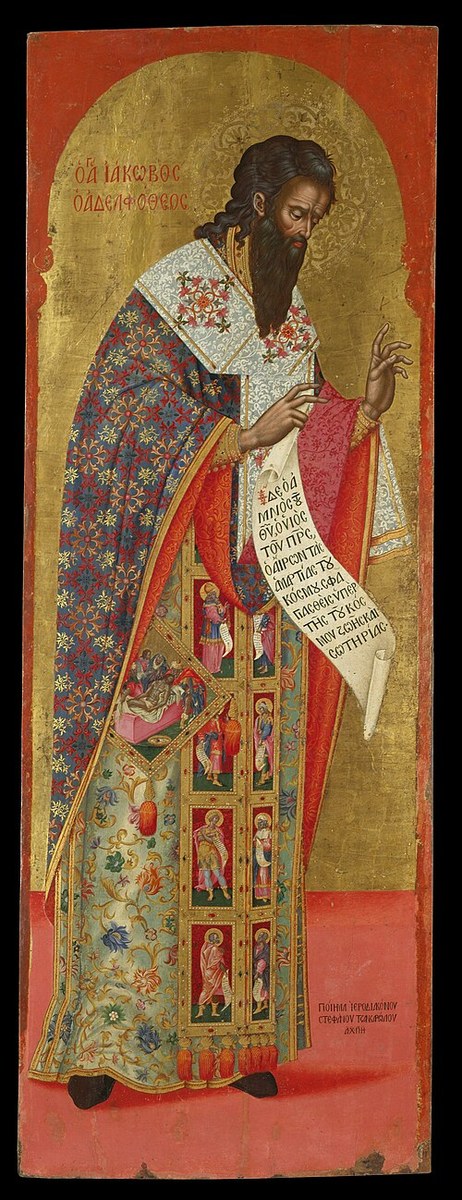
James the Brother of the Lord is depicted as a bishop of middle age or older, with dark hair and a full, pointed dark beard, vested in the episcopal phelonion or sakkos and omophorion and holding a Gospel book or a scroll — the scroll frequently inscribed with the opening of the Anaphora of his own Liturgy, marking him as its author and as the first celebrant of the Jerusalem church. His hierarchical vesture and the scroll distinguish him at a glance from the two apostolic Jameses of the Twelve, who are shown as apostles in tunic and himation. The narrative type of his martyrdom shows him cast down before the Temple and struck by the fuller's club, sometimes with the apostle praying on his knees for his slayers.
The stored primary image is a Cretan icon of 1688 by Stephanos Tzangarolas, inscribed "Ὁ Ἅγιος Ἰάκωβος ὁ Ἀδελφόθεος" ("St James the Brother of God"): the saint stands full-length as bishop in a richly flowered phelonion and omophorion, blessing, and unrolling a long liturgical scroll, with small scenes worked into his vesture — the painter's signature at lower right identifies the work (source, public domain, pd-old-work).
The second stored image is the miniature for October 23 in the Menologion of Basil II (Vat. gr. 1613, c. 1000), captioned in the manuscript "Apostle James, brother of the Lord": the haloed apostle, cast to the ground beside the altar of the Temple, is beaten by an executioner who raises the fuller's club over him — the martyrdom of Hegesippus's account, and a distinct miniature from the Menologion's separate image of James of Alphaeus (Oct 9) (source, public domain, pd-old-work).
Disputed questions
- The "brethren of the Lord": three views. The question is how James (and
Joses, Simon, Judas, and the unnamed sisters) can be "brethren" of Jesus
while the Church confesses Mary Aeiparthenos, ever-virgin.
- The Epiphanian view (named for Epiphanius of Salamis, †403, but far older, resting on the Protevangelium and much of the early Greek tradition): the brethren are children of Joseph by a former wife, older than Jesus, step-brothers reared in Joseph's house. This preserves the perpetual virginity of the Theotokos and requires nothing of Joseph that the tradition does not already hold. It is the view of the Orthodox Church, written into her calendar — which keeps James the Brother of the Lord (Oct 23) as a distinct person from James of Alphaeus of the Twelve (Oct 9) — and into the title Adelphotheos.
- The Hieronymian view (Jerome, Adversus Helvidium, 383): the brethren are cousins, sons of "Mary of Clopas" (John 19:25), taken to be the Virgin's sister; on this reading James the Lord's brother is James the son of Alphaeus, one of the Twelve, and "brother" means kinsman. This became the standard Roman Catholic position; it too guards the virginity of Mary (and of Joseph), but at the cost of collapsing two Jameses whom the Christian East keeps carefully apart.
- The Helvidian view (Helvidius, whom Jerome wrote against): the brethren are true younger children of Joseph and Mary, born after Jesus. This denies the perpetual virginity and is the reading of most Protestants. The Orthodox Church rejects it as incompatible with the dogma of the ever-virginity of the Theotokos.
- Galatians 1:19 — "James the Lord's brother" numbered among "the apostles" — is read by the Hieronymian side as proof that the Brother was of the Twelve, and by the Orthodox as using "apostle" in its wider sense (as of Barnabas, Silas, and the Seventy). The three constructions cannot all be true; this entry follows the Church's Epiphanian usage and records the others plainly.
- Apostle of the Twelve, of the Seventy, or sui generis? The Orthodox tradition does not reckon James among the Twelve (he is not in the four apostolic lists) but styles him simply "the Apostle," the Brother of God and first hierarch of Jerusalem — an apostle in the wider sense of Galatians 1:19 and 1 Corinthians 15:7. The Byzantine enumeration of the Seventy (the ps-Dorotheus and ps-Hippolytus lists) nonetheless places "James the brother of the Lord, bishop of Jerusalem" at their head, and he is commemorated in the Synaxis of the Seventy on January 4 (see Feast and commemoration); the calendars therefore honour him now as of the Seventy, now as an apostle set apart, and this entry leads with the general term apostle accordingly.
- The manner of death. Josephus (stoning, by the Sanhedrin under Ananus) and Hegesippus (cast from the pinnacle, stoned, and clubbed by a fuller) differ in detail; they agree that James died a violent death at Jerusalem at the hands of the Temple authorities about the year 62, and the Church has never sought to harmonise them beyond noting that stoning is common to both.
- Not to be confused with James the son of Zebedee (one of the Twelve and of the inner three, beheaded by Herod Agrippa, Acts 12:2; feast April 30) or with James the son of Alphaeus (of the Twelve; feast October 9). The Western tradition, on the Hieronymian reading, identifies the Brother of the Lord with the son of Alphaeus; the Orthodox calendar keeps all three Jameses distinct, and this entry, with the October 9 and April 30 entries, notes the divergence in all directions. The decisive iconographic difference is that this James, first bishop of Jerusalem, is portrayed as a hierarch in vestments, whereas the son of Zebedee is always an apostle of the fisherman type.