
Samuel the Prophet
The Holy Prophet Samuel, Judge of Israel
Prophet · b. c. 1105 BC, at Ramathaim-Zophim in the hill country of Ephraim — d. c. 1020 BC, at Ramah; buried in his own house
Commemorated 20 August — Memory of the prophet, kept within the Afterfeast of the Dormition
Samuel (eleventh century BC) stands at the hinge of the Old Testament: the last of the Judges and the first of the great line of prophets after Moses, the man who closed the age of the tribal deliverers and opened the age of the kings. Asked of God by his barren mother Hannah, vowed to the sanctuary before he was conceived, and given to the priest Eli at Shiloh as a small child, he was called by night while he slept beside the ark and answered with the words the Church has never let the world forget — "Speak, Lord, for thy servant heareth." He judged Israel from Ramah, put away the strange gods at Mizpah, warned the people what a king would cost them, and then, at God's command, anointed Saul and afterwards David. He died mourned by all Israel, and appeared once more, after his death, to pronounce Saul's doom on the eve of Gilboa.

The vow of Hannah
Samuel's history begins not with him but with his mother. Elkanah, a man of Ramathaim-Zophim in the hill country of Ephraim, had two wives: Peninnah, who bore children, and Hannah, who was barren. The genealogies of Chronicles trace Elkanah's descent through Kohath to Levi, so that the tradition followed by the synaxaria makes Samuel a Levite dwelling among the Ephraimites — which is why he could minister at the sanctuary and offer sacrifice without usurpation.
Year by year the household went up to the sanctuary at Shiloh, where the ark of the covenant then rested and where Eli was priest. There Hannah, taunted by her rival and unconsoled by her husband's affection — "am not I better to thee than ten sons?" — prayed in the bitterness of her soul, moving her lips without sound, so that Eli took her for a drunken woman and rebuked her. Her answer, that she had poured out her soul before the Lord, drew from him instead a blessing. She had vowed that if God gave her a man-child she would give him back to the Lord for all the days of his life, and that no razor should come upon his head — the vow of a Nazirite, made not by the man himself but for him before his conception.
The child was born and she called him Samuel, Shemu'el, "because I have asked him of the Lord": the name is read both as "asked of God" and as "heard of God," and both readings are used in the hymns. When he was weaned — at three years old, in the tradition the Church received — she brought him up to Shiloh with a bullock, an ephah of flour and a skin of wine, and gave him to Eli with the words that name the whole of his life: "For this child I prayed; and the Lord hath given me my petition which I asked of him: therefore also I have lent him to the Lord."
Hannah's song and the third ode
Hannah's prayer of thanksgiving (1 Samuel 2:1–10) is one of the great canticles of the Old Testament and has a permanent place in the Church's worship. "My heart rejoiceth in the Lord, mine horn is exalted in the Lord… The bows of the mighty men are broken, and they that stumbled are girded with strength… The Lord killeth, and maketh alive: he bringeth down to the grave, and bringeth up." It is the model and the ancestor of the Magnificat of the Theotokos, whose structure and whose reversals it supplies, and in the Byzantine rite it is the third of the nine biblical odes: every canon at Matins, of every saint and every feast, builds its third ode on Hannah's words, so that the barren woman's thanksgiving is sung in Orthodox churches daily. Samuel is therefore present in the office far beyond his own feast, at one remove, through his mother.
The child at Shiloh and the call by night
The boy remained at the sanctuary and "ministered before the Lord, being a child, girded with a linen ephod" — the vestment of the priesthood, worn by an infant — while his mother made him a little robe and brought it up to him year by year when she came for the yearly sacrifice. Against his growth the narrative sets the corruption of Eli's own sons, Hophni and Phinehas, "sons of Belial," who took the sacrifices by force and defiled the women who assembled at the door of the tabernacle, and whom their father rebuked too late and too gently.
"And the word of the Lord was precious in those days; there was no open vision." Into that silence came the call. The lamp of God had not yet gone out and Samuel was lying down in the temple where the ark of God was, when a voice called him by name. Three times he ran to Eli, and three times the old priest sent him back; at the third, Eli perceived what was happening and taught the child the answer that has become the pattern of every vocation: "Speak, Lord; for thy servant heareth." What was then revealed to him was the judgment upon the house of Eli, and Samuel, afraid, was made to tell it to Eli himself, who received it with the resignation of a man who had long expected it: "It is the Lord: let him do what seemeth him good."
From that night the word was not silent again. "And all Israel from Dan even to Beersheba knew that Samuel was established to be a prophet of the Lord." The Church reads the passage as the first calling of a prophet in Israel after Moses, and as the model of the obedience of the young — a boy of twelve, in the received reckoning, standing between an old priest's failure and the beginning of a new order.
The loss of the ark and the judgeship
The word came to pass. Israel went out against the Philistines and was beaten at Aphek; the elders sent to Shiloh for the ark of the covenant, thinking to compel God to save them, and Hophni and Phinehas carried it into the camp. The Philistines, terrified at first, fought the harder; Israel was routed, the two priests were killed, and the ark was captured. When the runner brought the news to Shiloh, Eli — old, heavy and blind — fell backward from his seat by the gate and broke his neck; and the wife of Phinehas, dying in labour, named her son Ichabod, "the glory is departed from Israel," not for her husband or her father-in-law but because the ark of God was taken.
The ark's own history was brief and terrible: Dagon fell twice before it in his temple at Ashdod and was broken; plagues followed it from city to city; and the Philistines sent it back on a new cart drawn by two milch kine, with a trespass offering of gold. It came to rest at Kiriath-jearim, where it stayed twenty years, and the sanctuary of Shiloh never recovered — a desolation Jeremiah would still be citing four centuries later.
Through those twenty years Samuel grew into the office of judge, the fifteenth and last of them. He gathered the people to Mizpah with the summons that is the sum of his preaching: "If ye do return unto the Lord with all your hearts, then put away the strange gods and Ashtaroth from among you." They put away the Baalim, fasted, drew water and poured it out before the Lord, and confessed their sin. The Philistines came up against the assembly; Samuel offered a sucking lamb for a whole burnt offering and cried unto the Lord, "and the Lord thundered with a great thunder on that day upon the Philistines, and discomfited them." Samuel set up a stone between Mizpah and Shen and called it Ebenezer, "the stone of help," saying, "Hitherto hath the Lord helped us."
He judged Israel all the days of his life, going on a yearly circuit — Bethel, Gilgal, Mizpah — and returning always to Ramah, where his house was and where he built an altar to the Lord. He is the only one of the Judges whose authority was prophetic and priestly rather than military; he delivered Israel by prayer and by the reformation of its worship, and the Philistine pressure was held back all his days.
"Give us a king"
Samuel grew old, and made his sons Joel and Abiah judges in Beersheba; but they "walked not in his ways, but turned aside after lucre, and took bribes, and perverted judgment." On this the elders of Israel came to him at Ramah and demanded a king to judge them "like all the nations."
The thing displeased Samuel, and he prayed; and the answer he received is one of the gravest sentences in the Old Testament: "They have not rejected thee, but they have rejected me, that I should not reign over them." He was told to grant the request and to protest solemnly first — and the protest he made (1 Samuel 8:11–18) is the earliest sustained critique of monarchy in literature: the king will take your sons for his chariots and your daughters for his kitchens, your fields and your vineyards and the tenth of your seed, your servants and your asses and your sheep; "and ye shall cry out in that day because of your king which ye shall have chosen you; and the Lord will not hear you in that day." The people refused to hear, and Samuel — who had every human reason to resent the demand — bowed to it without bitterness and set himself to make the new institution work.
The anointing of Saul
The choice fell on Saul the son of Kish, a Benjamite, taller than any of the people from the shoulders upward, who came to Ramah looking for his father's strayed asses and was directed to "the seer." Samuel had been forewarned; he received Saul at the high place, seated him at the head of the guests, kept the reserved portion for him, and the next morning at the edge of the city took a vial of oil, poured it on his head and kissed him: "Is it not because the Lord hath anointed thee to be captain over his inheritance?" He gave him three signs, and the last of them was that Saul would meet a company of prophets coming down from the high place with psaltery, tabret, pipe and harp, and would prophesy among them and "be turned into another man" — whence the proverb, "Is Saul also among the prophets?"
The private anointing was ratified publicly: at Mizpah the lot fell upon Saul, who had hidden himself among the baggage, and the people shouted "God save the king." After Saul's relief of Jabesh-gilead the kingdom was renewed at Gilgal, and there Samuel delivered his farewell address (1 Samuel 12) — the audit of a lifetime's office: "Whose ox have I taken? or whose ass have I taken? or whom have I defrauded?" The people acquitted him. He called for thunder and rain in the wheat harvest as a sign, and closed with the promise no successor improved upon: "God forbid that I should sin against the Lord in ceasing to pray for you."
The rejection of Saul
Twice the prophet had to pronounce against the king he had made. At Gilgal, with the Philistines massed and his levies melting away, Saul would not wait the appointed seven days and offered the burnt offering himself; Samuel arrived as he finished and told him his kingdom should not continue, for "the Lord hath sought him a man after his own heart."
The second and final breach came over Amalek. Saul was commanded to devote the Amalekites utterly and spared Agag their king and the best of the sheep and oxen, pleading that the people had kept them to sacrifice. Samuel's reply is the prophetic principle in its purest form, quoted ever after against every attempt to buy God with religion: "Hath the Lord as great delight in burnt offerings and sacrifices, as in obeying the voice of the Lord? Behold, to obey is better than sacrifice, and to hearken than the fat of rams." When Saul caught at his mantle and tore it, Samuel made the tearing a sign: "The Lord hath rent the kingdom of Israel from thee this day." Then he called for Agag — who came "delicately," saying "surely the bitterness of death is past" — and hewed him in pieces before the Lord in Gilgal, an act the Fathers read as the judge executing a sentence Saul had refused to execute, not as private vengeance.
"And Samuel came no more to see Saul until the day of his death: nevertheless Samuel mourned for Saul." The two sentences together are the measure of the man.
The anointing of David
He was mourning still when God rebuked the mourning and sent him to Bethlehem, to the house of Jesse, with a horn of oil and a heifer for sacrifice. There the sons were brought before him one by one. Of Eliab, tall and impressive, Samuel thought, "Surely the Lord's anointed is before him"; and he was answered with the sentence that governs all Christian discernment of persons: "Look not on his countenance, or on the height of his stature, because I have refused him: for the Lord seeth not as man seeth; for man looketh on the outward appearance, but the Lord looketh on the heart." Seven passed and none was chosen; the youngest was keeping the sheep. David was fetched — ruddy, of a beautiful countenance and goodly to look to — and Samuel anointed him in the midst of his brethren, "and the Spirit of the Lord came upon David from that day forward."
Later, when Saul's persecution began, David fled to Samuel at Ramah and the two of them went to dwell at Naioth, among the company of the prophets. Saul sent messengers to take him and each party in turn was caught up in prophecy; at last Saul came himself, and the Spirit of God came upon him also, and he stripped off his clothes and lay down naked all that day and night before Samuel. The prophetic communities gathered about Samuel at Naioth and elsewhere are the beginning of what the later books call the sons of the prophets — the schools that would produce Elijah's and Elisha's disciples — and it is on this account that Acts calls him the first of the prophetic succession: "all the prophets from Samuel and those that follow after, as many as have spoken, have likewise foretold of these days" (Acts 3:24).
Repose
"And Samuel died; and all the Israelites were gathered together, and lamented him, and buried him in his house at Ramah" (1 Samuel 25:1). He had judged Israel from his childhood, outlived the order he was born into, and given the nation both its first king and its second. Ben Sira's praise of the fathers gives him a long paragraph — "beloved of his Lord… he called upon the mighty Lord, when his enemies pressed upon him on every side, with the offering of a sucking lamb" — and the Epistle to the Hebrews numbers him among the cloud of witnesses who "through faith subdued kingdoms" (Hebrews 11:32).
The witch of Endor
The last scene in which Samuel appears takes place after his death, and it is the one that has caused the Church most trouble. The Philistines were encamped at Shunem and Saul at Gilboa; "and when Saul enquired of the Lord, the Lord answered him not, neither by dreams, nor by Urim, nor by prophets." Saul, who had himself purged the mediums out of the land, went by night in disguise to a woman at Endor who had a familiar spirit — in the Greek, an engastrimythos, a "belly-speaker" — and asked her to bring up Samuel. The woman cried out when she saw what she had raised, and described "an old man… covered with a mantle"; and Saul heard a voice reproaching him for disquieting it, repeating the sentence of the kingdom's rending, and adding the sentence that was fulfilled the next day: "the Lord will also deliver Israel with thee into the hand of the Philistines: and to morrow shalt thou and thy sons be with me."
Whether that apparition was in truth the prophet is discussed under Disputed questions below.
Relics and the shrine at Ramah
The tomb "in his house at Ramah" was venerated through antiquity. In 406, under the emperor Arcadius, the relics of Samuel were taken up in Palestine and carried to Constantinople. Saint Jerome, writing against Vigilantius within a few years of the event and with evident satisfaction, describes the translation: the ashes borne in a vessel of gold and wrapped in silk, bishops carrying them, the provinces turning out along the whole road, and the emperor himself going forth to meet them — a chain of rejoicing peoples from Palestine to Chalcedon. They were deposited in a church built for them at the Hebdomon outside the walls. The Chronicon Paschale records the same translation under the same year, and it is one of the best-attested relic translations of the early fifth century.
The traditional site of the tomb is the height north-west of Jerusalem still called Nebi Samwil, "the prophet Samuel," honoured by Jews, Christians and Muslims alike; the Crusaders, who first saw Jerusalem from its summit, called it Mons Gaudii, the Mount of Joy.
Feast and commemoration
August 20 (church date; New Calendar civil August 20, Old Calendar civil September 2) is the memory of the prophet in the whole Byzantine calendar — Greek, Antiochian, Slavic — and the same day is kept for him in the Roman and Lutheran calendars, a rare unanimity. The Armenian Church commemorates him on July 30, the Coptic on 9 Paoni.
The day falls within the Afterfeast of the Dormition of the Theotokos, so that the prophet's office is sung beneath the festal canon and stichera of the Dormition — an arrangement the Byzantine books make deliberately expressive: the child asked of God and given back to the temple is commemorated in the octave of the feast of her who was likewise asked of God by barren parents, presented in the temple as a child, and offered to the Lord all the days of her life. The parallel between Hannah and Anna the mother of the Theotokos is drawn explicitly in the hymnography of the Nativity and Entry of the Theotokos, and the placing of Samuel's feast in the Dormition afterfeast keeps it in view.
No fast attaches to the day; the Dormition fast ended on August 14.
Hymns
Apolytikion — Tone 2
As we keep the memory of thy Prophet Samuel, O Lord, through him we entreat thee: save our souls.
Apolytikion — Tone 5
Besought of thy mother and consecrated to God from thy birth, by his good pleasure thou wast shown forth a prophet, a judge and shepherd of the people of Israel and an anointer of kings: O Prophet Samuel, entreat Christ God that our souls may be saved.
Kontakion — Tone 8
As a gift most honourable thou wast given to God before ever thou wast conceived, and from infancy didst serve him as an angel, O blessed one, and didst foresee things to come as though they were present: wherefore we honour thee, O glorious Samuel, as a great prophet and a venerable high priest.
Original translation from the Slavonic
Iconography
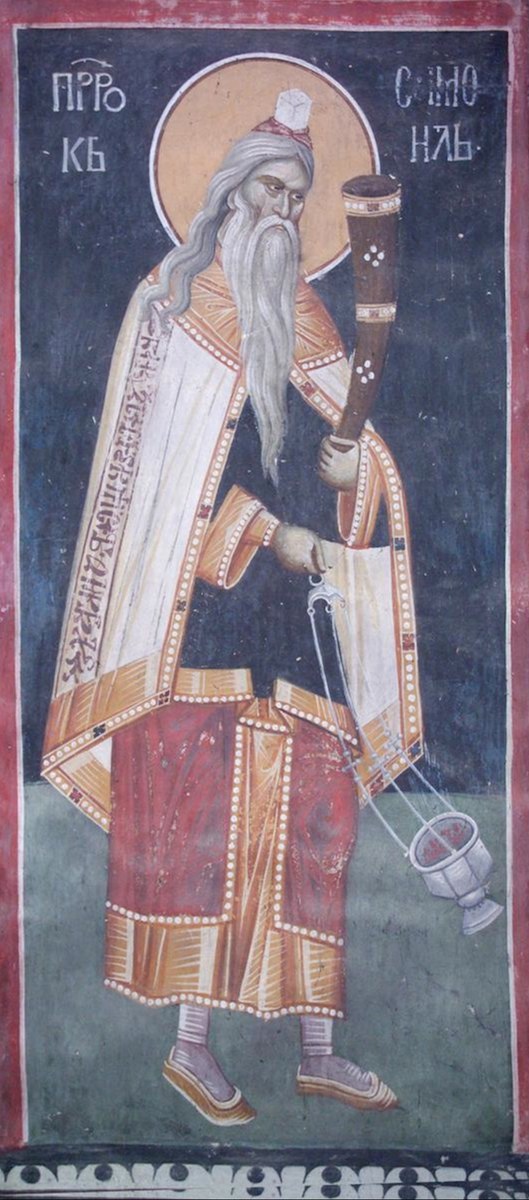
Samuel is painted as an old man, long-haired and with a long white beard flowing to his breast, and — uniquely among the prophets — in priestly rather than prophetic dress, since the tradition reckons him a Levite and a high priest: the sticharion and a broad, richly bordered vestment, sometimes with the priestly cap or mitre of the Aaronic type on his head. His proper attribute is the horn of holy oil with which he anointed Saul and David, held up in one hand; a censer is frequently placed in the other, marking his sacrificial ministry, and he may also hold a scroll bearing a text of his prophecy. He belongs by right to the prophet tier of the tall Russian iconostasis and to the prophet registers of Byzantine and Serbian church decoration, where he is normally set among the pre-monarchic figures — Moses, Aaron, Joshua — rather than among the writing prophets. In narrative cycles he appears anointing David from the horn, and, in the Psalter miniatures and the Octateuchs, as the child Samuel before Eli.
The stored image is the fresco of the Gračanica Monastery in Kosovo (1318–1321, the foundation of King Milutin), inscribed in Church Slavonic ПРРОКЪ САМОИЛЬ, "the Prophet Samuel." It shows him full-length as an aged priest in the white sticharion and gold-bordered mantle with the priestly cap, holding the horn of oil raised in his left hand and swinging a censer in his right — the two attributes of the anointer and the sacrificer together in one figure.
Disputed questions
- Was the apparition at Endor really Samuel? The text of 1 Samuel 28 says flatly that "Samuel said to Saul," and Sirach 46:20 — read as Scripture in the Orthodox canon — states that "after his death he prophesied, and shewed the king his end." Origen, in his homily on the passage, accordingly held that the soul of the prophet was truly brought up, arguing that if the words spoken were true prophecy they could not be a demon's. Against him Eustathius of Antioch (†c. 337) wrote an entire treatise, On the Belly-Myther, against Origen (De engastrimytho contra Origenem) — one of the founding documents of the Antiochene exegetical school and among the earliest surviving direct attacks on Origen's method. Eustathius argues that a woman in league with a demon has no power over the souls of the righteous; that what appeared was a demonic impersonation; and that the "prophecy" was merely the repetition of what Samuel had said publicly in his lifetime, plus a guess that any observer of the Gilboa position could have made. Gregory of Nyssa, John Chrysostom and Theodoret follow substantially the same line, and it became the majority Byzantine reading. The Church has never dogmatised the question; the entry records both traditions, and notes that the Antiochian tradition, on which this repository leans, is the tradition of Eustathius. (See Eustathius of Antioch.)
- Priest, Levite, or Ephraimite? 1 Samuel 1:1 calls Elkanah "an Ephrathite" of Mount Ephraim; 1 Chronicles 6 gives him a Levitical genealogy through Kohath. The usual harmonisation, and the one the synaxaria assume, is that the family was Levitical by descent and Ephraimite by domicile, the Levites having no tribal territory of their own. Modern critical scholarship generally treats the Chronicler's genealogy as a later regularisation; the hymns of the feast follow the traditional reading and call Samuel a high priest.
- Dates. No absolute chronology is possible. The synaxaria place him "more than 1146 years before the birth of Christ"; the conventional modern reckoning puts his birth around 1105 BC, his judgeship in the second half of the eleventh century, and his death shortly before Saul's, about 1020 BC. This entry indexes him under the eleventh century BC without asserting precision the sources cannot bear.
- Two accounts of the monarchy. Readers of the commentaries will meet the observation that 1 Samuel preserves both a favourable and a hostile view of the request for a king, and that Saul is presented as chosen at Ramah, at Mizpah and at Gilgal in three distinct scenes. Whatever the literary history, the received text as the Church reads it makes Samuel the reluctant but obedient founder of the monarchy, and that is the figure the hymns praise.