
Eustathius of Antioch
Our Father among the Saints Eustathius the Confessor, Archbishop of Antioch
Bishop · Confessor · b. c. 270, at Side in Pamphylia — d. c. 337 (in exile in Thrace; some traditions place his repose as late as c. 360)
Commemorated 21 February — Commemoration of the confessor and archbishop
Eustathius (c. 270 – c. 337) was Archbishop of Antioch and one of the chief defenders of the Nicene faith at the First Ecumenical Council of 325, where he stood in the front rank of the fathers who confessed the Son to be consubstantial (homoousios) with the Father against the teaching of Arius. A native of Side in Pamphylia, he was bishop of Beroea before the council raised him to the great Syrian see. His unyielding opposition to Arianism made him the first casualty of the Arian reaction: about the year 330 a synod at Antioch, packed by the party of Eusebius of Nicomedia, deposed him on a fabricated charge of immorality and the pretext of Sabellianism, and the emperor Constantine exiled him to Thrace, where he died. His fall did not silence his flock: the Nicene Christians loyal to his memory — the Eustathians — refused communion with the Arianising bishops set over Antioch, and their separation grew into the long Antiochene schism that troubled the Church for the better part of a century. The tradition honours him as a confessor and pillar of Orthodoxy; his relics were carried home to Antioch in 482.

Origins and the See of Beroea
Eustathius was born about the middle years of the third century — the tradition places his birth around the year 270 — at Side, a city of Pamphylia on the southern coast of Asia Minor. Of his youth little is recorded beyond that he was a man of wide learning, trained in the rhetoric and philosophy of the Greek schools and deeply read in the Scriptures, and that he passed through the last of the great persecutions — that of Diocletian and his successors — without faltering, so that the Church counts him among the confessors who suffered for the faith before the peace of Constantine. He was raised to the episcopate as bishop of Beroea in Syria (the modern Aleppo) about the year 320, in the very years when the presbyter Arius of Alexandria was beginning to teach that the Son of God was a creature, made out of nothing before the ages, and not truly God — the doctrine that would convulse the Church for two generations. From the outset Eustathius set himself against it, and his name is found among the bishops who condemned Arius in the councils that preceded Nicaea.
The First Ecumenical Council and the homoousion
When the emperor Constantine, newly master of the whole Roman world, summoned the bishops of the empire to Nicaea in Bithynia in the year 325 to settle the Arian question, Eustathius came as bishop of Beroea and took a leading part. The historian Theodoret — himself a bishop of the Antiochene region who had the local memory before him — records that it was Eustathius who, when the emperor entered the assembly, rose to deliver the opening address of welcome and praise on behalf of the fathers; other accounts assign that honour to Eusebius of Caesarea or to Ossius of Cordova, and the point is disputed among the sources, but all agree that Eustathius stood among the presidents and foremost speakers of the council. There he laboured, with Alexander of Alexandria, the young deacon Athanasius, Marcellus of Ancyra, and Macarius of Jerusalem, for the full confession of the Son's divinity, and he was among those who pressed for the decisive word ὁμοούσιος — of one essence — against the evasions of the Arian and compromising parties. The Creed of Nicaea, with its anathema against those who say "there was when he was not" and who call the Son a creature or of another substance, was in large measure the victory of the men Eustathius stood with, and he returned to the East one of the acknowledged champions of the definition.
Archbishop of Antioch
It was either just before the council or in its immediate aftermath — the sources differ, and both a date of about 324 and one of 325 are given — that Eustathius was translated from Beroea to the vacant throne of Antioch on the Orontes, the third city of the empire and the mother-church of the Christian East, where "the disciples were first called Christians." The Greek Menaion remembers him precisely as Patriarch of Antioch the Great. The see had been held by the confessor Philogonius, an early opponent of Arius, and after him briefly by Paulinus of Tyre; the elevation of so committed a Nicene as Eustathius set Antioch, for a few years, firmly on the side of the council.
As archbishop, Eustathius governed and taught in the Nicene faith and continued his war of pen and word against Arianism. He would not receive into communion the clergy who leaned to the Arian cause, and he wrote against them; and he did not spare, in his preaching and his letters, the two great bishops of the Eusebian party — Eusebius of Nicomedia and Eusebius of Caesarea the church-historian — whom he charged with covertly favouring Arius under cover of a moderate form of words. It was a courageous but a dangerous course, for those men stood high in the favour of the court, and the tide of imperial policy, after Nicaea, was turning back toward conciliation with the Arianising party.
Deposition and exile
The reckoning came about the year 330 (the sources give dates from 326 to 331). The Eusebian bishops, gathering at Antioch under colour of other business, convened a synod against Eustathius. They could not touch his faith, which was the faith of the council; so they proceeded, as the Church's memory has it, by calumny. They accused him of Sabellianism — the very opposite of the Arian error, the confounding of the Persons of the Trinity — a charge levelled precisely because his firm insistence on the one Godhead of Father and Son could be twisted to sound like a denial of their distinction. To this they added the charge that he had insulted Helena, the emperor's mother, on her pilgrimage through Antioch; and, most shamelessly, they suborned a woman to appear before the synod with an infant, swearing that Eustathius was its father. She swore falsely, the tradition holds, and confessed the fraud only long afterward on her deathbed, naming a coppersmith of the same name as the true father. On these charges, and without a canonical trial, the synod deposed him.
The people of Antioch, who loved their archbishop and knew the accusations for what they were, rose in tumult at the news, and the city came near to open violence between his supporters and his enemies; only the intervention of the imperial officers kept the peace. The emperor Constantine, informed by the Eusebians and unwilling to have his eastern capital in uproar, confirmed the deposition and sent Eustathius into exile — to Trajanopolis in Thrace (some sources say Philippi, near by, in the same region), where a company of his faithful clergy followed him. There, far from his city and his flock, he lived out his days in poverty and patience, still writing and still confessing the faith of Nicaea, and there he fell asleep in the Lord. The Church keeps him therefore as a confessor: he suffered deposition, calumny, and lifelong banishment for the truth, though he was not put to death.
Repose and the question of the year
The year of his repose is uncertain and is one of the standing questions of his biography. The common tradition, followed in the synaxaria, places his death about 337 — the year of Constantine's own death — after some seven years in exile. But other evidence, including notices in Jerome and the testimony of George of Laodicea, suggests that Eustathius lived on in Thrace far longer, into the reign of Constantius, and did not die until about 360 — so that his exile would have lasted the better part of thirty years. The sources cannot be reconciled with certainty; the entry gives his repose as c. 337, the received date, while recording that a strand of the evidence extends his life to about 360.
Writings and the Antiochene Christology
Eustathius was, in his own day, a prolific writer, and Jerome names him among the learned authors of the Church; but because he was condemned and exiled by the party that soon held power, and was suspected in a later age of an over-sharp distinction in his teaching, most of his works perished, and he survives chiefly in fragments quoted by friends and by critics. His one nearly complete surviving book is a treatise against Origen on the episode of the Witch of Endor (the "belly-myther," engastrimythos, of 1 Samuel 28) — a spirited attack on Origen's allegorical exegesis, insisting that the woman did not truly raise the prophet Samuel but that a demon deceived Saul, and defending the plain historical sense of the sacred text. In this he is a founding voice of the Antiochene school of interpretation, which read the Scriptures according to their literal and historical meaning against the boundless allegory of Alexandria.
In Christology Eustathius must be presented fairly, for his teaching has been read in two ways. Against the Arians — who made the divine Word the sole subject in Christ and put the Word in the place of a human soul, so that (on their scheme) it was God who suffered, changed, and grew — Eustathius insisted on the full and complete humanity of the Saviour: a real human body and a rational human soul, assumed by the eternal Word. He stressed the distinction between the Word who is unchangeably God and the man who was born, suffered, and died, lest the sufferings of the flesh be ascribed to the impassible Godhead and so the Arians be given their argument that the Son, because he suffered, could not be true God. This emphasis — the "Word–man" (Logos-anthrōpos) pattern — makes Eustathius a genuine forerunner of the Antiochene dyophysite tradition and, ultimately, of the orthodox confession of the two natures. It is right to note that some later readers, and some modern scholars, have detected in his sharp separation of "the God" and "the man" a tendency that, pressed further by others, would issue in the divisive Christology condemned at Ephesus; but Eustathius himself confesses one Christ, and his intent is not to divide the Saviour but to guard both his true Godhead and his true manhood against the Arian collapse of the two into one suffering demigod. His enemies' charge of Sabellianism — of so uniting Father and Son as to deny their distinction — was, in this light, doubly a slander: it was the reverse of his real concern, and it was pressed not because it was true but because it was the one accusation his Nicene firmness could be made to fit.
The Eustathian schism
The deposition of Eustathius did not end with his exile; it opened a wound in the church of Antioch that would not close for ninety years. The great body of Nicene Christians who had loved him refused to recognise the bishops the Arian party now set over the see — Paulinus of Tyre, Eulalius, Euphronius, Flacillus, and their successors down to the openly Arian Eudoxius and Euzoius — and, holding aloof from their communion, continued to meet apart under a presbyter of their own, Paulinus, as the remnant faithful to the deposed confessor. These were the Eustathians: not a sect in doctrine, for their faith was simply the faith of Nicaea, but a communion in separation, keeping the memory of their wronged archbishop and declining to acknowledge any bishop of tainted origin.
Their separation became the seed of the long Antiochene schism. When about the year 360 the Nicene Meletius was given the see — and was himself promptly exiled by the Arians for his orthodoxy — the great mass of Antiochene Nicenes rallied to him; but the old Eustathians would not join Meletius, distrusting a bishop who had been consecrated with the goodwill of the Homoian party, however plainly he now confessed the truth. So in 362 the Western bishop Lucifer of Cagliari, passing through Antioch, consecrated their presbyter Paulinus a bishop, and the city was left with two orthodox claimants of one Nicene faith — Meletius and Paulinus — besides the Arian intruder. Rome and Alexandria recognised Paulinus and the Eustathian line; the East and the Cappadocian fathers, above all Basil the Great, laboured for Meletius. The division — remembered in the histories under both names, the Eustathian and the Meletian schism, for it was one continuous rupture — outlived Eustathius, Meletius, and Paulinus alike, and was not fully healed until about 415. The Church, in numbering Eustathius among the saints, has rendered its verdict on the original injustice: his faith was the faith of the council, and the reproach cast upon him was a lie.
Relics and translations
Eustathius died in his Thracian exile and was buried there. Long afterward, when the storms of the Arian age were spent and his vindication complete, his relics were brought home to Antioch: about the year 482, in the reign of the emperor Zeno, they were translated from Thrace (from Philippi, or the neighbouring Trajanopolis) to the city he had shepherded and been torn from, and were received with great honour and rejoicing by the church that had never ceased to hold his memory dear. The homecoming of the confessor's body was itself read as the seal of his cause and the healing, in symbol, of the wound his deposition had opened.
Feast and commemoration
Eustathius is kept on February 21 (church date; Old Calendar civil March 6). In the Greek Menaion he is a synaxarion commemoration of the day, named after the venerable Timothy of Symbola, whose office the books appoint: the notice styles him "our father among the saints Eustathius, Patriarch of Antioch the Great," and he is commemorated together with George of Amastris, John Scholasticus of Constantinople, and Zacharias of Jerusalem. For the Church of Antioch he is, with Ignatius the God-bearer, Babylas, and Meletius, one of the greatest of its archbishops and the first great confessor of its throne in the Nicene age — the shepherd whose deposition opened, and whose memory long prolonged, the division of the Antiochene church. The day falls, in most years, within the pre-Lenten or early Lenten season; in the year 2026 it coincides with the Saturday of Cheesefare, the movable commemoration of all ascetic Fathers and Mothers, which governs the Lenten Triodion office of the day.
Hymns
Troparion — Tone 4
O guide of Orthodoxy, teacher of piety and holiness, luminary of the whole world, God-inspired adornment of hierarchs: by thy teachings thou hast enlightened all, O harp of the Spirit. O righteous father Eustathius, intercede with Christ our God that our souls may be saved.
Original translation from the Greek
Kontakion — Tone 4
Enthroned upon the summit of the true confession, thou didst shepherd the flock of Antioch in the faith of Nicaea; and driven out for the sake of the consubstantial Word, thou didst endure thy long exile as a confessor. O steadfast Eustathius, entreat Christ God to grant us his great mercy.
Original translation from the Greek
Iconography
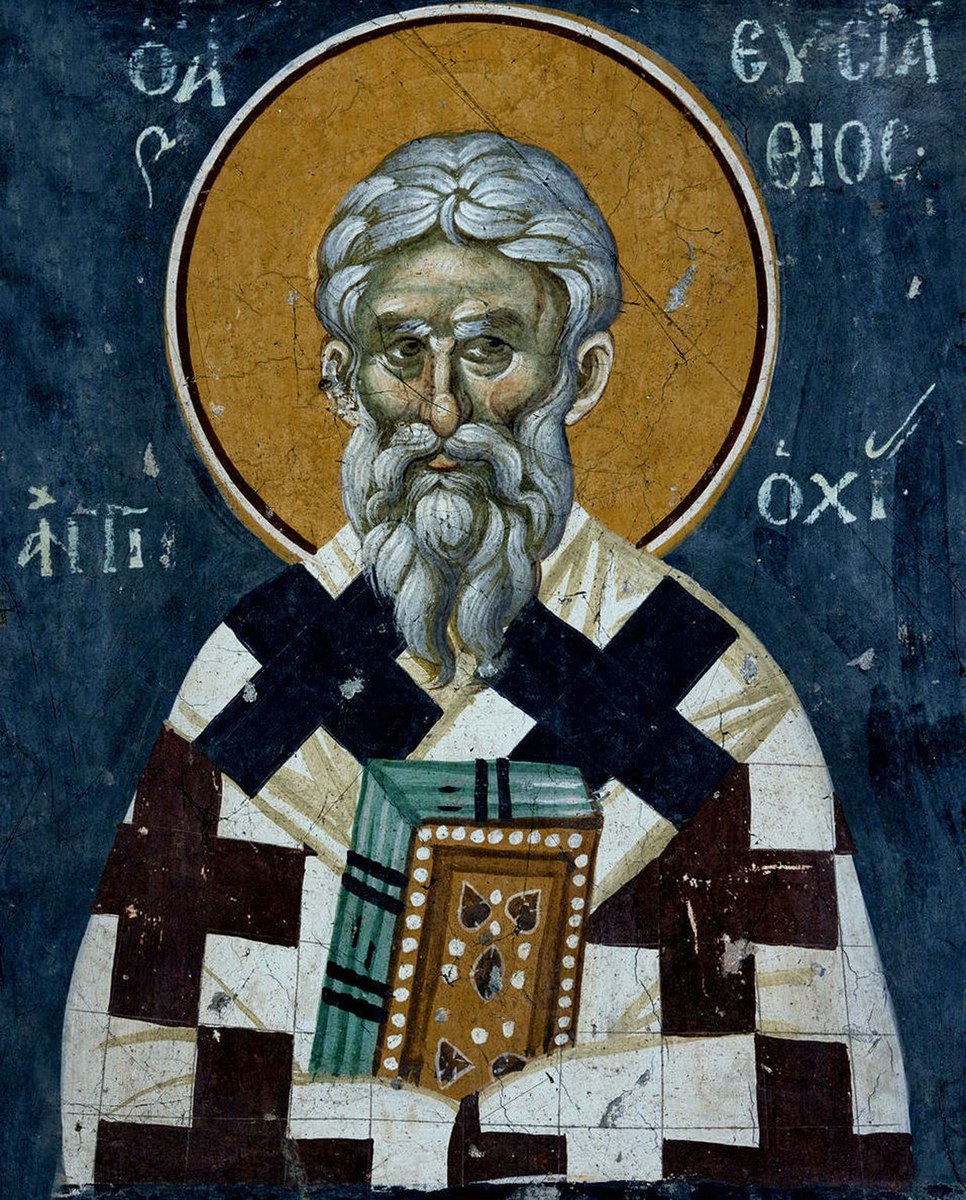
Eustathius is depicted in the settled type of a Greek hierarch of the age of the fathers: an aged bishop, high-browed and grey-bearded, vested in the phelonion or the cross-figured polystavrion, wearing the omophorion and holding or blessing over the Gospel-book. In the great fresco programmes of the Byzantine and Palaiologan churches he stands among the officiating hierarchs of the sanctuary apse, in the ranks of the concelebrants of the eternal Liturgy, his figure named by the inscription "of Antioch" — as at Staro Nagoričane (1317) and at the Peribleptos church of Ohrid. He also appears, as one of the fathers of the First Ecumenical Council, in the composite icons of Nicaea — the assembled bishops enthroned about the emperor, with the condemned Arius cast down beneath. An eleventh-century menologion miniature (Moscow, State Historical Museum, Sin. gr. 183, f. 103r) preserves his portrait, inscribed with his name and see.
The stored image is his figure from the frescoes of the Church of the Theotokos Peribleptos (Saint Clement) at Ohrid, the celebrated work of the painters Michael and Eutychios Astrapas of about 1295 — a masterpiece of the early Palaiologan revival — showing the archbishop full-length and vested as a hierarch, inscribed as Eustathius of Antioch (source, public domain, pd-old-work).
Disputed questions
- The year of his death (c. 337 vs c. 360) — treated above; the received synaxarion date is c. 337, but a strand of the evidence extends his exile and life to about 360.
- Who presided at Nicaea, and who gave the opening address. Theodoret assigns the welcoming oration to Eustathius; other sources name Eusebius of Caesarea or Ossius of Cordova, and the presidency of the council is variously reported. The entry records Eustathius among the foremost of the fathers without resolving the precedence, which the sources leave contested.
- The reach of his Christology. Whether Eustathius's sharp distinction of "the God" and "the man" in Christ is simply the sound anti-Arian safeguard of the two natures, or already leans toward the later Antiochene extreme, is debated among patristic scholars; the fragmentary survival of his works keeps the question open. Handled under Writings and the Antiochene Christology above.
- Not to be confused with several same-named saints of the calendar: the Roman soldier and great-martyr Eustathius Placidas (September 20), converted by the vision of the stag; Eustathius of Sebaste, the semi-Arian bishop and ascetic leader (a contemporary, and no saint of the Church); Eustathius of Mtskheta, the Georgian martyr (July 29); and the learned twelfth-century Eustathius, Archbishop of Thessalonica, the classical commentator and chronicler of the Norman sack of 1185. "The confessor of Nicaea and Archbishop of Antioch" belongs to this Eustathius alone.