
Serapion the Sindonite
Our Venerable Father Serapion the Sindonite, of Egypt
Venerable · d. 5th century (some reckonings, late 4th)
Commemorated 21 March — Greek synaxarion usage, 14 May — Slavonic and OCA usage
Serapion the Sindonite is the Egyptian ascetic who owned nothing at all but a single coarse linen cloth — the sindōn that gave him his name — and who twice sold himself into slavery in order to convert his masters. Known from the Lausiac History of Palladius, he lived without roof or possessions "like the birds of the air," gave away even his cloth and his Gospel-book, walked from Egypt to Rome, and made of destitution an instrument of mission rather than a private discipline. Because his freedom from property extended to his own body and his own reputation, he stands at the head of a line that runs to the fools-for-Christ; and his few recorded sayings — above all his rebuke to a Roman recluse who thought herself dead to the world — are among the sharpest words in the desert literature.

The man with one garment
Serapion was an Egyptian, and from his youth he chose a form of ascetic life so stripped that even the desert found it startling. He built no cell and joined no coenobium; he had no shelter, no bag, no book, and no second garment. His whole property was one length of coarse linen — a sindōn — worn wrapped about him, from which the fathers gave him his surname, the Sindonite. He would go for days without eating, not from a rule of fasting but simply because he had nothing and asked for nothing; and he moved constantly from place to place, so that the older collections class him among the gyrovagues — but a wanderer of the sort that made wandering into a form of preaching rather than of escape.
Two anecdotes fix the temper of the man. Meeting a beggar shivering in the cold, he took off his one sindōn and gave it away, and remained naked; found in that state and asked who had stripped him, he pointed to the Gospel-book that was, for a time, his only other possession. Shortly after he sold the book itself, and when he was asked where it had gone he answered that he had sold the book which told him to sell all he had and give to the poor. A Greek philosopher, wishing to test whether his indifference to property was real, put a gold coin into his hand and watched what he would do; Serapion went to a baker, bought a single loaf, laid down the gold piece, and walked away without waiting for the change, having no notion that the coin was worth more than the bread.
Selling himself to save his masters
The act for which he is chiefly remembered is that he made his own person the last thing he had left to give away. Coming to a city where a Greek actor — a mime of the theatre, in the world's eyes the lowest of trades — lived with his household in unbelief, Serapion offered himself to him for a price and entered his house as a bought slave. He served him in that condition, ate what a slave was given, and by the plain sight of his life brought the actor to faith; the man was baptised with his whole family, gave up the theatre, and begged Serapion to remain with him not as a servant but as guide and friend. Serapion returned the purchase-money, refused the gifts pressed on him, and went away.
The Lausiac History records that he did the same thing a second time, selling himself into a household of Manichaeans and by patience and argument drawing them out of the sect. In each case the pattern is the same: he owns nothing, therefore he can be spent; he sells the only property remaining to him, his freedom, and takes the price back out of the transaction by returning it.
The voyage to Rome and the Roman recluse
He determined at length to go to Rome. He boarded a ship without paying the owners, having nothing to pay with, and at first was reproached and abused for it; but when the crew saw that five days had passed and the old man had eaten nothing, they began to feed him for God's sake, and so, the narrator remarks drily, fulfilled the Lord's commandment without meaning to. At Rome he lived as he had lived in Egypt, going from house to house, gathering no possessions, storing up nothing but what could be given to his neighbour.
At Rome, too, falls the exchange that has kept his name alive in ascetic literature. Told of a virgin recluse of great reputation who had shut herself away and neither went out nor saw anyone, he came to her and asked her, since she was dead to the world, to do something a dead woman would not mind: to walk out through the city unclothed, as he did. She answered that it was impossible, that she would be thought mad and scandalise everyone. "Then," said Serapion, "you are not dead to the world after all; you are as alive to it as I am." The story is told in the Lausiac History not to disparage the recluse but to expose the difference between renouncing goods and renouncing the good opinion of men — and it is precisely the point on which the later fools-for-Christ would build.
Veneration and later cultus
Serapion left no writings and founded nothing; his memory rests entirely on the desert collections, and above all on the chapter Palladius devoted to him in the Lausiac History, written about 419–420 for the chamberlain Lausus. From there he entered the synaxaria of both Greek and Slavonic usage. He has no relics of note, no shrine, and no proper hymnography — a poverty after death that suits him — but he is read yearly in monastic refectories wherever the Lausiac History is read, and he is invoked in the Orthodox tradition as a pattern of non-acquisitiveness (aktēmosynē) carried to its logical end.
Feast and commemoration
May 14 (church date; Old Calendar civil May 27) in Slavonic and OCA usage, where he is commemorated as "Venerable Serapion of Egypt"; March 21 in the Greek synaxarion. Depending on the year, May 14 falls late in the Paschal season or after Pentecost, and March 21 within Great Lent — so his memory is in practice kept in two quite different liturgical settings. No proper service exists in either usage; he is sung with the common of a venerable father.
Hymns
Apolytikion — Tone 8 (common of a venerable father)
In thee, O Father, was preserved unfailingly that which is according to the image; for taking up the Cross thou didst follow Christ, and by thy deeds thou didst teach us to despise the flesh, for it passes away, but to care for the soul, a thing immortal. Wherefore, O venerable Serapion, thy spirit rejoices with the angels.
Kontakion — Tone 2 (common of an ascetic)
Having nothing upon the earth, thou didst possess Christ alone; and selling even thy own freedom, thou didst purchase souls for God. Wherefore, O Serapion, teach us to be poor, that we may be rich in Him.
Original translation from the Greek
Iconography
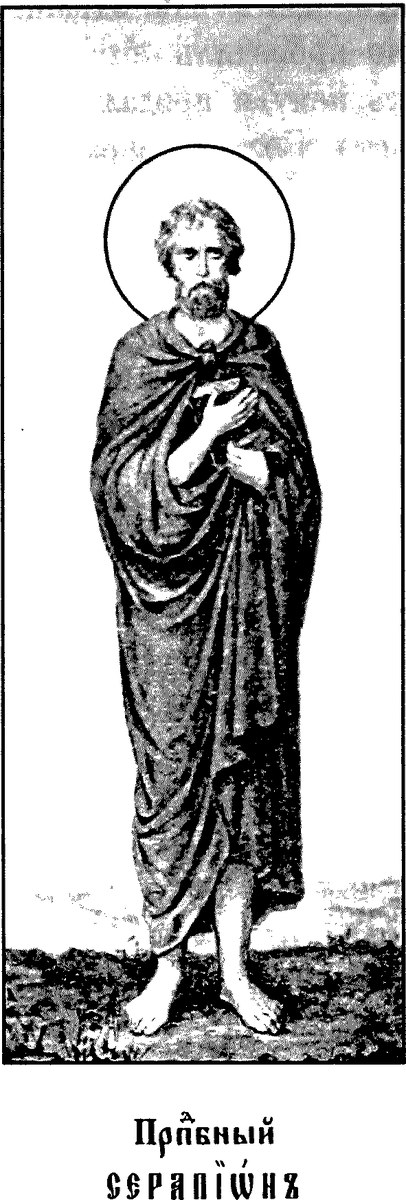
There is no fixed iconographic type for Serapion, and no early image of him is known. Where he is painted at all — in modern Greek and Romanian menologion cycles, and occasionally among the Egyptian fathers in a monastic refectory programme — he is shown as an aged ascetic, white-bearded, gaunt, barefoot and wrapped in a single undyed linen cloth, the sindōn that names him, sometimes with one shoulder bare; his hands are empty, or he holds a scroll inscribed with the saying about the Gospel he sold. He carries none of the usual monastic attributes — no koukoulion, no analavos, no book, no staff — and it is precisely this absence that identifies him. The stored image is the captioned plate of the illustrated Zhitiya Svyatykh (1903–1911).
Disputed questions
- Date. The synaxaria commonly place him in the fifth century; but Palladius, who wrote about 419–420 and reports meeting or hearing of him among his contemporaries, implies a life largely in the later fourth century. The fifth-century label of the calendars is retained here as the received one, with the earlier dating noted.
- Feast day. Slavonic usage and the Orthodox Church in America keep him on May 14; the Greek synaxarion keeps "Serapion the Sindonite" on March 21. Both days are recorded in this entry; the two are the same ascetic, not two saints.
- The name. Sindonitēs is from sindōn, the linen sheet; the form Sidonite, found in some manuscripts and modern lists, is a copyist's error that turns his garment into a birthplace at Sidon. He was an Egyptian.
- Not to be confused with the several other Serapions of the same milieu: Serapion of Thmuis (March 21 — the same day as this saint's Greek feast, which is the commonest confusion of all), the bishop, friend of Athanasius and author of the Euchologion; the Serapion of the company of Cronides, Leontius and Serapion (September 13); Serapion of Novgorod (†1516); and Serapion of Pechenga. Nor with Serapion the Great Abbot, the fourth-century Egyptian coenobiarch of the Arsinoite.