
Sergius and Bacchus
The Holy Great Martyrs Sergius and Bacchus of Syria
Martyr · d. c. 303–305
Commemorated 7 October — Joint commemoration; the day of Sergius's beheading at Rasafa
Sergius and Bacchus (†c. 303–305) were Roman officers of high rank and favourites of the emperor, exposed as Christians when they refused to enter the temple of Jupiter. Stripped of the insignia of their rank, dressed in women's clothing, and paraded through the city in mockery, they were sent to the Euphrates frontier of Syria, where Bacchus was scourged to death at Barbalissos and Sergius, forced to run in boots pierced with nails, was beheaded at Rasafa. Their joint cultus — the two are never separated — became one of the greatest of the Christian East: Rasafa grew into the pilgrimage city of Sergiopolis, the Arab tribes took Sergius as their patron, and Justinian raised their church in Constantinople, the "Little Hagia Sophia." They are commemorated together on October 7.

Rank and confession
The Passion of Sergius and Bacchus presents the two as Roman citizens of noble standing and intimates of the emperor it calls Maximian: Sergius primicerius (first officer) and Bacchus secundarius of the schola gentilium, an elite palace corps recruited from barbarian federates. Envious courtiers, unable to strike at men so highly placed except through their religion, informed the emperor that his two trusted officers did not honour the gods. The test was arranged as court ceremonial: the emperor entered the temple of Jupiter with his suite to sacrifice, and Sergius and Bacchus remained outside, praying to Christ. Summoned and commanded to sacrifice, they confessed one God and refused the idols.
The punishment struck first at their honour. They were stripped of the marks of their rank — the military belts, the gold neck-collars (maniakia), the rings — their names were ordered erased from the army's rolls, and they were dressed in women's clothing and led through the middle of the city with iron chains about their necks, the crowd jeering. The Passio has them walk through the mockery chanting, turning the parade into a procession: soldiers now of the heavenly King, they counted the shame their adornment, "putting off the form of the soldiery of this world." When the emperor, changing tack, appealed to them in friendship to return to the gods of Rome, they answered by refuting the idols, and he sent them east — out of his sight and out of Roman honour — to Antiochus, dux of the frontier province on the Syrian Euphrates, a notorious enemy of the Christians who owed his very office to Sergius's patronage.
Martyrdom at Barbalissos and Rasafa
At Barbalissos on the Euphrates, Antiochus pleaded with his former benefactors: "My fathers and benefactors, have pity on yourselves, and on me — I do not wish to condemn my benefactors to torture." The martyrs answered in the words of the Apostle: "For us, to live is Christ, and to die is gain." Antiochus then had Bacchus beaten with rawhide scourges until he died under the blows; his body was cast out unburied to the beasts and birds, and was recovered and hidden by Christians. That night, the Passio relates, Bacchus appeared to Sergius in radiance, showing him his crown and promising that they would not be parted: their fellowship, sundered in the body, awaited its restoration in glory.
Sergius's own contest was fitted to a soldier who had walked in honour: he was shod in boots through whose soles iron nails were driven, and made to run before the governor's carriage the long stage from Barbalissos to the fort of Tetrapyrgium — the tradition reckons some nine miles — and, after a night in which his wounds were found healed, was shod and driven again the further stage to the fortress of Rasafa. There, on October 7, he was beheaded with the sword. The accounts add that the beasts of the desert gathered to guard his body until the Christians of the place buried it. The conventional dating places the martyrdoms about 303–305, at the outbreak of the Great Persecution (see Disputed questions).
Rasafa becomes Sergiopolis
What followed made Sergius the most venerated martyr of the Syrian East. His grave at Rasafa — a small frontier fort on the barren steppe between the Euphrates and Palmyra — began to draw pilgrims within a century. About 425–434 Alexander, bishop of Hierapolis, the metropolis of the province Euphratensis in the Patriarchate of Antioch, built a worthy martyrium for the relics; by the middle of the fifth century Rasafa had its own bishop, and the city was renamed Sergiopolis, "the city of Sergius" — one of the very few cities of the empire to bear a martyr's name. Raised in time to metropolitan rank, exempt and honoured within the Antiochian sphere, it was ringed under Anastasius and Justinian with mighty walls — Procopius describes the fortification in his Buildings — that still stand in the Syrian desert, enclosing the great pilgrimage basilicas whose ruins are among the most impressive monuments of early Byzantine Syria. Pilgrims came from the whole East; the water cisterns of Sergiopolis, among the largest of antiquity, were built for their multitudes.
Patron of the Arabs, and a cult without borders
Sergius became, beyond any other saint, the patron of the Christian Arabs. The Ghassanid federate kings, Miaphysite Arabs who guarded the empire's desert flank, attached their dynasty's prestige to his shrine: the audience-hall of the phylarch al-Mundhir, its inscription still legible — "the fortune of al-Mundhir conquers" — stands outside the walls of Rasafa, where the king sat in assembly under the martyr's patronage. Tribes swore their oaths by Sergius, the rider-saint of the steppe, and his cult ran far beyond the imperial frontier: even the Persian king Khusrau II, no Christian, sent a gold cross and rich gifts to the shrine of Sergius in thanksgiving — for victory, and for the conception of a son by his Christian wife Shirin — as the historians Evagrius Scholasticus and Theophylact Simocatta record in wonder. After the Islamic conquest the caliph Hisham made his residence beside the city (Rusafat Hisham), and the veneration of Mar Sarkis continued unbroken among the Syriac- and Arabic-speaking Christians: monasteries and churches of Mar Sarkis and Bakos stand from Maaloula — where the liturgy is still heard in Aramaic — across Lebanon and Syria, and the pair remain among the best-loved saints of the Church of Antioch, in whose territory their whole story unfolded.
In Constantinople, Justinian and Theodora built for the pair, early in Justinian's reign (c. 527–536), the church of Saints Sergius and Bacchus beside the palace of Hormisdas — the domed marvel known from its resemblance to the Great Church as the "Little Hagia Sophia" (now the Küçük Ayasofya mosque), whose carved epigram names Sergius as the patron whom emperors delight to honour. The cult travelled west as well: Gregory of Tours knows relics of Sergius in Gaul in the sixth century, a church of Saints Sergius and Bacchus stood in Rome — served in time by the Syrian diaspora that gave Rome Pope Sergius I — and the Roman Martyrology keeps the pair on October 7 as the East does. Among Armenians the beloved Sarkis, among Syrians Mar Sarkis, among Arabs Sarjis: the name itself maps the cult's immense range.
Feast and commemoration
October 7 (church date; Old Calendar civil October 20), a universal commemoration of the Byzantine rite and the principal feast of the day: the received Menaion gives the whole office of the day to the pair. The Synaxarion of Constantinople heads the day "the holy great martyrs Sergius and Bacchus" — the Greek books thus accord them the great-martyr style, while the OCA and Slavic calendars title them simply "Martyrs Sergius and Bacchus in Syria"; the difference is one of styling, not of identity. The day's verses give each martyr his own distich — to Bacchus, sinews of bronze against the sinew-whips; to Sergius, a heart of fire against the sword. The Roman Martyrology likewise keeps the pair on October 7. In the Slavic tradition the day is also the tonsure-day name-feast of Sergius of Radonezh.
Hymns
Troparion — Tone 5 (Slavic proper)
Adornment of Christ's passion-bearers and eyes of the Church of Christ, enlighten the eyes of our souls, O Sergius of many sufferings and Bacchus most glorious: pray to the Lord, that we may flee the darkness of sin and be shown to be partakers of the light that knows no evening, by your prayers, O saints.
Original translation from the Slavonic
Troparion — Tone 4 (Greek usage — common of martyrs)
Thy martyrs, O Lord, in their contest received incorruptible crowns from Thee, our God; for possessing Thy strength they cast down the tyrants and shattered the feeble insolence of the demons. By their intercessions save our souls.
Original translation from the Slavonic
Kontakion — Tone 2
Arraying your minds manfully against the enemies, you overthrew all their deceit, and receiving victory from on high, O all-praised martyrs, you cried with one mind: Good it is, and pleasant, to be with Christ.
Original translation from the Greek
Iconography
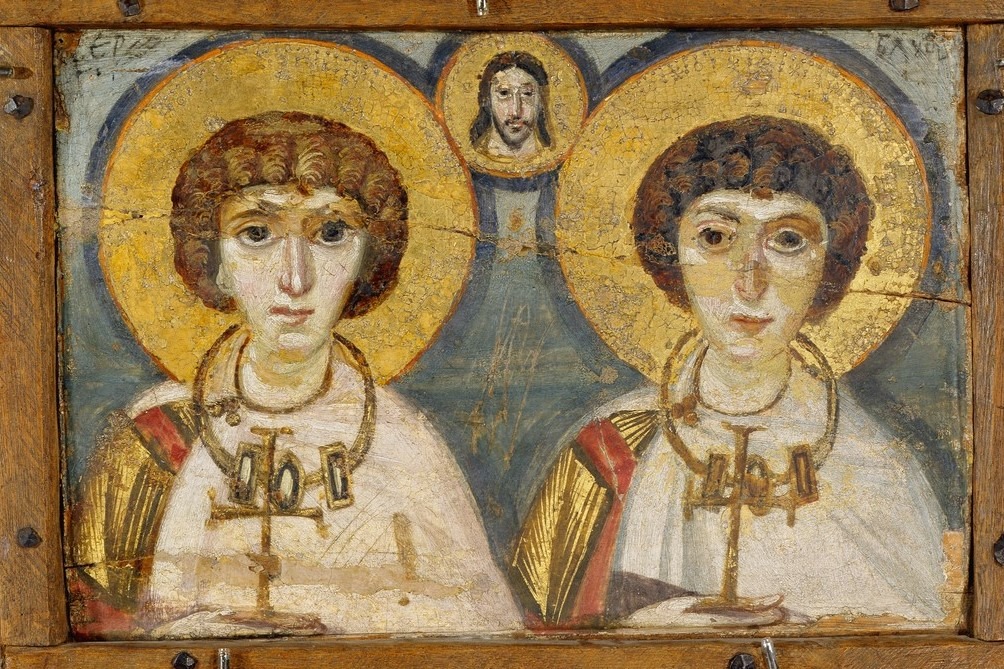
The iconography of Sergius and Bacchus is fixed and ancient: two beardless young officers, always together, in the court dress of their rank, each wearing the maniakion — the gold neck-torque of the palace guard that became their unmistakable attribute — often holding martyrs' crosses, with Christ blessing between them. Later Byzantine art also shows them as mounted warriors, and among the Christian Arabs Sergius above all is the rider-saint. The martyrdom scene shows Sergius kneeling beneath the sword with Bacchus standing by.
The stored primary image is one of the oldest icons in existence: the encaustic panel of the seventh century from Saint Catherine's Monastery on Sinai, brought to Kyiv in the nineteenth century by Porphyrius Uspensky and now in the Khanenko Museum. The two saints stand frontal, haloed, in white chlamydes with their gold maniakia and jewelled crosses, the medallion of Christ between their halos — a pre-iconoclastic witness to the pair's inseparable cult.
A second stored image is the miniature for October 7 from the Menologion of Basil II (Constantinople, c. 985; Vatican Library, Vat. gr. 1613): Sergius bends beneath the executioner's sword before the red mountain of the desert, while Bacchus stands haloed at the right — the two martyrdoms gathered into one scene.
Disputed questions
- Date and emperor. The Passio's "Maximian" is ambiguous — Maximian Herculius never governed the East, and scholars read the name as Galerius Maximianus or Maximinus Daia; the conventional dating of the martyrdoms, c. 303–305, places them at the outbreak of the Great Persecution, but dates as early as the 290s and as late as 311 appear in the literature.
- The Passio and the cult's beginnings. The Passion as we have it is a literary work of the fifth century, and it carries anachronisms — the schola gentilium in which the martyrs serve was instituted only under Constantine. The cult itself is securely attested from the early fifth century (Alexander of Hierapolis's martyrium, the see of Rasafa, and Severus of Antioch's homily on the pair a century later). David Woods has argued from the anachronisms that the historical kernel may belong to a later persecution altogether, a thesis discussed but not generally adopted; Elizabeth Key Fowden's study of the cult (The Barbarian Plain, 1999) treats the Passio as a fifth-century monument to an already flourishing veneration. The entry above tells the tradition as the Church received it and records the scholarly discussion here.
- The bond between the martyrs. The Passio's whole drama turns on the pair's inseparable devotion — comrades in rank, "one soul in two bodies" in the language of ancient friendship, brothers not by nature but by faith, as the Church's own hymns for the feast insist. In 1994 John Boswell (Same-Sex Unions in Premodern Europe) proposed that Sergius and Bacchus were a romantic couple and their cult a warrant for the Byzantine rite of brother-making (adelphopoiesis) understood as a union; the thesis rests in part on a single manuscript's use of the word erastai. Byzantinists and hagiographers have broadly rejected both the reading and the argument, situating the pair's love within the well-documented ideals of military comradeship and spiritual brotherhood. The question belongs to modern scholarship, not to the tradition, and is recorded here without adjudication.
- Not to be confused with the many later saints named for Sergius of Rasafa, above all Sergius of Radonezh (†1392), who received his monastic name because he was tonsured on this feast (October 7), nor with the other Sergii of the Russian calendars commemorated this same day (Sergius of Nurma, †1412; Sergius the Obedient of the Kiev Caves, 13th c.), whose entries are pending.