
Silvanus of Emesa
The Holy Hieromartyr Silvanus, Bishop of Emesa, and his companions Luke the Deacon and Mocius the Reader
Hieromartyr · Martyr · Bishop · Deacon · d. c. 312, at Emesa
Commemorated 29 January — Given to the wild beasts at Emesa with the deacon Luke and the reader Mocius
Silvanus, Bishop of Emesa in Phoenicia Libanensis (modern Homs, in Syria), was an aged hierarch given to the wild beasts in the amphitheatre of his city together with two of his clergy — Luke the deacon and Mocius the reader — in the great persecution, about the year 312. His martyrdom is one of the few of its region attested by a contemporary historian: Eusebius of Caesarea names Silvanus, "bishop of the churches about Emesa," among the bishops thrown to the beasts as the persecution reached its height. The Byzantine calendars keep the three together on January 29. Because his name and death so closely resemble those of his exact contemporary Silvan of Gaza, the two are constantly confused in the sources; they are distinct saints of the same persecution.

Emesa — the city of the great temple of the sun-god Elagabal, the home of the Severan empresses, and by the fourth century a Christian see — lay on the Orontes in the Roman province of Phoenicia. Silvanus was its bishop in the last and fiercest years of the persecution begun by Diocletian and pressed in the East by Maximinus Daza, when the churches of Syria and Palestine were emptied of their pastors. Already an old man, Silvanus had governed his church through the long assault and had not fled; when the order came for the destruction of the Christians of Emesa he was seized, with the clergy who had stood by him — the deacon Luke and the reader Mocius (Mucius) — and brought to judgment.
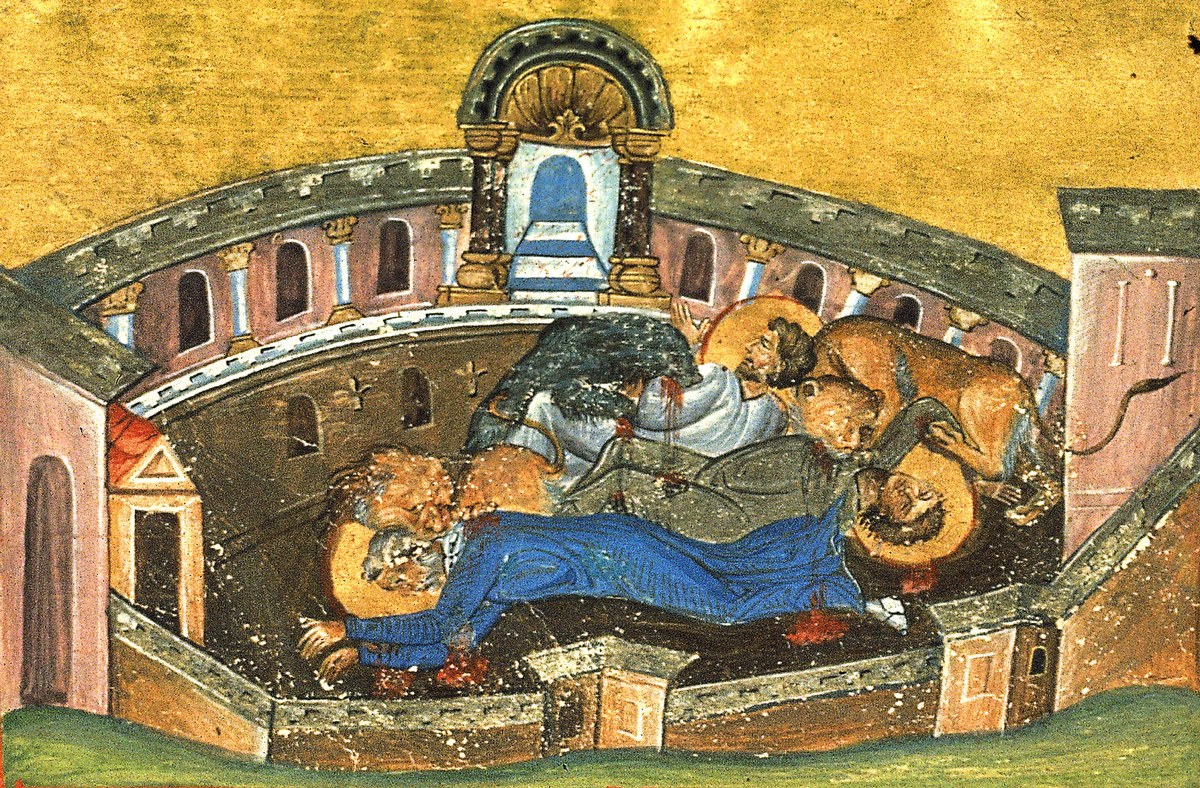
Refusing to sacrifice, and confessing Christ before the tribunal, the three were condemned to the cruelest of the public deaths: to be exposed to the wild beasts in the amphitheatre of Emesa for the entertainment of the people. There, before the crowd, the aged bishop and his two ministers were torn and devoured, and so received the martyr's crown together. The tradition dwells on the dignity of Silvanus's great age, the constancy of a shepherd who died with his own clergy about him, and the completeness of the little company — bishop, deacon, and reader, the ranks of the ministry offered whole in one martyrdom.
The eyewitness historian Eusebius, cataloguing the bishop-martyrs of the persecution in his Ecclesiastical History, sets Silvanus of Emesa in that company: after so many years of his episcopate, he writes, the old man "was given as food to the wild beasts, with others, at Emesa in Phoenicia." From that contemporary notice the memory passes into the synaxaria, which add the names of the deacon and the reader who died with him.
Feast and commemoration
January 29 (church date; New Calendar civil January 29; Old Calendar civil February 11), in the Greek Menaion, the Slavonic calendars, and the OCA's lives of the day — kept on the day led by the translation of the relics of Ignatius the God-bearer. The three martyrs of Emesa are commemorated together. No proper service is appointed; the common of a hieromartyr is used where the memory is kept liturgically. (Minor-order note: Mocius is styled a reader — ἀναγνώστης — a minor order for which the taxonomy has no term; it is recorded in prose, per the project's record of open questions.)
Hymns
Troparion — Tone 4 (from the common of a hieromartyr)
Sharing in the ways of the Apostles and a successor of their thrones, thou didst find in thy labours, O inspired of God, an ascent to divine vision; wherefore, rightly dividing the word of truth, thou didst contend for the faith even unto blood, O Hieromartyr Silvanus. Intercede with Christ our God that our souls may be saved.
Original translation from the Greek
Iconography
The stored image is the miniature of the Menologion of Basil II (Constantinople, 985): the bishop and his companions given to the beasts in the arena of Emesa, the lions and bear upon the blue-robed martyrs beneath the tiers of the amphitheatre — precisely the narrative type of their acts. A portrait icon would show Silvanus as an aged bishop in phelonion and omophorion, white-bearded, with the Gospel-book, his deacon and reader beside him.
Disputed questions
- The date and the reign. Eusebius sets the martyrdom in the final phase of the persecution, about 312, under Maximinus — the reckoning followed here, and given by the Slavonic calendars. A separate strand of the synaxarion tradition dates Silvanus of Emesa to the reign of the emperor Numerian (283–284); this is most probably a confusion, and the contemporary witness of Eusebius is preferred.
- Not to be confused with the hieromartyr Silvan of Gaza (†311, commemorated October 14), a soldier turned bishop of the churches about Gaza who was beheaded at the copper mines of Phaeno in the very same persecution: the two Silvani, both aged bishops of the Palestinian–Syrian coast martyred within a year of one another, are listed side by side by Eusebius and are continually mistaken for each other in the secondary literature. The distinguishing marks are the city (Emesa, not Gaza), the manner of death (the beasts, not the sword), the companions (Luke and Mocius), and the day (January 29, not October 14). Silvanus of Emesa is likewise distinct from the Apostle Silvanus (Silas) of the Seventy (July 30).