
Translation of the Relics of Ignatius the God-bearer
On January 29 the Church keeps the translation of the relics of the Hieromartyr Ignatius the God-bearer, Bishop of Antioch, who was devoured by beasts in the amphitheatre at Rome about the year 107. His companions gathered what the lions had left — his heart and the larger bones — and carried them the long way home, back over the road he had travelled in chains, to his own city of Antioch on the Orontes, where they were received with honour and laid to rest outside the gate near the suburb of Daphne. This homecoming of the God-bearing bishop to the see he had governed is the heart of the feast: the martyr who longed from Antioch to become "the pure bread of Christ" was given back to Antioch in his relics, the first and dearest treasure of the Patriarchate that traces its succession through him to the Apostle Peter. The relics were afterwards translated into the city itself and enshrined in a church raised in his name, and centuries later carried once more to Rome, to rest at San Clemente. The feast is one of the cornerstones of the cultus of the See of Antioch.
.jpg)
The martyr's remains and the road home
Ignatius was sent under military guard from Antioch across Asia Minor to Rome and there given to the wild beasts in the arena, on a day of public games, about the year 107 — the day the Church keeps as his principal feast on December 20. The Martyrium ascribed to his companions — the deacon Philo of Cilicia and Rheus Agathopous, who claim to have followed him to the end — records that after the beasts had done their work only the harder and larger of his bones remained, together with his heart; and that these the faithful gathered up as a treasure "more precious than gold and costly stones," wrapped in linen, and bore away.
The tradition is unanimous that the relics did not stay at Rome, the place of his crown, but were carried back to Antioch, the place of his labour. This return — the reversal of the martyr's own journey, the bishop borne home to his widowed church — is the event the feast of January 29 commemorates. The relics were received at Antioch with reverence and laid to rest outside the gate, not far from the beautiful suburb of Daphne, near the cemetery of the city, where the Christians of Antioch kept the memory of their God-bearing hierarch and resorted to his tomb.
The translation into the city (438)
The relics remained the treasure of Antioch through the persecutions and into the age of the Church's peace. In the reign of the emperor Theodosius II, about the year 438, they were solemnly translated from their resting-place outside the walls into the city itself and enshrined in a church dedicated to the saint — by the tradition, the former Tychaeum, the temple of the city's pagan Fortune (Tyche), which was cleansed and consecrated to Christ under the name of Ignatius, so that the shrine of the demon of the city became the shrine of its holy bishop. This translation into Antioch is reckoned by several of the Greek accounts as the very event the January 29 feast honours, and the two strands — the first carrying home from Rome, and the later enshrinement within the walls — belong together as the single movement by which Antioch received and kept her martyr. The Church of Antioch thus possessed, for some five centuries, the bodily relics of the third of her bishops and the first of her great teachers, at the physical centre of the city he had shepherded.
The Antiochian dimension
For the See of Antioch this feast is no mere commemoration of a relic-transfer but a keeping of the church's own foundations. Ignatius stands third in the line of her hierarchs — after the Apostle Peter, who founded the church, and Evodus — and he is the first bishop of the apostolic age to leave a body of writing, the seven epistles that are the earliest full witness to the office of the bishop as the living centre of the Church's unity: "Wherever the bishop appears, there let the congregation be; even as where Jesus Christ is, there is the catholic Church." That a church should possess, enshrined at its heart, the very bones of the hierarch who first taught it what a hierarch is, gave the See of Antioch a peculiar and treasured continuity; the presence of the relics bound the living bishops of Antioch to the God-bearer whose pattern they inherited. The feast of the translation is, in this sense, Antioch's feast of her own apostolic identity — the reason the Patriarchate of Antioch keeps the God-bearer not only among the martyrs of the universal calendar but as a father of its own house, whose return home the local church remembers with a proper joy.
The later translation to Rome
When, in the seventh century, the wars of the Persians and then of the Arabs overwhelmed Roman Syria and Antioch itself fell, the relics were removed for safety and, in the end, carried once more to Rome — the tradition placing the removal after the Persian sack (c. 540) or, more commonly, about the year 637 — and enshrined in the Basilica of San Clemente, where they rest today beneath the high altar, a homecoming of another kind to the city of his martyrdom. The relics of the God-bearer have thus made a threefold journey — Rome to Antioch, within Antioch, and Antioch to Rome — and portions are venerated more widely still, on Mount Athos and elsewhere. But the feast of January 29 looks to the first and the tenderest of these movements: the bringing of the martyr home to the church that bore him.
Feast and commemoration
January 29 (church date; New Calendar civil January 29; Old Calendar civil February 11). The feast is kept universally in the Byzantine rite as the translation of the relics of Ignatius, and stands as the day's leading commemoration. It is the second of the God-bearer's two feasts, complementing the December 20 commemoration of his martyrdom: December 20 keeps the crown at Rome, January 29 the homecoming to Antioch. Ignatius's own Life, writings, and the full account of his martyrdom belong to his entry, which this feast file supplements and to which it is cross-linked; the person is not re-minted here. The Menaion appoints a proper office of the translation — apolytikion, kontakion, stichera, and canon — sung with the day's other commemorations, chief among them the Martyrs of Samosata and Silvanus of Emesa and his companions.
Taxonomy flag — feast_type. The controlled feast_type vocabulary of PRD
§5.3 (indiction | theotokos-synaxis | icon-of-the-theotokos | angelic | dominical | theotokian | dedication | deliverance) has no value for the
translation or veneration of a saint's relics — the character of this feast,
which is a translation-of-relics in the sense of the per-feast rank list, a
value that does not exist among feast_types. Following the precedent already
set in this collection — the Veneration of the Chains of Peter
(January 16) and the Translation of the Relics of John Chrysostom
(January 27), both typed feast_type: dedication as the nearest available term — this feast is likewise
given feast_type: dedication, the choice being additionally supported here by
the historical enshrinement of the relics in a dedicated church of Ignatius
at Antioch (the consecrated Tychaeum). The term is nonetheless a stretch: the
feast honours the movement and reception of a portable relic, not the anniversary
of a church's consecration. No new term is minted. The gap is flagged, extending
the standing feast_type question at the project's record of open questions — which already
records the parallel absence of a generic synaxis value and, in its
relic-feast note, proposes a relic / relic-veneration feast_type — to which
this translation feast is a further witness.
Hymns
Apolytikion
Winged with divine longing for him who once held thee in his undefiled hands, thou wast shown to be a God-bearer, O Ignatius; having finished thy course in the West, thou hast pitched thy dwelling in the unwaning day of the heavens. Wherefore intercede with Christ our God, that our souls may be saved.
Apolytikion
Receiving today with gladness the myrrh-breathing shrine of thy relics as a treasury enriching her with gifts, the Church rejoiceth and is glad, and in faith crieth out to thee: O all-praised Ignatius, most sacred Father, cease not to intercede with Christ for those who in faith and love honour thy memory.
Kontakion — Tone 4
Having risen today from the East and illumined all creation with thy teachings, thou wast adorned with martyrdom, O God-bearing and divine Ignatius.
Original translation from the Greek
Appointed readings
Epistle — Hebrews 4:14–5:6
14Seeing then that we have a great high priest, that is passed into the heavens, Jesus the Son of God, let us hold fast our profession. 15For we have not an high priest which cannot be touched with the feeling of our infirmities; but was in all points tempted like as we are, yet without sin. 16Let us therefore come boldly unto the throne of grace, that we may obtain mercy, and find grace to help in time of need. 1For every high priest taken from among men is ordained for men in things pertaining to God, that he may offer both gifts and sacrifices for sins: 2Who can have compassion on the ignorant, and on them that are out of the way; for that he himself also is compassed with infirmity. 3And by reason hereof he ought, as for the people, so also for himself, to offer for sins. 4And no man taketh this honour unto himself, but he that is called of God, as was Aaron. 5So also Christ glorified not himself to be made an high priest; but he that said unto him, Thou art my Son, to day have I begotten thee. 6As he saith also in another place, Thou art a priest for ever after the order of Melchisedec.
Gospel — Mark 9:33–41
33And he came to Capernaum: and being in the house he asked them, What was it that ye disputed among yourselves by the way? 34But they held their peace: for by the way they had disputed among themselves, who should be the greatest. 35And he sat down, and called the twelve, and saith unto them, If any man desire to be first, the same shall be last of all, and servant of all. 36And he took a child, and set him in the midst of them: and when he had taken him in his arms, he said unto them, 37Whosoever shall receive one of such children in my name, receiveth me: and whosoever shall receive me, receiveth not me, but him that sent me. 38And John answered him, saying, Master, we saw one casting out devils in thy name, and he followeth not us: and we forbad him, because he followeth not us. 39But Jesus said, Forbid him not: for there is no man which shall do a miracle in my name, that can lightly speak evil of me. 40For he that is not against us is on our part. 41For whosoever shall give you a cup of water to drink in my name, because ye belong to Christ, verily I say unto you, he shall not lose his reward.
Iconography
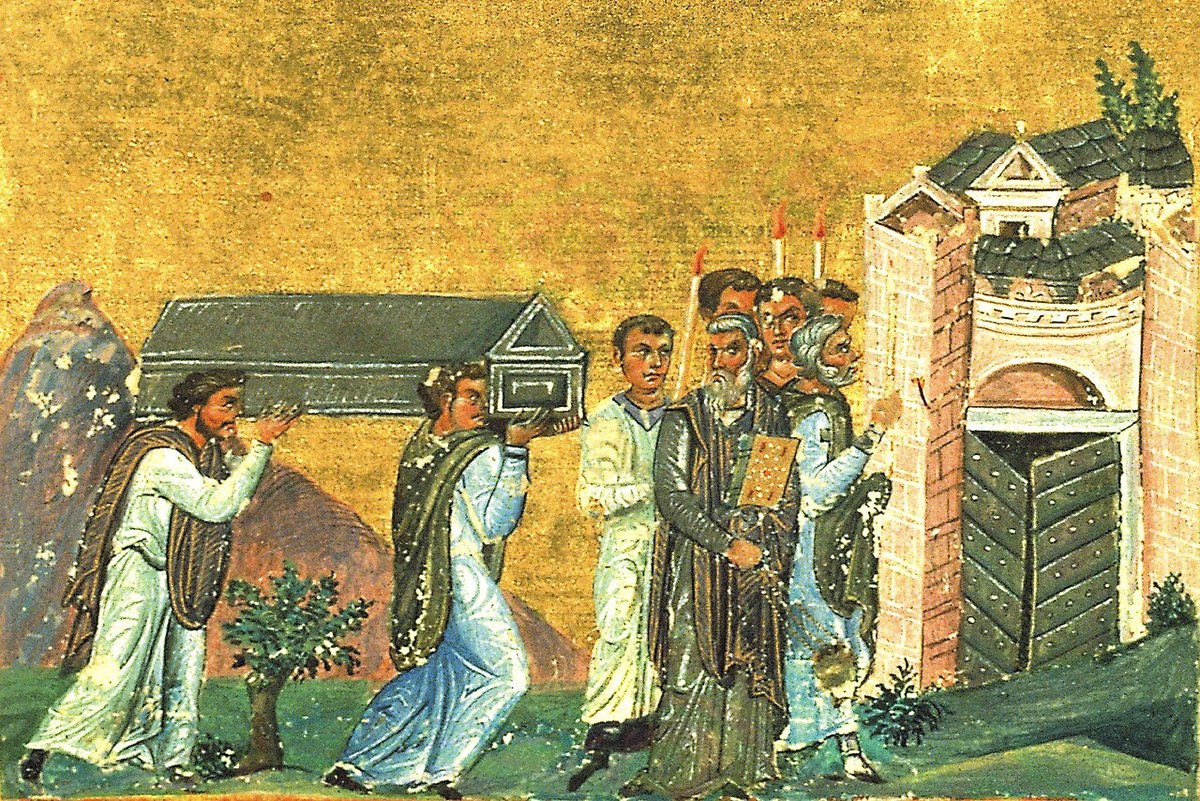
The feast is imaged by the narrative type of the translation: the reliquary-coffin of the saint borne in procession — carried by deacons or clergy, preceded by candle-bearers and a bishop bearing the Gospel-book — toward the church that will receive it, the visual form of the relics' homecoming. It is distinct from the martyrdom type (Ignatius between the lions in the arena) proper to December 20. The stored image is the miniature from the Menologion of Basil II (Constantinople, c. 985; Vatican, Vat. gr. 1613) depicting the translation of the relics of Ignatius — the coffin carried in procession toward the church (source, public domain, pd-old-work). The same miniature is stored in the God-bearer's own entry as the illustration of this feast.