
Sophia and her Daughters Faith, Hope and Love
The Holy Martyr Sophia and her Three Daughters, the Virgin-Martyrs Faith, Hope and Love
Martyr · Virgin · Child Martyr · d. c. 126–137
Commemorated 17 September — Martyrdom at Rome under Hadrian
Sophia ("Wisdom") was a Christian widow of Italy whose three young daughters — Faith, Hope and Love (Pistis, Elpis and Agape; in Slavic use Vera, Nadezhda and Lyubov), aged twelve, ten and nine — were tortured and beheaded at Rome under the emperor Hadrian (117–138), the mother being compelled to watch. Burying her children on a hill outside the city, Sophia kept vigil at their grave and died there on the third day; the Church crowns her as a martyr in heart though not in blood. Their relics have been venerated at Eschau in Alsace since 777. They are commemorated together on September 17.

Origins and early life
The passio, transmitted in both Greek and Latin recensions, presents Sophia as a devout widow of Italian origin — later tradition names Milan — who came to live at Rome with her three daughters. She had named the girls for the three great virtues of 1 Corinthians 13: Pistis (Faith), Elpis (Hope) and Agape (Love), and raised them in piety answering to their names, so that the whole household was, as the hymnographers delighted to observe, a living image of Wisdom bringing forth the theological virtues. At the time of their trial Faith was twelve years old, Hope ten, and Love nine.
The family made no secret of its Christianity. Denounced — the accounts name an official, Antiochus — they were summoned before the emperor Hadrian himself. The passio relates that mother and daughters prepared themselves by prayer, and that their composure before the tribunal astonished the court: they came, the narrative says, as though invited to a wedding feast rather than to torment.
Martyrdom
Hadrian examined the sisters one by one, from the eldest, urging each to sacrifice to Artemis and each time meeting the same refusal. The tortures the passio then describes are extreme in proportion to the children's ages, and the Lord's preservation of the girls through them is the narrative's theme: Faith was scourged and burned upon an iron grating; Hope was cast into fire and into a cauldron of boiling pitch; Love, the youngest, was stretched — some accounts say upon a wheel — and beaten with rods until her small body was covered with welts. Through it all the sisters encouraged one another, and their mother, forced to watch as her own most refined torture, did not weaken but exhorted her daughters to endure for the sake of their heavenly Bridegroom. All three were finally beheaded.
Sophia was not executed. The emperor, the passio says, permitted her to take the bodies — a calculated cruelty, that her grief might complete what the sword had begun. She laid her daughters' remains in coffins, carried them on a wagon beyond the city, and buried them with honour on a high place outside Rome. For three days she sat at the grave without leaving it, and on the third day she gave up her soul to God. The faithful buried her beside her children, and the Church has always numbered her with the martyrs: she suffered, as the synaxaria put it, not in the flesh but in her heart, martyred three times over in each daughter and a fourth time in her own dying.
The traditional dating places the martyrdom under Hadrian, c. 126–137; the sources do not permit a more exact year (see Disputed questions).
Relics and translations
The Western tradition takes up the story of the relics. In 777/778 Remigius, bishop of Strasbourg, obtained relics of Sophia at Rome — the gift is associated with Pope Adrian I — and translated them to the Benedictine convent he had founded at Eschau (Alsace, near Strasbourg), which he placed under her patronage. Eschau remained a pilgrimage centre through the Middle Ages, its Romanesque abbey church of Saint-Trophimus housing the shrine. At the French Revolution the abbey was suppressed and sold (1793) and the relics were scattered and lost; in 1938 a relic of Sophia was again obtained from Rome for the parish church of Eschau, and the pilgrimage was revived. The Western books keep Sophia on September 30, the civil day on which the Old Calendar churches, by coincidence of the present thirteen-day offset, now keep September 17.
Veneration and later cultus
In the Christian East the four martyrs became and remain among the most beloved of the Roman saints. Their veneration is strongest in the Slavic lands, where the translated names Vera, Nadezhda and Lyubov — with Sofia untranslated at their head — are among the most common of women's baptismal names, and September 17/30 is kept as a great collective name-day. Churches are dedicated to the four throughout the Russian world. In Greek use the names remain Pistis, Elpis and Agape, and Sophia is a favoured baptismal name in their honour.
Hymnographic and literary legacy
The Byzantine service, transmitted in the Menaion for September 17, is rich for saints of this rank: proper stichera (Tone 4, to Edōkas sēmeiōsin), a canon in Tone 1 by Theophanes the Branded whose acrostic reads "I celebrate the illustrious and splendid children of Sophia," a proper kontakion and oikos, and an exaposteilarion that calls the sisters "maidens of the Trinity, named for the triad of virtues." The hymnography plays constantly and deliberately on the allegory latent in the names: Wisdom bringing forth Faith, Hope and Love, the three girls as an earthly icon of the Trinity, and the mocking of pagan "wisdom" by children who bore the true Wisdom's name.
Feast and commemoration
September 17 (church date; Old Calendar civil September 30), within the afterfeast of the Universal Elevation of the Cross, with whose service the martyrs' office is combined in the Menaion; the four are the principal commemoration of the day in every Byzantine-rite calendar consulted (Antiochian, OCA, Greek, Russian). The Roman church keeps Sophia of Eschau on September 30, with an older and now-suppressed commemoration of the three sisters in early August (see Disputed questions). In Slavic lands the day is a major name-day festival.
Hymns
Troparion — Tone 4 (Slavic use)
The Church of the firstborn keepeth festival, and rejoiceth with her, receiving the mother who rejoiceth over her children; for she, bearing the name of wisdom, bore three daughters equal in number to the theological virtues, and beholdeth them, with the wise virgins, wedded to the Bridegroom, God the Word. With her we also rejoice in spirit at their memory, saying: O champions of the Trinity, Faith, Love and Hope, establish us in faith, love and hope.
Original translation from the Slavonic
Kontakion — Tone 1
Shown forth as most sacred branches of the noble Sophia, Faith, Hope and Love by grace made foolish the wisdom of the Greeks; and having contended and proved victorious, they were wreathed with a crown incorruptible by Christ, the Master of all.
Original translation from the Greek
Iconography
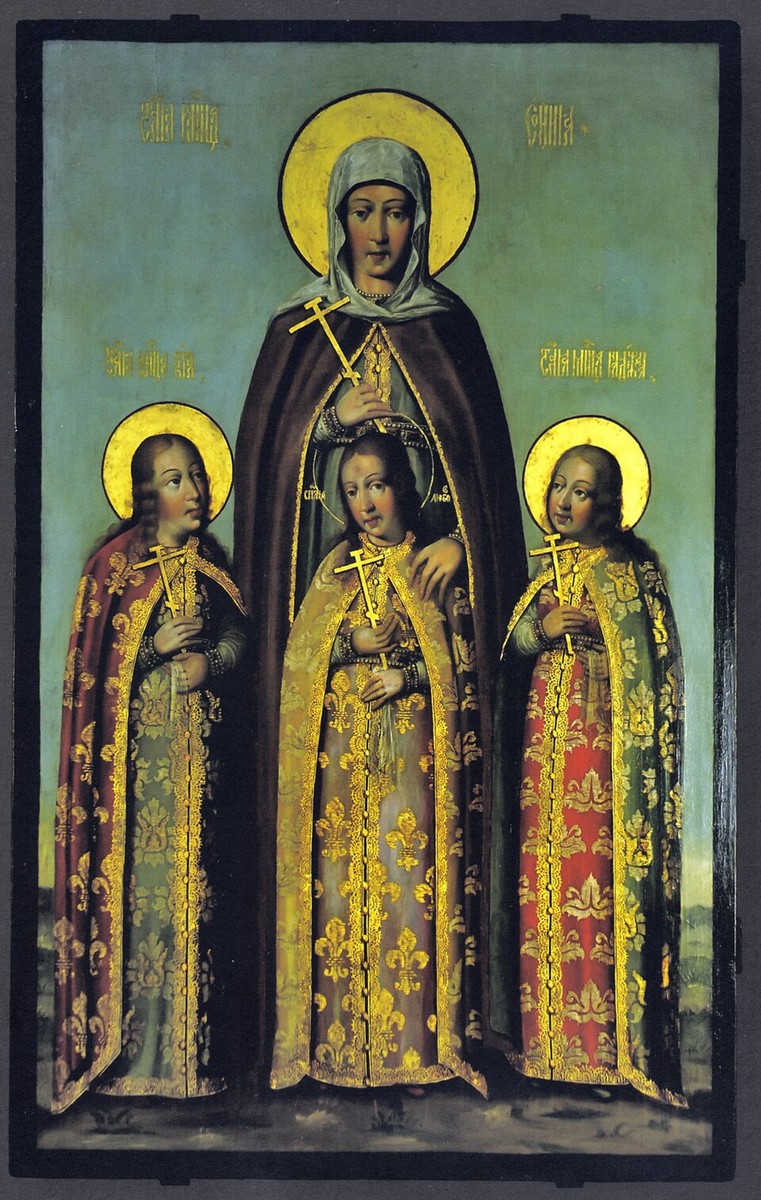
The four are almost always painted together: Sophia, a mature matron in a dark maphorion, standing behind or above her three small daughters, who are shown in descending height in rich maidens' robes, each holding a martyr's cross; Sophia often extends her hands over them or holds them in a protecting gesture. The composition is a catechism in itself — Wisdom presenting Faith, Hope and Love. The primary stored image is a large Moscow icon of 1685 by Karp Zolotaryov, painted for the Novodevichy convent; the variant is the miniature for September 17 in the Menologion of Basil II (c. 1000), which compresses the whole passio into one scene: the executioner beheading the last of the daughters, the severed haloed heads upon the ground, and Sophia at the right laying her children's bodies in the tomb. A 16th-century Novgorod-school icon of the standing composition also survives on Commons.
Disputed questions
- Date. The passio fixes only the reign: Hadrian (117–138). Later martyrologies and synaxaria offer c. 126 or c. 137, and neither year can be verified; this entry gives the range.
- Historicity and the personification question. Modern hagiographical scholarship, from Adolf von Harnack to Hippolyte Delehaye and after, has asked whether the cult began not with a historical family but with a personification: Wisdom (Sophia/Sapientia) as mother of the three theological virtues of 1 Corinthians 13:13, an allegory turned into a passio by an edifying author. The grounds are real: the schematic names and ages, the absence of secure early evidence of the cult at Rome, the late and literary character of the passio (BHG 1637x–1637z; BHL 2966, where the mother is "Sapientia"), and the existence in the Latin books of two commemorations — the three sisters with their mother in early August, and a Sophia on September 30 — which may be one tradition doubled. On the other side stands the unbroken reception of the four as historical martyrs by the liturgical tradition of East and West alike, the relic tradition at Eschau since the eighth century, and the fact that allegorically apt names were genuinely borne in the ancient Church. The question is recorded here as open: the tradition and the criticism both deserve their statement, and the veneration of the four does not stand or fall with the literary history of their passio.
- Order of the names. The received order is Faith, Hope, Love (so the ages 12, 10, 9), but the Greek books vary — the Menaion's own title for the day reads "Pistis, Agape and Elpis," and the Slavic troparion invokes "Faith, Love and Hope."
- Not to be confused with the feast of the icon of Sophia the Wisdom of God (the Kiev icon, kept September 8, and the Novgorod icon, kept August 15 in Russian use): those feasts, like the great churches of Hagia Sophia, honour Christ as the personal Wisdom of God, not the Roman widow-martyr — though popular devotion has often mingled the two, and the Kiev iconography itself draws the martyr Sophia's family into its scheme. Nor with the martyr Sophia of Egypt, who suffered with Irene in the third century and is commemorated the very next day, September 18.