
Sophia and Irene of Egypt
The Holy Martyrs Sophia and Irene of Egypt
Martyr · d. 3rd century
Commemorated 18 September — Martyrdom by the sword in Egypt
Sophia and Irene were two women martyred for Christ in Egypt in the third century — the Russian tradition places their death under the emperor Aurelian (270–275), at the hands of Claudius, governor of Egypt — and the Greek synaxarion records that they were perfected by the sword after tortures. Their relics are said to have been translated to Constantinople by Constantine the Great. They are commemorated together on September 18. They are not to be confused with Sophia of Rome, the mother of the martyrs Faith, Hope and Love, commemorated the day before (September 17), nor with the great-martyr Irene (May 5).
.jpg)
The record of Sophia and Irene is a synaxarion line, and this entry keeps to it. The Greek notice for September 18 states simply that the holy martyrs Sophia and Irene were perfected by the sword (ξίφει τελειοῦνται). The Russian menological tradition, drawing on the older martyrologies, fills in the frame: the two women suffered in Egypt — the OCA places the martyrdom at Alexandria — in the reign of Aurelian (270–275), under Claudius, the governor of Egypt, and were beheaded after enduring tortures for their confession of Jesus Christ. Nothing is transmitted of their station in life, their ages, or their relationship to one another; the pairing of their names in every calendar is the whole of what survives of their story.
Relics and translations
The Russian tradition adds one later notice: their relics were translated to Constantinople ("Tsargrad") by Constantine the Great — a report that, if exact, would place the translation within two generations of their death, when the new capital was gathering the relics of the martyrs of the persecutions. No shrine or later history of the relics is recorded.
Feast and commemoration
September 18 (church date; Old Calendar civil October 1), within the afterfeast of the Elevation of the Cross. The commemoration is universal in the Byzantine rite: the Greek synaxarion carries the two martyrs by name, and the Russian calendar lists "мцц. Софии и Ирины Египетских (III)." The OCA joins Castor to their company as described above. They have no proper service; the day's hymnody belongs to the Cross and to Eumenes of Gortyna.
Hymns
Troparion — Tone 4 (from the common of martyrs)
Thy martyrs, O Lord, in their contest received incorruptible crowns from thee, our God; for possessing thy strength they cast down the tyrants and broke the feeble insolence of the demons. By their intercessions save our souls.
Original translation from the Greek
Iconography
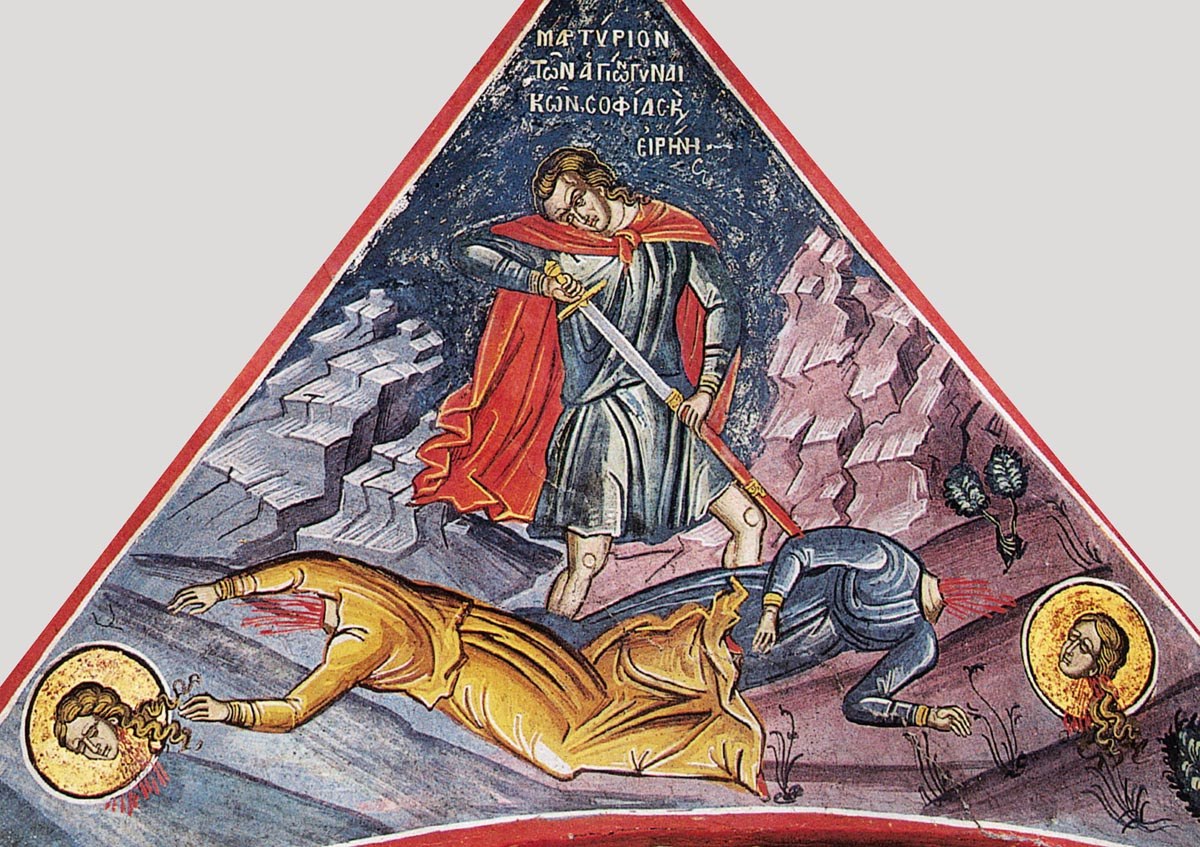
The stored image is the fresco of Zorzis Fouka in the katholikon of Dionysiou Monastery on Mount Athos (1547), inscribed in Greek "The martyrdom of the holy women Sophia and Irene" — the executioner sheathing his sword between the two beheaded martyrs, their haloed heads laid at the corners of the frame. The inscription names the pair exactly, which matters here more than usually: icon images labelled "Saint Sophia" almost always depict Sophia of Rome with her three daughters, and images of "Saint Irene" the great-martyr of Thessalonica; neither should be used for this commemoration. (The Menologion of Basil II gives its September 18 miniatures to Eumenes of Gortyna and Ariadne of Phrygia.)
Disputed questions
- Not to be confused. Two better-known same-named saints stand close to this commemoration and are perennially confused with it: Sophia of Rome, mother of Faith, Hope and Love, whose feast falls the previous day (September 17); and the great-martyr Irene, popularly called "of Thessalonica" (May 5). The Egyptian Sophia and Irene of September 18 are distinct persons with no connection to either.
- The company of Castor. The OCA heads the day's entry "Martyrs Sophia, Irene, and Castor of Egypt," joining to the two women the martyr Castor, of whom the Greek and Slavic synaxaria make a separate commemoration on the same day, with no place or company recorded. Whether Castor suffered with them or merely shares their date the sources do not say; this collection keeps the two commemorations distinct, as the older calendars do, and records the OCA's grouping here.