
Sophronius of Vratsa
Our Father among the Saints Sophronius, Bishop of Vratsa
Bishop · b. 1739, at Kotel — d. 1813, at Bucharest
Commemorated 11 March — Commemoration of Saint Sophronius, Bishop of Vratsa
Sophronius of Vratsa (1739–1813), born Stoyko Vladislavov, was a bishop of the Church of Bulgaria and one of the fathers of the Bulgarian National Revival. A priest of Kotel who copied out Paisius of Hilendar's Slavo-Bulgarian History and carried its call for national awakening, he was made Bishop of Vratsa in 1794, taking the name Sophronius; driven from his see by the lawlessness of the age, he withdrew at last to Wallachia, where he wrote and printed the Nedelnik (Kyriakodromion, "the Sunday Book," 1806) — the first printed book in modern Bulgarian — and his celebrated autobiography, The Life and Sufferings of Sinful Sophronius. A tireless labourer for the enlightenment and the liberation of his people, he died in Bucharest about 1813 and was glorified by the Bulgarian Orthodox Church in 1964; he is commemorated on March 11.

Stoyko of Kotel
The saint was born in 1739 at Kotel, a town of the eastern Balkan range famed for its craftsmen and its schools, and was named Stoyko Vladislavov. Orphaned young — his mother died when he was three, his father when he was about eleven — he was raised in hardship, learned his letters in Slavonic and Greek at the town's church school, and worked for a time at a craft before he was ordained priest of Kotel in 1762. As a village priest under the Ottoman yoke he knew the full weight of the age: the exactions of the Turks, the depredations of the roving brigand-bands (the kŭrdzhalii), and the slow strangling of Bulgarian learning under the Greek-speaking higher clergy.
The awakener: Paisius and the History
In 1765 the priest Stoyko met Paisius of Hilendar, the Athonite monk whose Istoriya Slavyanobolgarskaya (Slavo-Bulgarian History, 1762) had sounded the first trumpet of the Bulgarian awakening, summoning his countrymen to remember their name, their tongue, and their forefathers. Stoyko made one of the earliest and most important copies of the History — the "Sophronian transcript" that still bears his later name — and became a carrier of its message, a link between Paisius's solitary vision and the national movement that grew from it. This is his first title to a place among the fathers of the Bulgarian Revival.
Bishop of Vratsa
After years of trial as a parish priest — including journeys to Mount Athos in the 1770s — the widowed Stoyko was consecrated Bishop of Vratsa (Vratchа) on 17 September 1794, and took in religion the name Sophronius. But his episcopate was broken almost at once by the anarchy of the kŭrdzhali years: the countryside of his diocese was ravaged, and the bishop himself was more than once in peril of his life and even held captive. About 1797 he was forced to leave Vratsa, and after years of wandering and danger he crossed the Danube and settled at last, from about 1803, in Bucharest, in the Romanian principality of Wallachia, where a large Bulgarian émigré community had gathered.
The writer and printer
It is the Bucharest years that made Sophronius immortal in the memory of his people. In 1806 he published at Rimnic his Nedelnik — the Kyriakodromion, a collection of sermons for the Sundays and feasts of the year, rendered into the plain spoken Bulgarian of his day so that ordinary people could understand it. It was the first printed book in modern Bulgarian, and it broke the long silence of the printed vernacular; through it Sophronius became the father of modern Bulgarian prose. In the same years he wrote his autobiography, The Life and Sufferings of Sinful Sophronius (Zhitie i stradaniya greshnago Sofroniya) — a frank, vivid, and moving first-person account of his hard life and his times, the first true autobiography in Bulgarian literature and a classic of the Revival. He translated and composed other works of instruction and devotion as well, all bent to the one end of enlightening his people.
The patriot, and repose
During the Russo-Turkish War of 1806–1812 Sophronius, from Bucharest, became a spokesman for the Bulgarians before the Russian command, appealing for the protection and the eventual liberation of his nation and helping to raise Bulgarian volunteers — so that he stands at the head of the political as well as the literary awakening of Bulgaria. He died at Bucharest about the year 1813, his last known act dated to that summer, and was buried there. His memory was kept as a father of the nation long before it was kept as a feast; the Bulgarian Orthodox Church glorified him as a saint on 31 December 1964, and appointed his commemoration for March 11.
Feast and commemoration
Sophronius of Vratsa is commemorated on March 11 (church date; Old Calendar civil March 24), chiefly by the Bulgarian Church, which glorified him in 1964, and he is listed by the OCA as "Sophronius, Bishop of Vratcha (Bulgaria)." His feast shares the day with the far more ancient Sophronius, Patriarch of Jerusalem — the two hierarchs of the same name, of the seventh century and of the nineteenth, kept together on the eleventh of March — and, like the other commemorations of the day, ordinarily falls within Great Lent. He is not to be confused with the Patriarch of Jerusalem, nor with the sixth-century Sophronius, Bishop of Cyprus (kept December 8). Nor is he the "Sophronius of Bulgaria" that older English calendars occasionally list on May 11: the Sophronius of that day is Sophronius the Recluse of the Kiev Far Caves, and Sophronius of Vratsa — the only Bulgarian hierarch of the name — is kept on March 11 alone.
Iconography
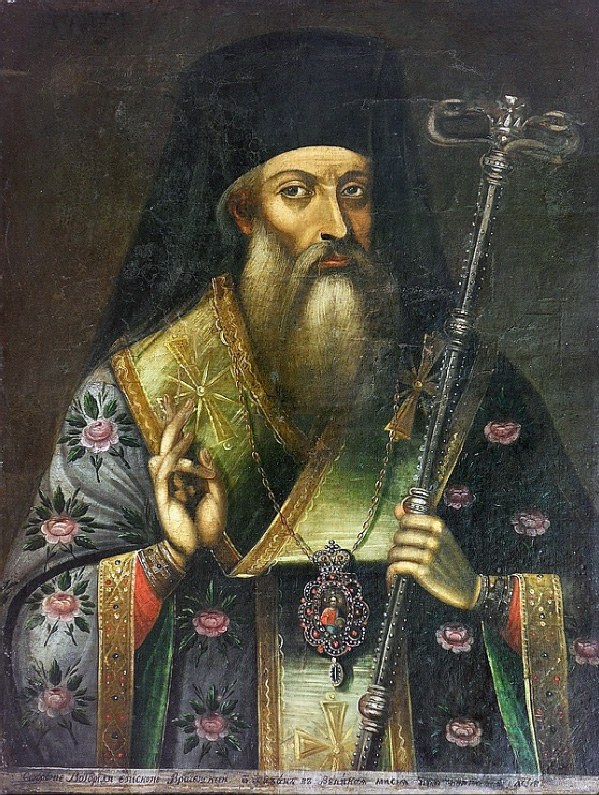
As a saint glorified in the twentieth century, Sophronius of Vratsa is depicted in modern Bulgarian icons in the type of a hierarch of the Revival: a bishop in phelonion or sakkos and omophorion, with the engolpion and the Gospel or a scroll, sometimes holding a book to mark his labour as a writer and printer, his features drawn from the engraved portrait in his own 1806 Nedelnik — the first printed portrait of a Bulgarian — which fixed his long-bearded, grave appearance for posterity. Because his authentic likeness and his iconography are of the modern period, the historical portraiture remains the ground of his icons.
The stored image is the celebrated 1812 portrait — the earliest and standard likeness of the bishop, painted within living memory.