
Sophronius of Jerusalem
Our Father among the Saints Sophronius the Sophist, Patriarch of Jerusalem
Bishop · b. c. 560, at Damascus — d. 11 March 638 (some 639), at Jerusalem
Commemorated 11 March — Repose at Jerusalem
Sophronius the Sophist (c. 560 – 638) was Patriarch of Jerusalem in the last years before the Arab conquest, and one of the towering figures of seventh-century Orthodoxy. A rhetorician of Damascus turned monk, he was for decades the companion and disciple of John Moschus, with whom he wandered the monasteries of Palestine, Egypt, Sinai and the West gathering the sayings that became the Spiritual Meadow; healed of an eye disease at the shrine of Cyrus and John, he wrote their Miracles, and he composed the Life of John the Almsgiver of Alexandria. As a hymnographer he gave the Church a wealth of stichera and the learned anacreontic odes, and above all the great consecratory prayer of the Great Blessing of the Waters at Theophany, "Great art thou, O Lord." Raised to the throne of Jerusalem in 634, he spent his brief patriarchate as the first and most formidable opponent of Monotheletism — his Synodical Letter is the founding document of the Orthodox defence of the two wills of Christ, the cause Maximus the Confessor would carry to martyrdom. He lived to see Islam overwhelm the Holy Land, preached the Saracens' seizure of Bethlehem at the very Nativity, and negotiated the surrender of Jerusalem to the Caliph Umar; he died soon after, on March 11, 638.

Damascus, the schools, and the monastic call
Sophronius was born about the year 560 at Damascus, of a Christian family of the Syrian metropolis, and received the full education of the late-antique Greek world — grammar, rhetoric, and philosophy — so completely that he carried through his whole life the surname by which the tradition still knows him, "the Sophist" (ὁ σοφιστής): a master of the schools, a teacher of rhetoric before he was a teacher of the faith. The learning is not incidental to his sanctity. It is everywhere in his writings — in the metrical exactness of his anacreontic verse, the rhetorical architecture of his homilies, the dogmatic precision of his Synodical Letter — and the Church, playing on his name, made his very learning a figure of holiness: Sophronios, it heard, is the man of sophrosynē, of sound-mindedness and self-mastery, wisdom turned to temperance.
Drawn from the world to the ascetic life, he attached himself — while still, it seems, a layman and a young man — to the monastic circles of Palestine, and above all to a certain John, a monk of the monastery of Saint Theodosius the Cenobiarch near Bethlehem, surnamed Moschus ("the little calf") and better known to the world as the author of the Spiritual Meadow. The bond between the two men — Moschus the elder, Sophronius his disciple and inseparable companion — is the frame of the first half of Sophronius's life, and one of the great friendships of monastic history.
The wandering years and the Spiritual Meadow
For some four decades Sophronius and John Moschus travelled together through the monastic world of the Christian East, gathering the wisdom of the fathers before the age that had produced them passed away. They went from the lauras and coenobia of the Judaean desert — Saint Theodosius, the New Laura, and others — to the monasteries of Egypt: the great communities of the Thebaid, and the Enaton, the monastic suburb of Alexandria, where the desert tradition met the learning of the city. They visited Sinai and the monasteries of its wilderness, and ranged through Asia Minor and the islands to Rome itself. Everywhere they went they set down what they saw and heard — the sayings, the struggles, the miracles and the deaths of the monks — and out of this harvest John Moschus composed the Spiritual Meadow (Λειμών, Leimonarion; the Latin Pratum Spirituale), the most beloved of all the collections of monastic tales, which he dedicated to "my Sophronius," the companion of his wanderings. The Meadow is as much Sophronius's book as Moschus's: the fruit of their shared pilgrimage, and the reason later scholarship sometimes names them together as its authors.
The purpose of these journeys was not antiquarian. The monasteries of the East in these decades were the front line of a bitter struggle against Monophysitism — the denial of the two natures of Christ defined at Chalcedon — and Sophronius and Moschus travelled in part as champions of the Chalcedonian and Orthodox faith, strengthening the wavering, disputing with the Severan and other anti-Chalcedonian communities that were strong in Egypt, and binding the scattered Orthodox of Alexandria to the great patriarch who then held its throne.
Egypt, John the Almsgiver, and the Miracles of Cyrus and John
That patriarch was John the Almsgiver (John V of Alexandria, †c. 620), the Cypriot nobleman whose boundless charity made his name a byword. Sophronius and Moschus attached themselves to him and became his counsellors and his weapons in the defence of the Chalcedonian faith in Egypt; and when the almsgiving patriarch died, it was Sophronius (with Moschus) who wrote the first Life of John the Almsgiver, the supplementary biography that preserves, beside the great man's mercy, the labours of his two Palestinian advisers in the Alexandrian church — a Life on which every later account of the Almsgiver draws.
Egypt gave Sophronius a second and more personal debt. He fell gravely ill of a disease of the eyes that the physicians could not cure, and went as a suppliant to the shrine of the holy Unmercenaries Cyrus and John at Menouthis, near Alexandria — the great healing sanctuary to which the sick of the whole region came. There, the tradition holds, he was healed; and in thanksgiving he composed a work that is at once a monument of gratitude and one of our richest documents of the cult of the healing saints: the Miracles of Cyrus and John (the Thaumata), seventy accounts of cures wrought at the shrine, prefaced by an encomium of the two martyrs. The book is a window onto the piety, the medicine, and the daily life of Byzantine Egypt on the eve of its loss, and it fixed the memory of Cyrus and John in the calendar of the whole Church.
When John Moschus died — at Rome, about the year 619, whither the pair had withdrawn before the advancing Persians — Sophronius fulfilled his master's last wish: he carried the body back across the sea to the Holy Land and buried it at the monastery of Saint Theodosius, where their long companionship had begun. The first half of Sophronius's life closes with that grave; the second opens with the loss of the Holy Land itself.
Hymnographer and poet
Through all these years Sophronius was writing, and the Church counts him among its great hymnographers. To him the tradition ascribes a large body of liturgical poetry: idiomela and stichera for the feasts — most famously the stichera of the Royal Hours of the Nativity and of the Theophany, and hymns of the forefeasts — and the verses sung at the blessing of waters and through the festal cycle. He is credited with revising and enriching the Horologion and the psalmody of the Jerusalem rite, the usage of the Holy City that would shape the whole Byzantine office. And he composed the learned Anacreontica — twenty-three odes in the classical anacreontic metre, on the great feasts, on the holy places of Jerusalem, on the Persian sack of the city and the loss of the True Cross, and on his own longing for the Holy Land: poems in which the last rhetorician of Christian antiquity turns the metres of the pagan schools to the praise of Christ and the lament of a vanishing world.
His single most enduring composition is liturgical and is prayed to this day. The great consecratory prayer of the Great Blessing of the Waters at Theophany — "Great art thou, O Lord, and marvellous are thy works, and there is no word which sufficeth to hymn thy wonders" (Μέγας εἶ, Κύριε…) — is attributed by the tradition to Sophronius: a sustained hymn of praise that recounts the whole economy of salvation, calls the Holy Spirit down upon the water, and prays that in it the Lord may crush the heads of the dragons and make it a fountain of incorruption. Through that prayer, sung every January at every font and frozen river of the Orthodox world, Sophronius's voice reaches further than any of his other works. He is likewise held to have written the Life of Saint Mary of Egypt, the harlot-turned-hermit of the Jordan desert, read each Great Lent — though the ascription is debated (see Disputed questions).
Patriarch of Jerusalem
In the year 634 Sophronius, now an old man of some seventy-four years and long famous for learning and sanctity, was raised to the throne of Jerusalem, succeeding Modestus, who had restored the holy places after the Persian devastation of 614. He came to the see at the very hinge of its history: the Roman recovery of the Holy Land under Heraclius was barely a decade old, the True Cross had lately been carried back in triumph — and already, out of the deserts to the south, the armies of the new faith of Islam were moving north into Syria and Palestine. Sophronius's patriarchate, brief and beset, was spent on two fronts at once: the defence of Orthodox doctrine against a heresy promoted by the emperor himself, and the pastoral care of a Church about to pass under the sword.
The defence of the two wills: against Monotheletism
The doctrinal battle is Sophronius's chief title to greatness. The emperor Heraclius and the Patriarch Sergius of Constantinople, seeking to win back the great Monophysite populations of Syria, Egypt and Armenia — whose loyalty the empire could ill afford to lose with the Arabs at the gates — had devised a formula of reunion: that in Christ, though the two natures be confessed, there is but one operation (energeia) and, in the developed form, one will (thelēma) — Monoenergism and then Monotheletism. In 633 the formula won a great apparent success when Cyrus, Patriarch of Alexandria, used it to reconcile a large body of Egyptian Monophysites in the "Pact of Union."
Sophronius — then still a monk, in Alexandria at the time — saw at once what was at stake, and became the first and most uncompromising opponent of the new teaching. He fell at the feet of Cyrus and begged him to withdraw the offending article; failing there, he hastened to Constantinople and pressed Sergius himself. Sergius, to quiet the storm, issued the Psephos, forbidding all talk of "one operation" or "two operations" alike — a truce that suited the innovators, since it silenced their critics. Then, in 634, Sophronius was made Patriarch of Jerusalem, and the critic became a see-holder who could no longer be silenced.
His answer was his enthronement Synodical Letter (634), addressed to Sergius of Constantinople and to Pope Honorius of Rome — one of the great dogmatic documents of the age. In it Sophronius set out the whole Chalcedonian faith with scholastic fullness and drew the necessary conclusion the compromise had tried to bury: that since in Christ there are two natures, unconfused, each retains and acts by its own natural operation and its own natural will — a full divine willing and a full human willing, united without division in the one person of the Word. To confess one will, he argued, is to confess a truncated humanity, a Christ who did not truly assume all that he came to save. He is said further to have gathered some six hundred patristic testimonies in support of the two operations, an arsenal for the coming controversy; and, foreseeing that he himself would not live to see the fight through, he charged his deputy Stephen of Dora, upon Golgotha itself, to carry the cause to the Apostolic See of Rome and never to rest until the heresy was condemned.
Sophronius died before the storm broke in full — before the imperial Ekthesis of 638 made Monotheletism official, before the Typos, the Lateran Council of 649, and the sufferings of Maximus the Confessor and Pope Martin. But it was Sophronius who first named the danger, first defined the Orthodox answer, and first set in motion the resistance that the Sixth Ecumenical Council would vindicate in 681. Maximus, who had been formed in the same Palestinian monastic world and revered Sophronius as his master in the faith, took up and carried to martyrdom the cause the old patriarch had begun. The Orthodox doctrine of the two wills of Christ has its human origin in the Synodical Letter of Sophronius of Jerusalem.
The Arab conquest and the surrender of Jerusalem
The second front was the loss of the Holy Land. In the years of Sophronius's patriarchate the armies of the Caliphate poured into Palestine; the decisive Roman defeat at the Yarmuk (636) laid Syria and the Holy Land open, and the cities fell one by one. The horror of it fills Sophronius's last sermons. At the very Nativity of 634, unable to lead his people the few miles to Bethlehem because the Saracens held the road, he preached a famous Christmas homily lamenting that the faithful were kept from the Cave of the Nativity by the sword of the newcomers — one of the earliest Christian witnesses to the Arab conquest from within. In other sermons he read the disaster, in the old prophetic manner, as the chastisement of Christian sins, and called his flock to repentance as the only true defence.
At last Jerusalem itself was besieged, and in 637–638, when the city could hold out no longer, it was Sophronius who negotiated its surrender. He refused to yield the Holy City to any lieutenant, and stipulated that the Caliph Umar ibn al-Khattab should come in person to receive it. Umar came; and to him Sophronius surrendered Jerusalem, securing in return the covenant known as the Assurance of Umar (the Umariyya) — a guarantee of the lives, the property, the churches and the religious liberty of the Christian inhabitants, on the settled terms of the conquest. The tradition preserves the scene of the aged patriarch conducting the conqueror through the holy places; and the famous story that when the hour of Muslim prayer came upon them within the Church of the Resurrection, Umar declined to pray inside it, lest his followers should afterward seize the church as the site of a caliph's prayer, and prayed instead outside — where the Mosque of Umar was later raised. Whatever its precise words, the surrender of Sophronius set the pattern of the dhimma under which the Christians of the Holy Land would live for centuries.
Repose
Sophronius did not long survive the loss of his city. Broken, the tradition says, by grief at the desecration of the holy places and the passing of Jerusalem under a foreign faith, he reposed on March 11, in the year 638 (some sources 639), an old man of near eighty, having governed the see for about four years. He was buried in Jerusalem. A late and isolated notice that he was put to death by the Arab commander is not the common tradition, which holds that he died in peace, worn out by sorrow and by age; the Church keeps him not as a martyr but as a confessor of Orthodoxy and a holy hierarch.
Feast and commemoration
Sophronius is commemorated universally on March 11 (church date; Old Calendar civil March 24), the day of his repose, kept alike by the Greek, the Antiochian, and the Slavic calendars. The date falls, by the movable reckoning, most often within Great Lent — in 2026, in the Fifth Week of the Fast — so that on a weekday the full Liturgy is not served and his office is sung with the Lenten order; where the day falls on a Saturday or Sunday of the Fast his feast is kept more fully. His memory stands close, in the calendar, to that of his own disciple in the faith Maximus the Confessor (January 21 and August 13) and to the Sunday of Saint Mary of Egypt, whose Life the tradition gives to his hand, so that the Lenten setting of his feast gathers up the threads of his own labours. As the author of the prayer of the Great Blessing of the Waters he is remembered again, unnamed but present, at every Theophany.
Hymns
Troparion — Tone 4
A rule of faith and an image of meekness, a teacher of temperance, the truth of things revealed thee to thy flock; therefore by humility thou hast gained the heights, and by poverty the things of wealth. O Father and Hierarch Sophronius, intercede with Christ our God, that our souls may be saved.
Original translation from the Greek
Kontakion — Tone 8
Moved by divine zeal, and opening thy lips to declare the true commandments, thou didst well order the foundations of the Church and deliver them to the monastic company that dwelt there; O all-wise Sophronius of Jerusalem, chief among patriarchs, thou hast brought thy most wise words forth into the light, and, guided by them, we cry to thee: Rejoice, O radiant boast of the Orthodox.
Original translation from the Slavonic
Iconography
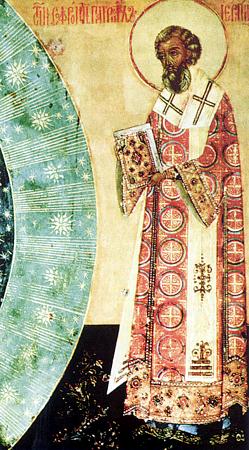
Sophronius is depicted in the settled type of a holy hierarch: an aged bishop, white-haired and with a long, full, tapering beard, vested in the phelonion or the cross-figured polystavrion, wearing the omophorion and holding the Gospel-book or blessing with his right hand. As a patriarch of the apostolic era of Jerusalem he is shown with the grave dignity of the great teaching hierarchs, and he is distinguished in a group chiefly by his inscription. Because his fame rests on learning and hymnody rather than on a dramatic martyrdom, he has no narrative icon of his own; where the scene of the surrender of Jerusalem is painted, he appears as the patriarch before the Caliph, and in Theophany contexts his authorship of the blessing-prayer links his image to the feast of the waters.
The stored image is a Russian icon of the 18th–19th century depicting Sophronius as a hierarch — the aged, long-bearded bishop in omophorion, blessing, with the Gospel — in the traditional type (source, public domain, pd-old-work). It is a small reproduction and is flagged for replacement by a higher-resolution or earlier image.