
Sozon of Cilicia
The Holy Martyr Sozon
Martyr · d. c. 304
Commemorated 7 September — Martyrdom at Pompeiopolis
Sozon (†c. 304) was a young Christian shepherd of Lycaonia, named Tarasios before his baptism, who suffered martyrdom at Pompeiopolis in Cilicia during the last great persecution. Warned of his coming contest in a vision at a spring where he watered his flock, he went to Pompeiopolis, broke the golden hand from a pagan idol and gave the gold to the poor, then surrendered himself so that no one else would suffer for his deed. Tortured with iron claws, iron boots nailed to his feet, and rods, he died confessing Christ. He is the chief saint of September 7, with a proper kontakion and a full canon in the Menaion.
.jpg)
Origins and early life
The synaxaria place Sozon's origins in Lycaonia, the inland Anatolian country bordering Cilicia, in the later third century. He was a shepherd, and before his baptism bore the name Tarasios; on becoming a Christian he received the name Sozon — from the Greek σῴζειν, "to save" — a name on which the hymnography of his feast plays repeatedly. The tradition remembers him as a young man who read the Scriptures attentively while keeping his flocks, drew other shepherds and passers-by to the knowledge of Christ, and reproached himself with being "inferior to the sheep" whose meekness he admired.
One day, watering his flock at a spring beneath an oak, he fell asleep and received a vision foretelling his martyrdom, with the promise that the place itself would afterwards become a source of grace and healing. Waking, he entrusted his sheep to a fellow shepherd and set out for the city of Pompeiopolis in Cilicia.
Martyrdom
At Pompeiopolis, grieved by the idolatry he found, Sozon entered a pagan temple and with his shepherd's staff broke off the right hand of a golden cult-statue. He shattered the gold into pieces and distributed it to the poor. The outrage set the city in an uproar: the governor of Cilicia, Maximian, ordered a search for the culprit, and innocent people were seized and tortured for a confession. Hearing this, Sozon presented himself to the governor of his own accord, declaring that he had done the deed, and that the idol's gold was of more use to the hungry than to a "god" that could neither feel the blow, cry out, nor defend itself — proof, he said, of its powerlessness.
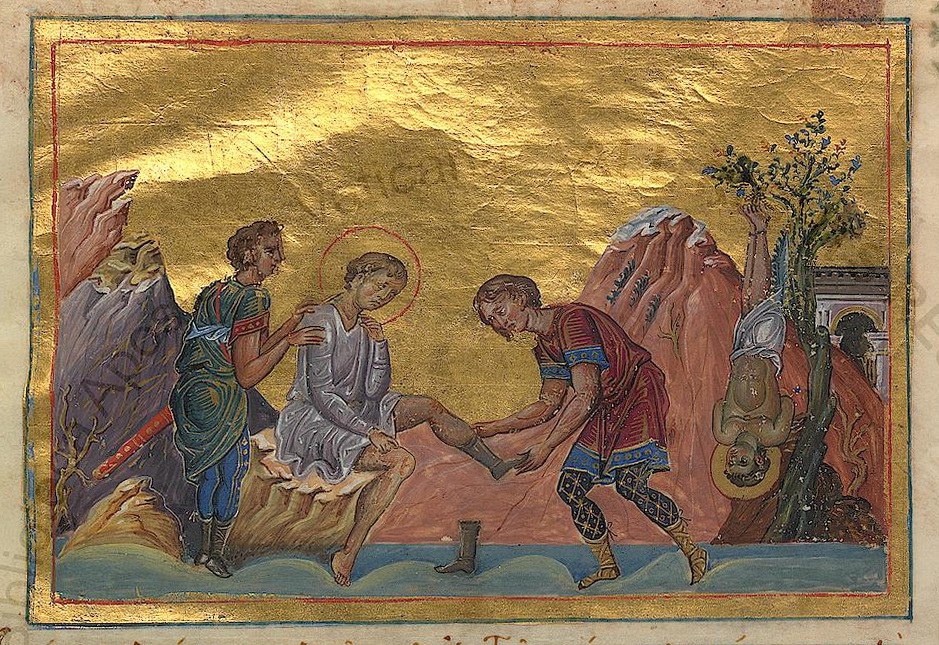
Maximian had him tortured without mercy. He was suspended and his body raked with iron claws; iron boots were nailed through his feet, and he was paraded through the city; hung up again, he was beaten with iron rods until his bones were broken. Glorifying Christ throughout, he gave up his soul under the blows, in the year 304 by the most common reckoning. The soldiers built a pyre to burn the body and deny the Christians their martyr's relics, but — so the account continues — a sudden storm of thunder, rain and hail extinguished the fire and scattered the pagans. The faithful came by night, and a light from heaven showed them where the relics lay; they buried them with honour.
Relics, veneration and miracles
Miracles are recorded both at the martyr's tomb and at the spring under the oak where he had received his vision; a church of Saint Sozon was later built beside the spring, and the healing associated with both places kept his memory alive across the Greek world. His cultus is ancient and universal: the Synaxarion of Constantinople and the Menologion of Basil II both carry his memory on September 7, the Menologion with a miniature of his torments, and the Roman Martyrology commemorates him on the same day. The Menaion gives him a proper kontakion, a kathisma, an exaposteilarion and a full canon — unusually full provision for a martyr of his era, and the mark of a living Byzantine cultus. Churches under his patronage survive in Cyprus and Greece, and his name remains in use among Greek and Slavic Christians.
Feast and commemoration
September 7 (church date; Old Calendar civil September 20), within the forefeast of the Nativity of the Theotokos, with which his service is joined in the Menaion. Sozon is the principal saint of the day in all Byzantine-rite calendars — Antiochian, Greek, Slavic — and the Roman Martyrology keeps him on the same date. In the received Greek Menaion the apolytikion and kontakion of the day are those of the forefeast, the martyr receiving stichera, a kathisma, a canon and an exaposteilarion; the Slavonic Menaion additionally appoints him the common troparion of a martyr and a proper kontakion.
Hymns
Troparion — Tone 4
Thy martyr Sozon, O Lord, in his contest received the crown of incorruption from thee, our God; for possessing thy strength he cast down the tyrants and broke the feeble insolence of the demons. By his prayers, O Christ God, save our souls.
Original translation from the Greek
Kontakion — Tone 2
Assembling today, let us with loud voices praise the true and divinely wise martyr, the proven champion of godliness, Sozon, the initiate of grace, the most bountiful giver of healings; for he prays to Christ God for us all.
Original translation from the Slavonic
Iconography
Sozon is painted as a young, beardless martyr, in the short tunic of a shepherd or the mantle of a martyr, with a cross in his hand; scenes of his passion show the iron boots of his torment. The stored image is the miniature of the Menologion of Basil II (Constantinople, c. 985; Vatican Library, Vat. gr. 1613): the young saint, haloed, sits while an executioner fastens the iron boots to his feet — the distinctive torture of his acts — with a second martyr shown hung on a tree behind.
Disputed questions
- Date of death. The commonest date, followed by the Slavic tradition and the OCA, is 304, within the Diocletianic persecution; parts of the Greek tradition give c. 288, under the reign of Diocletian and Maximian before the general persecution. The governor is named Maximian in the acts, and some retellings have confused him with the co-emperor of that name.
- Homeland. The sources divide between making him a Lycaonian who suffered in Cilicia and calling him simply a Cilician; the martyrdom at Pompeiopolis in Cilicia is constant, and "of Cilicia" (or "of Pompeiopolis") is his usual style.
- Original name. The name Tarasios before baptism is carried by part of the tradition (and survives in the Italian hagiographic tradition as "Farasio"); the oldest synaxarion notices know him only as Sozon. This pre-baptismal name is not to be confused with the later hierarch Tarasius, Patriarch of Constantinople (†806, February 25), a wholly different saint who bore the name in his own right.