
Tarasius of Constantinople
Our Father among the Saints Tarasius, Archbishop of Constantinople
Bishop · b. c. 730, at Constantinople — d. 25 February 806, at Constantinople
Commemorated 25 February — Repose at Constantinople
Tarasius (c. 730 – 806) was Patriarch of Constantinople from 784 to his death — a layman and imperial secretary raised in a single week through all the grades of the priesthood to the patriarchal throne, on the one condition that an ecumenical council be summoned to heal the Church of the iconoclast heresy. With the Empress Irene he convened and presided over the Seventh Ecumenical Council (Nicaea II, 787), which condemned iconoclasm and restored the veneration of the holy icons, teaching that the honour paid to the image passes to its prototype. A gentle and moderate shepherd who received repentant iconoclasts back into communion, he governed the Church for twenty-two years under three sovereigns, resisted the emperor Constantine VI in the "adulterous marriage" affair, and was renowned as a great almsgiver who spent his fortune on the poor, the aged, widows and orphans, serving them at table with his own hands. He reposed in peace on 25 February 806 and was buried in the monastery he had founded on the Bosphorus, where miracles were worked at his tomb.

Origins and imperial service
Tarasius was born at Constantinople about the year 730, into one of the great patrician families of the capital — a household of senatorial rank, related (the tradition and his kinsman Photius the Great attest) to the same confessing stock that would later give the Church the Patriarch Photius, his great-nephew. His father is remembered as a man of high judicial office, upright and charitable; his family gave him the finest education the city afforded, in the sacred writings and in the whole round of Hellenic learning, and he grew to be admired for eloquence, prudence, and a gravity of life beyond his years.
He entered the imperial service and rose swiftly, attaining the rank of senator and the office of imperial secretary (πρωτοασηκρῆτις, protasekretis) — the chief of the chancery, one of the most confidential posts in the palace — under the young emperor Constantine VI and his mother, the Empress Irene, who governed as regent. In the world he lived, the sources agree, as one already half a monk: unmarried, temperate, given to prayer and to the study of the Scriptures, using the wealth and station of his office as a steward rather than a possessor. It was this reputation — a layman of unblemished life, learning, and administrative genius, and known to be sound on the question of the icons — that would carry him, against his own will, to the throne of the Church.
The vacancy of the see and the iconoclast crisis
The Church into which Tarasius was called had been torn for two generations by iconoclasm — the imperial policy, inaugurated by Leo III and pressed with violence by Constantine V, of proscribing and destroying the holy images and persecuting those who venerated them, a policy given the false colour of a council at the palace of Hieria in 754. With the death of the iconoclast emperor Leo IV in 780 and the regency of his widow Irene, herself a venerator of the icons, the tide began to turn; but the hierarchy, the army, and much of the capital were still deeply committed to the iconoclast settlement, and the restoration of Orthodoxy could not be accomplished by a stroke of the pen.
In 784 the Patriarch Paul IV, who had governed uneasily and had taken the iconoclast oath on his accession, was seized with remorse. He withdrew to the monastery of Floros, received the great schism of the monastic habit, and — when the Empress and her son came to him — declared that he could no longer bear the guilt of a Church cut off from the other patriarchates and estranged from Orthodoxy, and that only an ecumenical council could set matters right. He died soon after; and when the question of a successor was put to the assembly of the people and the senate, the choice fell, by common acclamation, upon the layman Tarasius.
From layman to patriarch
Tarasius resisted. In a celebrated address to the assembly — which he afterwards set out in a letter — he protested that he was unworthy, that the office terrified him, and, above all, that he would not accept a Church at war with the rest of Christendom: he would take up the burden only if a general council were convened, in union with the see of Old Rome and the Eastern patriarchates, to restore the icons and the communion of the Churches. The Empress and the people consented; and, being still a layman, Tarasius was ordained in the space of a few days through all the intervening grades — reader, subdeacon, deacon, presbyter — and consecrated Archbishop of Constantinople on 25 December 784, the feast of the Nativity of Christ.
His elevation straight from the lay state drew criticism — from the rigorists at home, and from Pope Adrian I of Rome, who in his letters objected both to the uncanonical speed of the promotion and to the imperial style still used of the Constantinopolitan see; yet Adrian, recognising the Orthodoxy of the new patriarch and the promise of a council, sent his legates and lent his authority to the work. It was a pattern the age would repeat: after Tarasius, both Nicephorus and Photius would likewise be carried from the lay state to the patriarchate, and his own case became the precedent invoked for theirs.
The Seventh Ecumenical Council (Nicaea II, 787)
The great work of Tarasius's life was the Seventh Ecumenical Council. Letters went out to Rome and to the Eastern patriarchs, and a synod was summoned to meet at the Church of the Holy Apostles in Constantinople in the summer of 786. It was broken up almost before it began: soldiers of the capital's garrison, loyal to the memory of Constantine V and to iconoclasm, burst in under arms and scattered the fathers. Undismayed, Tarasius and Irene bided their time, replaced the mutinous regiments with troops drawn from the provinces, and reconvened the council the following year — not at the capital but at Nicaea in Bithynia, the city of the First Council, where in September and October 787 some three hundred and sixty-seven bishops assembled under the presidency of Tarasius, with the legates of Pope Adrian and representatives of the Eastern patriarchs.
Over seven sessions the council examined the whole question of the images. It heard the patristic testimonies read out, exposed the forgeries and the misreadings on which the council of 754 had rested, received back with mercy the iconoclast bishops who repented and confessed the Orthodox faith, and then set forth the definition (horos) that remains the Church's charter on the holy icons: that the making and veneration of the images of Christ, of the Theotokos, of the angels and the saints is agreeable to the Gospel; that they are to be honoured with reverence and the offering of incense and lights, but not with the true worship (λατρεία) which belongs to God alone; and that — in the words that became the touchstone of the whole doctrine — "the honour paid to the image passes to its prototype," so that he who venerates the icon venerates the person depicted in it. With the council's decree the first iconoclasm was, for a generation, undone, and the seventh and last of the ecumenical councils took its place in the Church's memory; the "Triumph of Orthodoxy" over iconoclasm is kept to this day on the First Sunday of Lent, and Tarasius is numbered among the fathers whose labour restored the icons.
Pastor and almsgiver
For twenty-two years Tarasius governed the Church of Constantinople, and the tradition remembers him as a shepherd of great gentleness. His policy toward the former iconoclasts was one of economy and mercy: bishops who had held office under the heresy were, on repentance and a right confession, left in their sees, rather than being deposed. This clemency earned him the sharp opposition of the rigorist party led by Theodore the Studite and the monks of Stoudios, who thought the discipline too lax; the disagreement, recorded honestly by both sides, runs through the whole later history of his patriarchate, and would flare again over the affair of the emperor's marriage.
Above all he was famed as an almsgiver. He lived himself in monastic austerity, and turned the resources of the patriarchate outward to the poor: he founded and endowed hospices and homes for the aged, the destitute, and the stranger, and made it his own practice — the synaxaria dwell on this — to gather the poor at his table and to serve them with his own hands, waiting on them as a servant, most of all at the Paschal feast. He kept careful watch over the clergy and against the buying and selling of holy office; the accusation of tolerating simony, which some later brought against him, he answered in a surviving letter to Pope Adrian, condemning the traffic in ordinations in the strongest terms.
The "adulterous marriage" (the Moechian affair)
The gravest trial of his rule came from the palace. In 795 the young emperor Constantine VI put away his lawful wife, the Empress Maria of Amnia, confined her to a convent, and took in her place a kinswoman of the court named Theodote. The act was a public scandal and a breach of the Church's law, and Tarasius refused to bless the union or to lend the patriarchate's sanction to it. A court priest named Joseph performed the marriage instead; and though Constantine, enraged, threatened the patriarch and is said to have hinted at a return to iconoclasm, Tarasius did not yield to the pressure to recognise the second marriage, and for his firmness fell for a time into the emperor's disgrace. The rigorists of Stoudios, for their part, held that Tarasius had not been severe enough — that he ought at once to have excommunicated the emperor and the priest Joseph — and the quarrel over the right measure of discipline, the "Moechian" (from μοιχεία, adultery) controversy, outlived both the patriarch and the emperor. Constantine VI was in the end deposed and blinded by the party of his own mother Irene in 797; Tarasius continued at his post, and the marriage he had refused to bless passed away with the reign that made it.
Repose
Tarasius served the Church under three sovereigns — Constantine VI, Irene, and Nicephorus I — and reposed in peace at Constantinople on 25 February 806, after a patriarchate of some twenty-two years. As his end drew near, the tradition relates, he was granted a vision of his soul's passage and the accusations of the demons at the toll-houses, and met death in prayer and confidence. He was buried in the monastery he had built on the Bosphorus, on the European shore, which bore his name; and there, the synaxaria record, miracles and healings were worked at his tomb, sealing the memory of the gentle patriarch who had given the icons back to the Church. He was succeeded on the throne by the confessor Nicephorus, who would defend the icons anew when the second iconoclasm broke out under Leo the Armenian.
Hymnographic and literary legacy
Tarasius was himself a writer. There survive from his hand the letters touching the council and the affairs of the Church — among them his apologetic letter on his own elevation, and letters to Pope Adrian I and to the Eastern patriarchs and bishops on the veneration of the icons and against simony — which are primary documents of the iconodule cause; a homily on the Entry of the Theotokos into the Temple is also ascribed to him, one of the early festal witnesses to that feast. His life was written not long after his death by the deacon and later hierarch Ignatius (the biographer of the patriarchs Tarasius and Nicephorus), a near-contemporary source of much value. In the hymnography of his feast he is sung as a "rule of faith and image of meekness," a great sun lighting the world with the radiance of true doctrine.
Feast and commemoration
Tarasius is kept universally on 25 February (church date; Old Calendar civil March 10), the day of his repose. The Antiochian, Greek, and Slavic calendars agree on the day. The Latin Church also venerates him, keeping his memory on February 18 (the Roman martyrology), but the Byzantine feast — the day observed in the Antiochian Archdiocese and throughout the Orthodox world — is February 25. He is commemorated besides among the fathers of the Seventh Ecumenical Council, whose synaxis the Greek tradition keeps on the Sunday nearest October 11 (the movable commemoration the Sunday nearest 11 October), and his name is invoked in the office of the Sunday of Orthodoxy, the Triumph of Orthodoxy over iconoclasm on the First Sunday of Lent, whose victory his council secured.
Hymns
Troparion — Tone 4
A rule of faith and an image of meekness, a teacher of temperance, the truth of things revealed thee to thy flock; therefore by lowliness thou didst win the things on high, and by poverty the things of wealth. O Father and Hierarch Tarasius, intercede with Christ our God that our souls may be saved.
Original translation from the Greek
Kontakion — Tone 4
Like a great sun, by the radiance of thy doctrines and thy wonders, thou dost forever give light to the whole fullness of the inhabited earth, O initiate of heaven's mysteries, all-blessed Tarasius.
Original translation from the Greek
Appointed readings
Epistle — Hebrews 7:26–8:2
26For such an high priest became us, who is holy, harmless, undefiled, separate from sinners, and made higher than the heavens; 27Who needeth not daily, as those high priests, to offer up sacrifice, first for his own sins, and then for the people’s: for this he did once, when he offered up himself. 28For the law maketh men high priests which have infirmity; but the word of the oath, which was since the law, maketh the Son, who is consecrated for evermore. 1Now of the things which we have spoken this is the sum: We have such an high priest, who is set on the right hand of the throne of the Majesty in the heavens; 2A minister of the sanctuary, and of the true tabernacle, which the Lord pitched, and not man.
Gospel — John 10:9–16
9I am the door: by me if any man enter in, he shall be saved, and shall go in and out, and find pasture. 10The thief cometh not, but for to steal, and to kill, and to destroy: I am come that they might have life, and that they might have it more abundantly. 11I am the good shepherd: the good shepherd giveth his life for the sheep. 12But he that is an hireling, and not the shepherd, whose own the sheep are not, seeth the wolf coming, and leaveth the sheep, and fleeth: and the wolf catcheth them, and scattereth the sheep. 13The hireling fleeth, because he is an hireling, and careth not for the sheep. 14I am the good shepherd, and know my sheep, and am known of mine. 15As the Father knoweth me, even so know I the Father: and I lay down my life for the sheep. 16And other sheep I have, which are not of this fold: them also I must bring, and they shall hear my voice; and there shall be one fold, and one shepherd.
Iconography
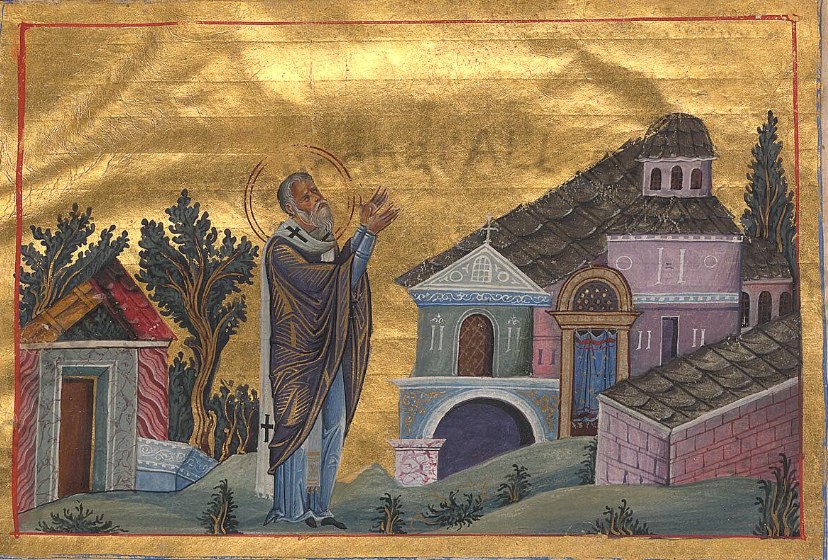
Tarasius is depicted in the settled type of the great hierarch: an aged bishop, his hair and forked beard grey, vested in the phelonion or the cross-figured polystavrion, wearing the omophorion, his right hand raised in blessing and his left holding the Gospel-book. As a father of the Seventh Council and a restorer of the icons, he is often shown holding or presenting an icon — most fittingly an image of Christ — the visual sign of the doctrine his council proclaimed, that the honour paid to the image passes to its prototype. He appears among the assembled fathers in the icon of the Seventh Ecumenical Council and in the composite icon of the Triumph of Orthodoxy.
The stored image is the miniature for February 25 from the Menologion of Basil II (Constantinople, c. 985; Vatican, Vat. gr. 1613): Tarasius the patriarch vested in the cross-marked omophorion, blessing, in the classic Byzantine hierarch type (source, public domain, pd-old-work).
Disputed questions
- The rapid ordination. Tarasius's elevation from the lay state through all the grades of orders in a matter of days was irregular by the strict letter of the canons, and both Pope Adrian I and later critics remarked on it. The Church received it as an act of economy justified by the need of the hour — the healing of iconoclasm — and his own insistence on a council as the price of his acceptance is read as the vindication of his motive; the precedent was invoked for the later lay-elevations of Nicephorus and Photius.
- Severity or economy toward the iconoclasts. The central controversy of his memory is the one that divided him from Theodore the Studite: whether his lenient reception of repentant iconoclast bishops, and his measured response to the emperor's unlawful marriage, were the wisdom of a peacemaker or a laxity that compromised the Church's discipline. The tradition honours Tarasius as a saint and Theodore the Studite as a saint alike, and records the disagreement between them without resolving it against either.
- Not to be confused with the martyr Sozon of Cilicia (September 7), whose pre-baptismal name was Tarasios — a wholly different saint, a young shepherd-martyr of the early fourth century; the patriarch bore the name Tarasius in its own right. Nor is he the several minor Tarasii of the synaxaria (e.g. the Vologda companion of Dionysius of Glushitsa). "Patriarch of Constantinople, who presided at the Seventh Council" belongs to this Tarasius alone.