
Stephen the Protomartyr
The Holy Apostle, Protomartyr and Archdeacon Stephen
Protomartyr · Martyr · Deacon · Apostle of the Seventy · Apostle · d. c. 34
Commemorated 2 August — Translation of the relics to Constantinople, 15 September — Uncovering of the relics at Kaphar Gamala (415), 27 December — Martyrdom; the third day of Nativity
Stephen the Protomartyr (†c. 34) was the first of the seven deacons chosen by the Apostles and the first Christian to die for Christ. "Full of faith and of the Holy Spirit," he worked wonders among the people, confounded the Hellenist synagogues in debate, and, arraigned before the Sanhedrin on a charge of blasphemy, delivered the longest speech in the Acts of the Apostles before beholding "the Son of Man standing at the right hand of God." Stoned outside Jerusalem with the young Saul consenting, he died praying for his killers. His relics, hidden for centuries, were uncovered at Kaphar Gamala in 415. His chief feast is December 27; the uncovering of his relics is kept on September 15 and their translation to Constantinople on August 2.
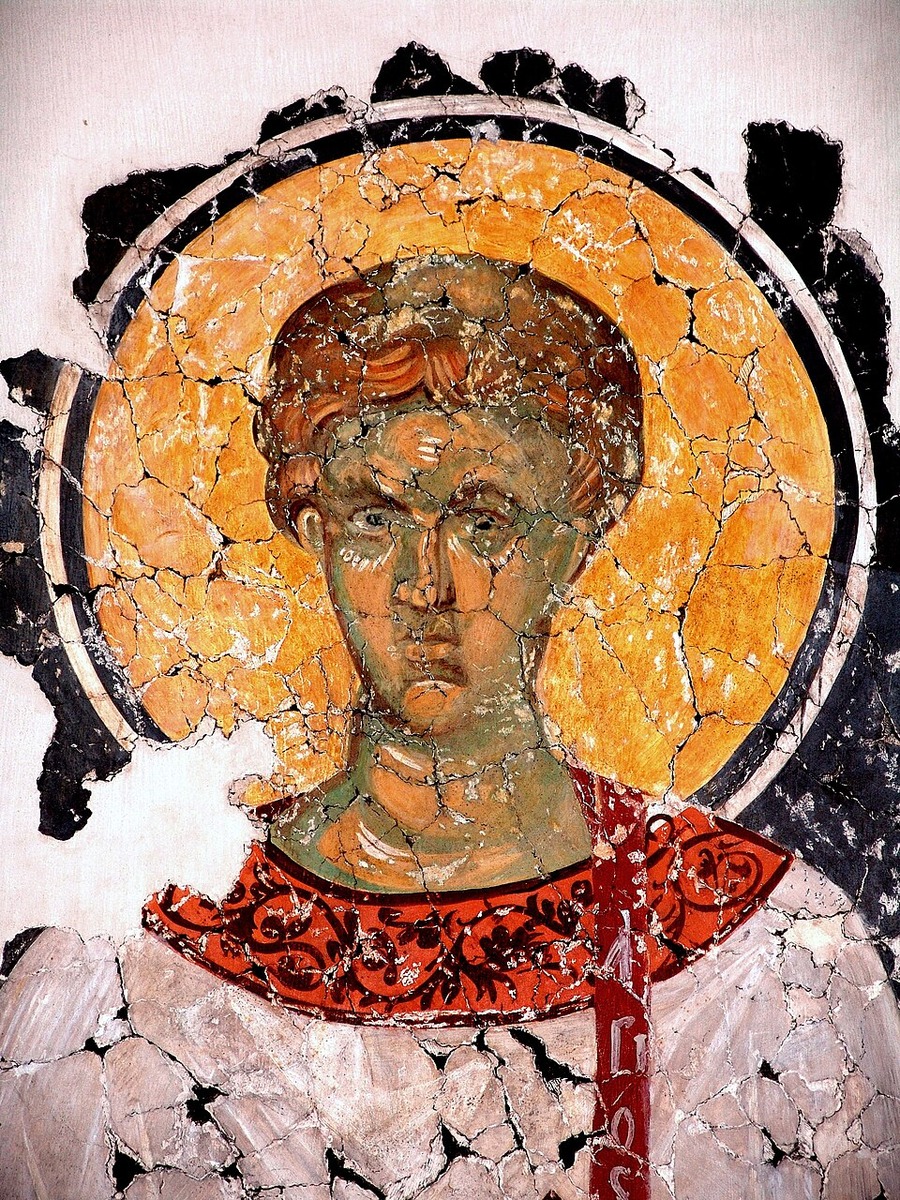

The first deacon
Everything certainly known of Stephen's life is contained in chapters 6 and 7 of the Acts of the Apostles. When the murmuring of the Hellenists — the Greek-speaking Jewish Christians — against the Hebrews over the daily distribution to the widows threatened the unity of the first community in Jerusalem, the Twelve called the disciples together and had them choose seven men "of good report, full of the Holy Spirit and of wisdom" to serve tables, that the Apostles might give themselves to prayer and the ministry of the word. Stephen heads every list: "a man full of faith and of the Holy Spirit," on whom the Apostles laid their hands. The Church has always seen in the Seven the origin of the diaconate, and in Stephen its archdeacon and crown; his Greek name (Στέφανος, "crown") became the theme of his entire hymnography. Byzantine tradition also numbers him among the Seventy Apostles, and he is commemorated with them at their synaxis on January 4.
Stephen's ministry immediately exceeded the serving of tables: "full of grace and power, he did great wonders and signs among the people." Members of the synagogue of the Freedmen, with Cyrenians, Alexandrians, Cilicians and Asians, disputed with him "and were not able to withstand the wisdom and the Spirit by which he spoke." Suborned witnesses then accused him before the Sanhedrin of speaking blasphemy against the temple and the law — the charge once brought against his Master — and as the council gazed at him "they saw his face as it had been the face of an angel."
The speech and the stoning
Stephen's defence, the longest discourse in Acts, is a sweeping recital of Israel's history from Abraham to Solomon, turning on a double theme: that God's presence was never confined to one land or one house ("the Most High dwelleth not in temples made with hands"), and that Israel had always persecuted the prophets sent to her — culminating in the betrayal and murder of the Righteous One himself. At the climax, "being full of the Holy Spirit, he looked up steadfastly into heaven, and saw the glory of God, and Jesus standing on the right hand of God" — the Church's hymnographers dwell on that "standing," as though the Lord had risen to receive his first martyr. The hearers stopped their ears, drove him out of the city, and stoned him, the witnesses laying their garments at the feet of a young man named Saul — the future apostle Paul, who "was consenting unto his death." Stephen died echoing his Master's words on the Cross: "Lord Jesus, receive my spirit," and, kneeling, "Lord, lay not this sin to their charge."
The martyrdom is usually dated to about the year 34 (traditions range from within a year of the Ascension to c. 36). Devout men buried him "and made great lamentation over him"; the tradition embodied in the fifth-century accounts of the finding of his relics holds that Gamaliel — the great teacher of the law who had counselled moderation in Acts 5 and was remembered by the Church as a secret Christian — had the body carried to his own estate at Kaphar Gamala ("the village of Gamaliel") north of Jerusalem and buried in his family tomb, where in time Gamaliel himself, his son Abibas, and Nicodemus were also laid.
A persecution "against the church which was at Jerusalem" broke out on the day of Stephen's death, scattering the Hellenist believers through Judaea and Samaria and as far as Phoenicia, Cyprus and Antioch — so that, as the Fathers loved to observe, the first martyr's blood was immediately the seed both of the Gentile mission and, through the prayers of the dying Stephen, of the conversion of Saul.
The uncovering of the relics (415)
For nearly four centuries the grave was forgotten. In December 415, under the emperor Theodosius the Younger, the priest Lucian of Kaphar Gamala received in sleep a threefold vision of a majestic elder — Gamaliel himself — who revealed the resting place of Stephen and of his companions in the tomb and commanded that they be brought to light. Lucian reported the vision to archbishop John of Jerusalem, who came to the spot with the bishops Eutonius of Sebaste and Eleutherius of Jericho; the coffins were found, and at the uncovering the earth shook and a fragrance filled the place, while — the account continues — angelic voices were heard singing "Glory to God in the highest, and on earth peace." Many sick were healed. The relics of the Protomartyr were solemnly translated to the church of Holy Sion in Jerusalem on December 26, 415. Lucian's own written account (the Epistula Luciani, translated into Latin at once by Avitus of Braga) spread the news through the whole Christian world with extraordinary speed; Augustine in Africa received relics of Stephen within a few years and devoted chapters of the City of God to the miracles wrought at their shrines.
Later translations
Under Theodosius the Younger the relics were translated from Jerusalem to Constantinople, where they were first laid in the church of the deacon Laurence until a church of the Protomartyr should be built; the Byzantine calendar keeps this translation on August 2. In Jerusalem the empress Eudocia later raised a great basilica of St Stephen north of the Damascus Gate, at the traditional place of the stoning, and was herself buried there (its successor is the present École Biblique church). A famous Western legend brought a portion of the relics to Rome, where Stephen was said to have been laid in one tomb with the deacon-martyr Laurence in San Lorenzo fuori le Mura — the two archdeacons of East and West together. Among the relics venerated in the Orthodox world, the right hand of the Protomartyr is kept in the Trinity–Sergius Lavra in Russia.
Veneration
Stephen's cultus is as old as the Church itself and universal in every calendar. In the Byzantine rite his principal feast stands on December 27, the third day of the Nativity, so that the first martyr follows immediately upon the birth of the Lord — a juxtaposition his kontakion turns into theology ("Yesterday the Master came to us in the flesh, and today the servant departs from the flesh"). He is patron of deacons; among the Serbs "Stefan" became the baptismal and throne-name of the Nemanjić dynasty, whose rulers styled themselves after the Protomartyr. Countless churches across East and West bear his name.
Feast and commemoration
Principal feast December 27 (church date; Old Calendar civil January 9), within the afterfeast of the Nativity; the uncovering of the relics on September 15 (Old Calendar civil September 28), within the afterfeast of the Elevation of the Cross; the translation of the relics to Constantinople on August 2 (Old Calendar civil August 15). He is also commemorated with the Seventy on January 4. All are kept universally, with the September 15 finding most prominent in the Slavic tradition (see above).
Hymns
Troparion — Tone 4
A royal diadem is set upon thy head for the contests thou didst endure for Christ God, O first combatant among the martyrs; for thou didst convict the frenzy of the Jews and behold thy Saviour at the right hand of the Father: entreat him ever, O Stephen, in behalf of our souls.
Original translation from the Greek
Troparion
A good fight didst thou fight, O Protomartyr of Christ, Apostle and Archdeacon Stephen, and didst expose the impiety of the tormentors; for, stoned by the hands of lawless men, thou didst receive a crown from the right hand on high, and didst cry aloud to God: Lord, lay not this sin to their charge.
Original translation from the Greek
Kontakion — Tone 3
Yesterday the Master came to us in the flesh, and today the servant departs from the flesh; yesterday he that reigneth was born according to the flesh, today the servant is stoned to death: for his sake the Protomartyr, the divine Stephen, is made perfect.
Original translation from the Greek
Kontakion — Tone 6 (Slavic books)
First wast thou sown upon the earth by the heavenly Husbandman, O all-praised Stephen; first didst thou shed thy blood upon the earth for Christ, O blessed one; first wast thou wreathed by him in heaven with the crown of victory, O beginning of the sufferers, crowned one, first-champion of the martyrs.
Original translation from the Greek
Magnification
We magnify thee, holy passion-bearer Stephen, and we honour thy precious sufferings, which thou didst endure for Christ.
Original translation from the Slavonic
Appointed readings
Epistle — Acts 6:8–7:5, 47–60
8And Stephen, full of faith and power, did great wonders and miracles among the people. 9Then there arose certain of the synagogue, which is called the synagogue of the Libertines, and Cyrenians, and Alexandrians, and of them of Cilicia and of Asia, disputing with Stephen. 10And they were not able to resist the wisdom and the spirit by which he spake. 11Then they suborned men, which said, We have heard him speak blasphemous words against Moses, and against God. 12And they stirred up the people, and the elders, and the scribes, and came upon him, and caught him, and brought him to the council, 13And set up false witnesses, which said, This man ceaseth not to speak blasphemous words against this holy place, and the law: 14For we have heard him say, that this Jesus of Nazareth shall destroy this place, and shall change the customs which Moses delivered us. 15And all that sat in the council, looking stedfastly on him, saw his face as it had been the face of an angel. 1Then said the high priest, Are these things so? 2And he said, Men, brethren, and fathers, hearken; The God of glory appeared unto our father Abraham, when he was in Mesopotamia, before he dwelt in Charran, 3And said unto him, Get thee out of thy country, and from thy kindred, and come into the land which I shall shew thee. 4Then came he out of the land of the Chaldæans, and dwelt in Charran: and from thence, when his father was dead, he removed him into this land, wherein ye now dwell. 5And he gave him none inheritance in it, no, not so much as to set his foot on: yet he promised that he would give it to him for a possession, and to his seed after him, when as yet he had no child. 47But Solomon built him an house. 48Howbeit the most High dwelleth not in temples made with hands; as saith the prophet, 49Heaven is my throne, and earth is my footstool: what house will ye build me? saith the Lord: or what is the place of my rest? 50Hath not my hand made all these things? 51Ye stiffnecked and uncircumcised in heart and ears, ye do always resist the Holy Ghost: as your fathers did, so do ye. 52Which of the prophets have not your fathers persecuted? and they have slain them which shewed before of the coming of the Just One; of whom ye have been now the betrayers and murderers: 53Who have received the law by the disposition of angels, and have not kept it. 54When they heard these things, they were cut to the heart, and they gnashed on him with their teeth. 55But he, being full of the Holy Ghost, looked up stedfastly into heaven, and saw the glory of God, and Jesus standing on the right hand of God, 56And said, Behold, I see the heavens opened, and the Son of man standing on the right hand of God. 57Then they cried out with a loud voice, and stopped their ears, and ran upon him with one accord, 58And cast him out of the city, and stoned him: and the witnesses laid down their clothes at a young man’s feet, whose name was Saul. 59And they stoned Stephen, calling upon God, and saying, Lord Jesus, receive my spirit. 60And he kneeled down, and cried with a loud voice, Lord, lay not this sin to their charge. And when he had said this, he fell asleep.
Gospel — Matthew 21:33–42
33Hear another parable: There was a certain householder, which planted a vineyard, and hedged it round about, and digged a winepress in it, and built a tower, and let it out to husbandmen, and went into a far country: 34And when the time of the fruit drew near, he sent his servants to the husbandmen, that they might receive the fruits of it. 35And the husbandmen took his servants, and beat one, and killed another, and stoned another. 36Again, he sent other servants more than the first: and they did unto them likewise. 37But last of all he sent unto them his son, saying, They will reverence my son. 38But when the husbandmen saw the son, they said among themselves, This is the heir; come, let us kill him, and let us seize on his inheritance. 39And they caught him, and cast him out of the vineyard, and slew him. 40When the lord therefore of the vineyard cometh, what will he do unto those husbandmen? 41They say unto him, He will miserably destroy those wicked men, and will let out his vineyard unto other husbandmen, which shall render him the fruits in their seasons. 42Jesus saith unto them, Did ye never read in the scriptures, The stone which the builders rejected, the same is become the head of the corner: this is the Lord’s doing, and it is marvellous in our eyes?
Iconography
Stephen is depicted as a young, beardless deacon in the sticharion and orarion of his order, holding a censer and often the incense-boat or a small casket or church; sometimes stones rest on his head or shoulders or are gathered in his vestment, the instruments of his martyrdom. The narrative scene of the stoning, with Saul seated on the garments, appears from early Christian art onward, and the finding of the relics has its own iconography in the menologia. The stored image is the fresco of the Protomartyr from the church of the Saviour on Kovalyovo near Novgorod, painted in 1380 (the church was destroyed in the Second World War and its frescoes partially recovered from the rubble).
Disputed questions
-
The date of death is not transmitted; c. 34 is conventional, bracketed by the Crucifixion and Paul's conversion.
-
Among the Seventy. The traditional Byzantine list of the Seventy Apostles (ascribed to Dorotheus) includes Stephen and the rest of the Seven; the enumeration is a later systematisation, since Acts presents the Seven as chosen after Pentecost. The calendars nevertheless commemorate him with the Seventy on January 4, and the finding-troparion addresses him as "apostle."
-
The chronology of the uncovering. The historical sources (the Epistula Luciani, Sozomen) place the uncovering in 415 under Theodosius the Younger; the OCA's September 15 notice opens the story "during the reign of Saint Constantine the Great" before itself giving the year 415 — an inconsistency reflecting a variant late tradition that set the revelation under Constantine. The 415 dating is followed here, as in the Russian calendar ("Обретение мощей… 415").
-
September 15 and August 2. The Synaxarion of Constantinople lists the finding of the relics under September 15, and the Slavic calendars keep it there; the Greek Menaion today celebrates the finding together with the translation on August 2, so that the September commemoration is now more prominent in Slavic than in Greek practice. Both dates are recorded above.
-
Not to be confused with two later saints named Stephen: Stephen the New (the Younger, monastic-martyr of Mount Auxentius, †764, November 28), the great martyr of the second iconoclasm, whose epithet "the New" distinguishes him from this Protomartyr; and Stephen the Hymnographer of the Lavra of Saint Sabbas (October 28).