
Tamara of Georgia
The Holy Right-Believing Tamara, Queen of Georgia
Righteous · Queen · b. c. 1166 — d. 1213
Commemorated 1 May — Repose of the queen, Pascha offset 14
Tamara (c. 1166–1213) is the queen under whom Georgia reached the height of its power and holiness, and whom her own people call not queen but king — mepe — because she ruled in her own right. Daughter of George III of the Bagratid house, crowned co-ruler at about twelve and sole sovereign at eighteen, she opened her reign by summoning a council that purged the Church of simony, and closed it having doubled her kingdom: the victories of Shamkor (1195) and Basiani (1203) broke the Muslim coalitions ranged against her, and Georgian arms reached from the Black Sea to the Caspian. She abolished capital punishment and torture, endowed churches and monasteries from Vardzia to Athos, Palestine, Cyprus, Sinai and Antioch, wove vestments with her own hands, and lived beneath the purple as an ascetic. To her court belongs the golden age of Georgian letters, and Shota Rustaveli's Knight in the Panther's Skin is dedicated to her. She reposed in 1213 and is honoured on May 1 and on the Sunday of the Myrrh-bearing Women.

Origins and accession
Tamara was born about 1166, the elder daughter of George III (r. 1156–1184) and of Burdukhan, daughter of the king of the Alans (Ossetians). The Bagratid dynasty into which she was born had already given Georgia its unifier David III and its restorer David the Builder (David IV, †1125), her great-grandfather, whose reforms she inherited and completed. George III had put down a great feudal revolt mounted in the name of his nephew Demna, and having no son he did what no Georgian king had done: in 1178 he had his daughter crowned co-ruler with himself, so that when he died in 1184 the succession would be beyond dispute.
They reigned together for some five or six years, and at about eighteen Tamara was left sole sovereign. The nobility, unreconciled to a woman on the throne, at once pressed her; she was re-crowned at Gelati, and had to accept a redistribution of offices that limited her power. Her answer was patience: she conceded where she must, removed her opponents gradually, and built her authority on the Church and on men of her own choosing.
The council of the Church
The first great act of her reign, and the one for which the Georgian Church remembers her most gratefully, was ecclesiastical. She convoked a council of the whole Church of Georgia — the Sinodo — to correct abuses, above all the buying and selling of holy orders and the occupation of sees by unworthy men. Rather than dictate to the bishops she set the principle before them and required them to judge: they were to affirm what was good and condemn what was evil without regard to persons, and she bound herself to enforce their decisions. Unworthy hierarchs were deposed; the aged and holy Nicholas Gulaberisdze, formerly Catholicos, was recalled from Jerusalem to assist the reform. The Georgian chronicles present the episode as the model of the right relation of crown and altar: the queen putting her power at the service of the Church's own canons rather than above them.
The two marriages
The nobles required an heir, and in 1185 Tamara was married to Yuri Bogolyubsky — "George the Rus," son of the murdered Grand Prince Andrei Bogolyubsky of Vladimir, then an exile among the Kipchaks. He proved a brave soldier and a disastrous husband: the Georgian sources describe him as a drunkard given to gross vice, and after two years the queen, with the consent of the Church, put him away, sent him to Constantinople with a generous provision, and refused to be moved when he twice returned at the head of rebel armies. Both risings were defeated and Yuri was pardoned and dismissed again.
In 1189 she married Davit Soslan, an Ossetian prince of Bagratid descent raised at the Georgian court — a marriage of affection and of policy that succeeded entirely. Davit became her general and co-ruler, and their two children, George IV Lasha and Rusudan, both reigned after her. Davit died in 1207, some six years before his wife.
Shamkor, Basiani, and the Georgian golden age
Tamara's reign was almost continuous war, and almost continuous victory. In 1195 at Shamkor (Shamkir, in what is now Azerbaijan) the Georgian army under Davit Soslan destroyed the coalition assembled by the atabeg Abu Bakr of Azerbaijan, and Georgian overlordship was extended over Shirvan and the neighbouring emirates. In 1203 the Seljuk sultan of Rum, Rukn al-Din, sent Tamara an ultimatum demanding that she renounce Christ or lose her kingdom; at Basiani (Basian, in the upper Araxes basin) his far larger army was broken and his camp taken. Georgian tradition surrounds the battle with the queen's all-night prayer barefoot before the icon of the Theotokos of Vardzia and her sending of the standard to the army from the sanctuary. Trebizond was taken in 1204 by her forces, and out of that campaign her Komnenian kinsmen founded the Empire of Trebizond, which for two and a half centuries was Georgia's Christian neighbour on the Black Sea.
Within this security Georgia's culture reached a height it never touched again. Tamara's reign built or completed the rock-cut monastic city of Vardzia, the monasteries of Betania, Kintsvisi, Pitareti, Timotesubani and many more, and endowed Georgian foundations far outside the kingdom: the Iveron monastery on Athos, the Monastery of the Cross at Jerusalem and other Palestinian houses, foundations in Cyprus, on Sinai, at Antioch and in Greece, and hostels for pilgrims on the roads. Her chancery patronised the poets whose work is still the foundation of Georgian literature, and Shota Rustaveli dedicated to her the Vepkhistq'aosani, "The Knight in the Panther's Skin," in which her person is transparently the model of the wise sovereign.
The ascetic beneath the crown
The hagiographic tradition is unanimous, and the historical sources do not contradict it, that Tamara's private life was that of a monastic. She kept the fasts strictly, slept little, prayed at night, wore a hair-shirt under the imperial silks, and with her own hands wove and embroidered vestments and cloths which she gave to churches and to the poor. She would not allow her judges to impose death or mutilation, and her reign is remembered as one in which no man was executed and no one tortured — a thing then unheard of in a great kingdom, and among the clearest signs of her sanctity. She gave audience to the poor, redeemed captives, and endowed hospitals and hostels. The chronicles record that she wept when the death of enemies was reported to her, and that she took no revenge on those who had risen against her.
Repose and burial
Tamara died in 1213, after a long illness, in the palace at Agarani near Tbilisi, and the lamentation for her was national. Her body was brought to the cathedral of Gelati, the mausoleum of the Bagratids; but her actual grave has never been identified. The Georgian tradition holds that she directed her burial to be secret so that her tomb should not be desecrated by invaders, and that a number of graves were prepared and only one used. A rival tradition, reported by a thirteenth-century Western pilgrim and repeated since, says that her body was conveyed to the Monastery of the Holy Cross in Jerusalem, which she had endowed. Neither claim has been verified, and the disappearance of the grave has become part of her legend.
Feast and commemoration
May 1 (church date; New Calendar civil May 1, Old Calendar civil May 14) — the day of her repose, kept by the Church of Georgia and entered on the Russian and American calendars. She is commemorated a second time, and in Georgia more solemnly, on the Sunday of the Myrrh-bearing Women (the second Sunday after Pascha), a movable commemoration recorded here under the rule 14 days after Pascha and belonging to the movable calendar, not to this fixed day. Her name is among those most frequently given in Georgian baptism, and the great feast is kept at Gelati and at Vardzia.
Hymns
Troparion
Thou didst love Christ from thy youth, O blessed one, and having received the sceptre from God thou didst rule thy people in righteousness and in mercy; adorning thy royal state with fasting, almsgiving and prayer, thou didst finish thy course in peace. O right-believing Tamara, entreat Christ God that our souls may be saved.
Original translation from the Georgian
Kontakion
Having preserved thy soul unspotted in the midst of a kingdom, and having clothed the naked and comforted the afflicted, thou wast shown forth as a bright lamp of thy land, O most praised Tamara; wherefore we cry to thee: Rejoice, boast and protection of Georgia.
Original translation from the Georgian
Iconography
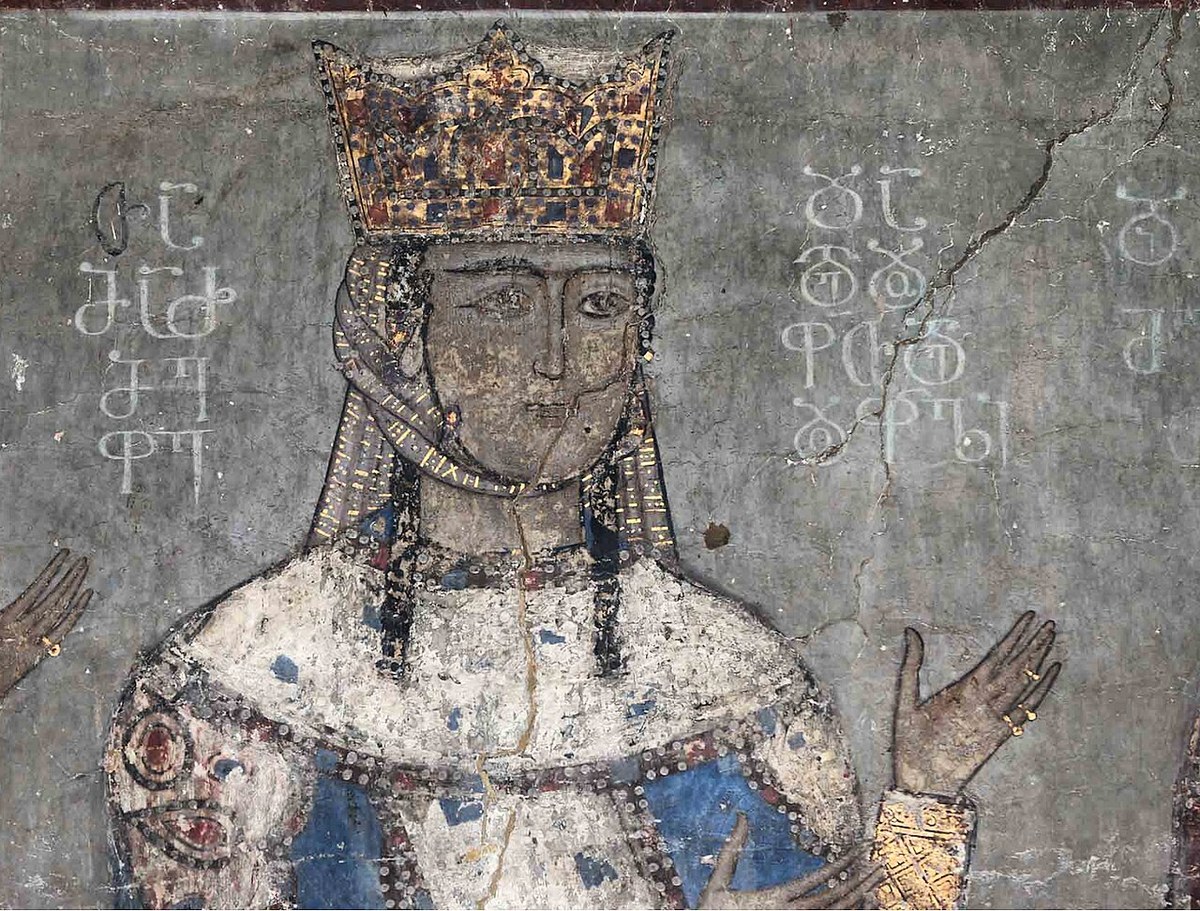
Tamara is painted as a young woman in the full regalia of a Georgian sovereign: the tall jewelled crown with pendant strings of pearls at the temples, a stiff embroidered loros or collar over a robe patterned with gold roundels, her hands raised in prayer or holding a model of a church or a scroll. Because Georgian tradition styles her mepe, her inscriptions are often in the masculine, and she is sometimes shown with the sword or standard of a ruler. In the great compositions she appears with her father George III and her son George IV Lasha — the dynastic group of the Bagratids — and among the saints of Georgia with Nino, David the Builder and the martyrs of the Caucasus.
Four contemporary or near-contemporary mural portraits survive, at Betania, Vardzia, Kintsvisi and Bertubani (the last in the Davit-Gareja complex), and these are the oldest images of her and the basis of all later icons. The stored image is the portrait from the katholikon of Betania, painted in the first years of the thirteenth century — that is, in her own lifetime or immediately after her death — with the Georgian asomtavruli inscription beside her head; it shows the crowned queen frontal, with hands raised, in the pearled crown and jewelled collar. It should be read as a royal donor portrait rather than a liturgical icon, but it is the face the Georgian Church venerates.
Disputed questions
- Queen or king? Georgian sources style Tamara mepe — "king" — not dedopali ("queen," properly a king's consort), because she reigned in her own right; her seals and the Betania inscription use the masculine royal title, and Georgian icons are inscribed "the holy right-believing King Tamar." English usage has settled on "Queen Tamara," which is retained here as the reader's name for her, with the Georgian titulature recorded. In this corpus she is typed queen in the sense of a reigning royal woman (see the Pulcheria precedent); the calendars' own category is simply "right-believing" (ketilmsakhuri).
- The year of her death. 1213 is the reading of most of the Georgian chronicles and is followed by the Church; 1207 and 1210 appear in some sources and in older Western literature, generally by confusion with the death of her husband Davit Soslan (1207).
- Her feast day. Georgian usage keeps her on May 1 and again on the Sunday of the Myrrh-bearing Women, and the Russian and American calendars follow. The movable commemoration — not the fixed one — is the more festively kept of the two in Georgia, the myrrh-bearers being taken as the type of the holy women who served Christ with their substance.
- Legendary accretions. A great body of folk-tale attaches to Tamara: castles, bridges and roads across the Caucasus bear her name, and the Romantic literature of the nineteenth century (Lermontov above all) made her a figure of cruel enchantment wholly foreign to the sources. None of this belongs to her hagiography.