
Tatiana of Rome
The Holy Martyr Tatiana the Deaconess of Rome
Martyr · Virgin · Deaconess · b. late 2nd century, Rome — d. c. 226, at Rome
Commemorated 12 January — Martyrdom at Rome under Alexander Severus
Tatiana of Rome (died c. 226) was a noble Roman virgin and deaconess martyred under the emperor Alexander Severus. Daughter of a man who had thrice been consul and who raised her secretly in the faith, she consecrated her virginity to Christ and served the Church of Rome as a deaconess, tending the sick and the poor. Arrested in the persecution driven by the prefect Ulpian, she was subjected to a long sequence of tortures out of which the tradition tells its most vivid signs: the temple of Apollo into which she was led fell in ruin, the arena lion loosed upon her lay down and licked her feet, and several of her executioners, seeing her wounds healed and their own blows turned back upon them, confessed Christ and were themselves baptised in their blood. Beheaded with the sword — together, the account says, with her aged father — she became one of the best-loved virgin-martyrs of the Church, and in Russia the patroness of students, her feast kept as "Tatiana's Day" and bound to the founding of the University of Moscow.
.jpg)
Origins and early life
Tatiana was a Roman by birth, of the high aristocracy of the city. Her father — whose name the passion does not preserve — had held the consulship three times, a mark of the first rank of the senatorial order, and was, the tradition says, a secret Christian, who "in fear" kept his faith hidden from the pagan world but did not hide it from his household: he raised his daughter in the fear of God and the knowledge of Christ. Formed thus from childhood, Tatiana as she grew "came to despise the wealth of this world" and set her heart on "the imperishable riches of heaven"; she renounced marriage, consecrated her virginity to Christ as to a bridegroom, and gave herself to fasting, prayer, and the service of the Church.
For this service she received the order of deaconess in one of the churches of Rome. The female diaconate of the early and Byzantine Church was a genuine ecclesiastical order — women set apart by the laying-on of hands for the care of the poor and the sick, the instruction and the baptism of women, and the ministry of the church's charity — and it is in this office that Tatiana is remembered: "she served God in fasting and prayer, tending the sick and helping the needy." Her rank is the ground of her most ancient title, "Tatiana the Deaconess," and sets her, in the calendar of women saints, beside Phoebe of Cenchreae and Olympias of Constantinople.
Martyrdom
The passion places her sufferings in the reign of Alexander Severus (222–235), who came to the throne a boy of some sixteen years. The emperor himself, the account says, was not the mover of the persecution — indeed he is remembered as a prince of syncretist tolerance, who is said to have kept an image of Christ among his household gods — but the government of the state fell to his ministers, and chief among them the powerful jurist and prefect Ulpian (the passion's "Ulpianus"), whom the tradition names as "an evil enemy and persecutor of the Christians." Under his direction the officers of the city hunted out the confessors of Christ, so that, in the words of the account, "Christian blood flowed like water." Tatiana, seized as a Christian and a woman of rank, was brought before the tribunal and commanded to sacrifice.
She was led first into the temple of Apollo to offer incense. There she prayed to the true God; and — the first of the wonders the passion records — an earthquake threw down the idol, and part of the temple fell, crushing the priests and worshippers beneath it. Then began the tortures, told by the account as a mounting series in which every cruelty is turned back:
- Her face was beaten and her eyes torn at with hooks, yet she bore it in silence, and (the tradition says) was healed.
- She was stretched out and scourged; but the very executioners were struck down as by an unseen power, some falling dead, and others — the number is given as eight — seeing angels standing about her and the blows returning upon themselves, confessed Christ, fell at her feet, and were baptised in their own blood, martyred with her.
- Cast into prison, she was found in the morning radiant and whole, the tradition says, comforted through the night by angels.
- Led into the amphitheatre and a fierce lion loosed upon her for the people's sport, the beast would not touch her but lay down and licked her feet meekly; when the lion was afterwards being returned to its den it fell upon and killed one of her tormentors.
- She was thrown into fire, which did not harm her; her hair was shorn, the pagans imagining her strength to lie in it.
- Brought again to the temple of the goddess Diana (Artemis), at her prayer a bolt of lightning struck and shattered the idol and its altar.
When neither the beasts, nor the fire, nor the failing of the gods could move her, sentence of death by the sword was passed. Tatiana was beheaded; and with her, the account adds, was executed her father, condemned for having raised her in the Christian faith. The Church keeps the day of her beheading, the twelfth of January, as her feast.
The number and shape of the tortures belong to the developed passio of a virgin-martyr, a literary form in which the marvels are told to display the powerlessness of the idols before the faith of a single unarmed woman; the historical core beneath them is a noble Roman deaconess and virgin who was put to death for Christ in the early third century, under the ministers of Alexander Severus. The tradition names, with her, the executioners converted at her suffering and her father slain beside her — "those who suffered with her" of the calendar's title — but transmits no separate roll of their names.
Veneration and later cultus
Tatiana was venerated from an early date among the martyrs of the city of Rome, and her memory passed into the Greek synaxaria under the twelfth of January, the day of her beheading, where it is kept to this day within the afterfeast of the Theophany. Her passion was translated into Slavonic and she became a beloved saint of the Russian Church.
It is in Russia that her cultus took on its most distinctive later form. On the twelfth of January (Old Style; the twenty-fifth by the civil calendar), in the year 1755, the empress Elizabeth signed the decree founding the Imperial University of Moscow — the petition having been laid before her on Saint Tatiana's day. The martyr thereby became the patroness of the University, whose church was dedicated to her, and then, by extension, the patroness of students throughout Russia. "Tatiana's Day" (Татьянин день) became at once a church feast and the great festival of Russian student life — a day of the Divine Liturgy in the university church and of unbounded celebration in the city after it — and it remains so, kept in the post-Soviet revival as the official Day of Russian Students. Thus a third-century Roman deaconess is honoured, improbably and enduringly, as the heavenly patron of the lecture-hall and the examination.
Feast and commemoration
Tatiana is commemorated on January 12 (church date; New Calendar civil January 12, Old Calendar civil January 25), within the afterfeast of the Theophany. Her office in the Menaion is sung together with the hymns of the afterfeast, and it is the leading commemoration of the day, kept in the Greek, Antiochian, and Slavic calendars alike, "together with those who suffered with her." In Russian usage the day carries the added weight of Tatiana's Day, the patronal feast of students and of the University of Moscow (see above). No separate translation-feast is kept; January 12 is her single feast.
Hymns
Troparion — Tone 4
Thy lamb Tatiana crieth unto Thee, O Jesus, with a loud voice: Thee, my Bridegroom, do I love, and seeking Thee I strive in contest; I am crucified and buried together with Thee in Thy baptism, and I suffer for Thy sake, that I may reign with Thee; I die for Thee, that I may live in Thee. Receive me then as a spotless sacrifice, offered unto Thee in love. By her prayers, O Merciful One, save Thou our souls.
Original translation from the Greek
Synaxarion
For the head of all-radiant Tatiana the sword wrought out a radiant crown. On the twelfth, the sword shore through Tatiana's neck.
Iconography
Tatiana is depicted as a young woman of noble bearing, in the maphorion or in a patrician's robes, holding the cross of a martyr and often a censer or the service-book of her diaconate; where the martyr's crown is shown she is crowned. The narrative type is the martyrdom — the saint before the idol that falls, among the beasts that will not touch her, or at the moment of her beheading.
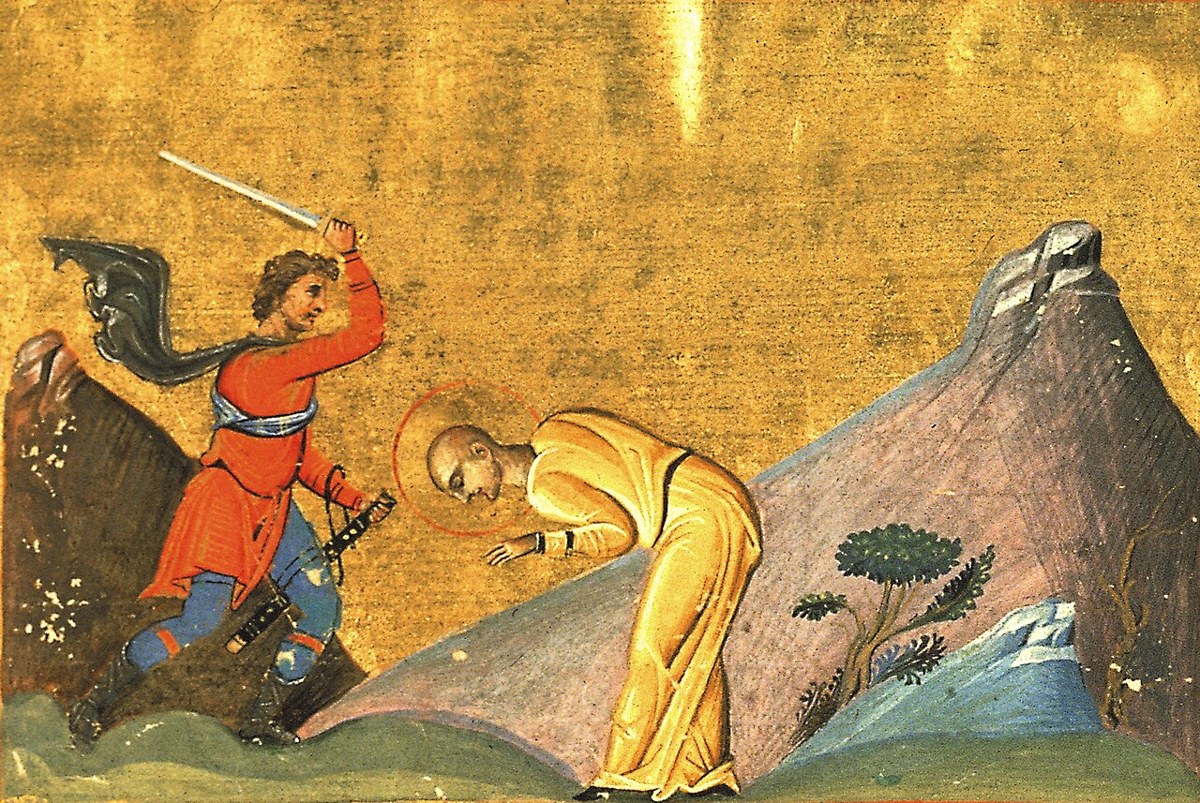
The stored image is the miniature for January 12 from the Menologion of Basil II (Constantinople, c. 985; Vatican, Vat. gr. 1613): the beheading of Tatiana — the standing saint and the executioner with drawn sword, in the compressed narrative form the Menologion gives to each day's martyr (source, public domain, pd-old-work).
Disputed questions
- The date of her martyrdom. The Greek synaxaria and the Russian menaia place her death about the year 226, in the reign of Alexander Severus (222–235); some accounts give a range across that reign (to c. 230 or 235). The reign is constant; the precise year is given with "c."
- The persecution under Alexander Severus. The reign of Alexander Severus is remembered in the secular sources as comparatively peaceful for the Christians, which has led some to place Tatiana's sufferings among the local and magistrate-driven persecutions of the time — the work of the prefect Ulpian and the city officers rather than an imperial edict — rather than a general persecution decreed from the throne. The passion itself distinguishes the young emperor from his persecuting ministers, and this reading is consistent with it.
- Not to be confused with the several other women of the name in the tradition. In particular, the Slavic recension of the passion of Eustathius Placidas (September 20) names that martyr's wife Tatiana (elsewhere Theopiste) — a wholly separate saint of a separate feast; and the day's own Euthasia, a virgin-martyr by the sword, is a distinct saint. "Tatiana the Deaconess of Rome" is this saint of January 12 alone.