
Eustathius Placidas
The Holy Great-martyr Eustathius Placidas, with his wife Theopiste and their sons Agapius and Theopistus
Great Martyr · Martyr · d. c. 118
Commemorated 20 September — Martyrdom at Rome with his wife and two sons
Eustathius, named Placidas before his baptism, was by tradition a celebrated Roman general under Titus and Trajan who was converted while hunting by a vision of Christ — a radiant Cross shining between the antlers of the stag he pursued. Baptised with his wife Theopiste and their sons Agapius and Theopistus, he was tried like Job: stripped of wealth, parted from wife and children, and reduced to a hired labourer, until God restored his family and his command. Refusing to sacrifice to the idols after his triumph, he was martyred with his whole family in a bronze bull under Hadrian, around 118. His passio became one of the most beloved legends of the Christian world, East and West, and the Vision of Eustathius a classic subject of iconography.
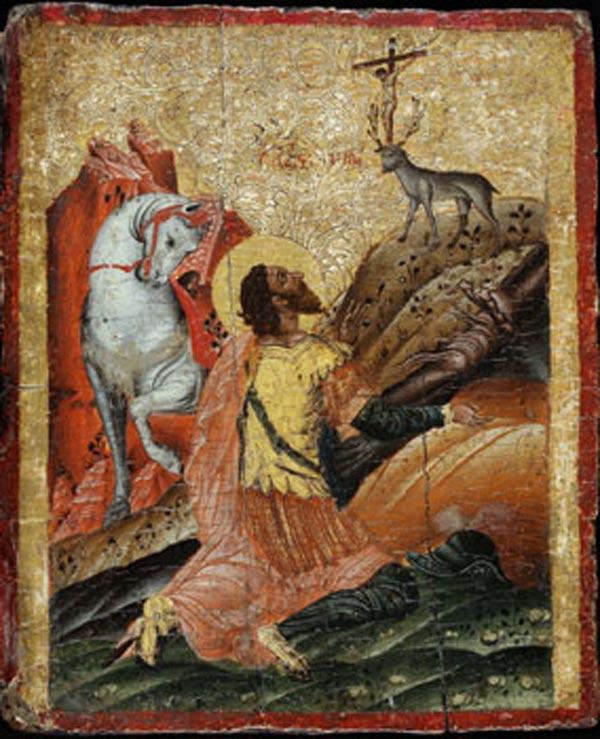

The Life of Eustathius rests entirely on his passio (BHG 641), a hagiographic narrative whose literary history is discussed below; it is retold here as the Church has received it, with the historicity question treated under Disputed questions.
Placidas the general
Placidas was a Roman of high rank, a stratelates — master of soldiers — who served with distinction in the reigns of Titus (79–81) and Trajan (98–117), victorious in the wars and admired by his men. Though a pagan, he was, the passio insists, a just and openhandedly merciful man, clothing the naked, feeding the hungry, and helping the wronged — a Roman Cornelius, as the narrative styles him, whose alms went up before God ahead of his faith. He lived in Rome with his wife (called Tatiana before her baptism in the Slavic tradition) and their two young sons.
The vision of the stag
While hunting in the hills, Placidas sighted a stag of unusual size and beauty and gave chase, drawn away from his companions. The stag halted at last upon a high rock and turned to face him — and between its antlers Placidas saw a radiant Cross, bearing (so the fuller texts say) the image of Christ, and heard a voice: "Why dost thou pursue me, Placidas? For thy good works' sake I have appeared to thee on this creature. I am Jesus Christ, whom thou, not knowing, dost honour: it is not right that one who does the works of righteousness should worship idols." Placidas fell from his horse and, like Paul on the Damascus road — the comparison is drawn by the Church's own hymnography — asked who spoke; and having heard, believed. Commanded to seek baptism, he returned home to find that his wife had received a dream that night of the same import. The whole household went by night to the bishop of Rome, who baptised them: Placidas received the name Eustathius ("the steadfast" — the canon plays on the name throughout), his wife Theopiste ("faithful to God"), and the boys Agapius and Theopistus. Returning next day to the place of the vision, Eustathius was told, in a second revelation, what awaited him: he would suffer as Job suffered, and be tried to the depths, but must not murmur; and being asked whether the trial should come now or at the end of his days, he chose to endure it at once.
The trials of Job
The trial came swiftly. Plague carried off his servants and murrain his herds; thieves stripped the house; and Eustathius, brought to nothing — delivered, the passio says, from the vanity of rank as from a snare — left Rome by night with his family, unrecognised and destitute, to take ship for Egypt and the Holy Land. At sea the shipmaster, coveting the beautiful Theopiste, put Eustathius and the boys ashore and carried her off. Wandering on with his sons, Eustathius came to a river too deep to cross with both children at once. He carried the first over, and was returning for the second, when — midstream, looking helplessly from bank to bank — he saw a lion seize the one child and a wolf the other and carry them off. Bereft in a moment of everything, he cried out the cry of Job — "the Lord gave, the Lord hath taken away" — and did not curse God; the Doxastikon of his feast calls him "adamant of soul" for it. Unknown to him, herdsmen drove off the lion and ploughmen the wolf, and the boys were rescued unharmed and raised in a nearby village, neither knowing the other was his brother. The shipmaster died of disease, leaving Theopiste untouched; she settled quietly in the land where the ship had put in. Eustathius himself came to the village of Badyssos and hired himself out, guarding the fields for bread — some fifteen years in the received chronology (the OCA life says five) — a general become a day-labourer, persevering in prayer.
Recognition and reunion
When war threatened the empire, Trajan, remembering the general whose campaigns had never failed, sent officers through the provinces to seek him. Two of them, Antiochus and Acacius, veterans who had served under Placidas, came at last to the village where he laboured. He knew them at once and served them at table, weeping in secret; they knew him only when they saw the old sword-scar on his neck and shoulders. Restored to his command with imperial honours, Eustathius levied new recruits for the war — among them, unrecognised, his own two sons, now grown, whose bearing so distinguished them that he kept them near his own tent. On campaign, quartered in the country where Theopiste lived — she kept a garden by the house where the two young soldiers' tent was pitched — the elder brother told over his broken memories of childhood: the lost mother, the river, the lion and the wolf; and the younger knew him for his brother. Their mother, overhearing, recognised her sons, and coming to the general to beg passage home to Rome recognised her husband; and so, the passio concludes, by the providence of God the whole family was restored to itself, as the family of Job was restored, and with joy the greater for the sorrow.
Martyrdom
Eustathius won the war and returned in triumph — but Trajan had died, and Hadrian (117–138) now reigned. When the emperor decreed sacrifice to the gods in thanksgiving for the victory (and, the texts add, for the finding of the general's family), Eustathius would not enter the temple. Questioned by Hadrian — to whom, if not to the gods, did he owe his victories and his restored wife and sons? — he confessed plainly: "I am a Christian. I know one God, Jesus Christ, and Him I worship and thank; all that I have is from Him." Stripped of his belt of rank, he was condemned with his whole family to the beasts in the arena; but the beasts would not touch them — a lion, the verses note with irony, having once been the instrument of his trial and now refusing to be the instrument of his death. The emperor then ordered a bronze bull — the instrument of Phalaris, revived — to be heated red-hot, and Eustathius, Theopiste, Agapius and Theopistus were shut inside it together. Before entering, Eustathius prayed that God would grant grace to their relics and hear all who should call on the martyrs in danger, on river or sea. The four were perfected in the bull, around the year 118. When it was opened on the third day, the bodies were found whole and untouched by the fire, radiant in appearance; the crowd cried out that great is the God of the Christians, and the faithful buried the martyrs with honour. The synaxarion distich for the day gathers the whole story into two lines: "A bull of bronze burns Eustathius with all his kin — and Thou, O Word of God, savest him with all his kin."
Veneration and later cultus
A church was later raised over the martyrs' burial in Rome; the basilica of Sant'Eustachio, near the Pantheon — its campanile crowned to this day with the stag's head and Cross — is attested from the eighth century and claims his relics under its high altar, and the surrounding quarter of Rome still bears his name. In the Byzantine East, Eustathius and his family stand in the Synaxarion of Constantinople and the Menologion of Basil II on September 20, and the great-martyr — one of the relatively few so ranked — was a favourite military saint, invoked with George, Demetrius, Theodore and Procopius; churches were dedicated to him from Constantinople to Georgia. In the medieval West he was counted among the Fourteen Holy Helpers, invoked against fire and family discord, and became with Hubert of Liège (whose later legend borrowed the stag-vision outright) the patron of hunters; his feast stood in the Roman calendar on September 20 until 1969, when it was removed on account of the legend's doubtful historicity — the Orthodox commemoration continues unchanged.
Hymnographic and literary legacy
The passio of Eustathius (BHG 641, with its Latin descendants BHL 2760 ff.) is among the most successful narratives Byzantine hagiography ever produced — a full romance of separation, recognition and reunion in the manner of the Greek novel, joined to the two great biblical patterns of Paul's calling and Job's trial. The Greek text was in circulation by the early eighth century at the latest: John of Damascus cites the vision of the stag as an accepted wonder in his orations in defence of the holy images, and the metaphrastic menologion of the tenth century gave the tale its classic Byzantine form. Translations and reworkings followed in nearly every language of Christendom: Latin, whence the Golden Legend and the Old French, Middle English, German and Italian versions; Old Norse (the Plácitus drápa, one of the earliest Christian skaldic poems); Old Church Slavonic; Georgian, Armenian, Syriac, Coptic and Arabic. The romance of Sir Isumbras and a whole family of medieval "man tried by fate" tales are built on its skeleton. In the Menaion the saints' canon (Tone 4) is by Theophanes, on the acrostic "Applause for him whose name is steadfastness," and the Doxastikon of Vespers, ascribed to Ephraim of Caria, is a meditation on the Job-cry of the saint. Western art knew the vision from Pisanello's panel and Dürer's engraving — the legend's reach, in every medium, is part of its history.
Feast and commemoration
September 20 (church date; Old Calendar civil October 3), a universal commemoration of the Byzantine rite, falling within the afterfeast of the Elevation of the Cross — the day's office joins the hymns of the Cross with those of the saints, a coincidence the fathers found fitting for the martyr converted by the vision of the Cross. The Synaxarion of Constantinople heads the day with "the holy Great-martyr Eustathius, and Theopiste his wife, and their two sons Agapius and Theopistus." The OCA styles the feast "Greatmartyr Eustathios Placidas, with his wife and children, of Rome"; the Greek and Antiochian calendars likewise lead the day with the great-martyr and his family. The pre-1969 Roman calendar kept Eustace and Companions on the same day, September 20.
Hymns
Troparion — Tone 4
Thy Martyrs, O Lord, in their contest received crowns of incorruption from Thee our God; for possessing Thy strength they cast down the tyrants and shattered the powerless insolence of the demons: by their intercessions, O Christ God, save our souls.
Original translation from the Greek
Kontakion — Tone 2
Having clearly imitated the Passion of Christ, and drunk His cup with faith, thou becamest a partaker, O Eustathius, and joint heir of His glory, receiving from the God of all divine remission from on high.
Original translation from the Greek
Stichera
O adamant of soul, how shall we praise thee as thou deservest? For thou didst surpass nature: bereft of riches, of children and of wife, thou didst cry out that blessed and ever-memorable word of Job, "The Lord gave, the Lord hath taken away; as it seemed good to the Lord, so it came to pass." But the God whom thou didst love and fervently desire gave thee back again those dearest to thee, providing that they should be thy fellow contestants; with whom, through manifold torments, thou didst accomplish thy blessed end. Taking them as ambassadors together with thee, O Eustathius of steadfast soul, importune Him that we be delivered from our iniquities.
Iconography
Two subjects belong to Eustathius. As a military great-martyr he is shown young and armed, with lance, sword and shield, among the warrior saints — so in countless Byzantine and Slavic programmes. But his distinctive subject is the Vision of Eustathius: the general on horseback, in hunting dress, reining in before the stag on whose brow — or between whose antlers — shines the Cross or the image of Christ, his hand raised in astonishment. The scene appears in the rock-cut churches of Cappadocia by the tenth century, on the carved façades of medieval Georgia (where the vision was a beloved sculptural subject), in Novgorodian and later Russian icons and frescoes, and — through the legend's westward travels — in Pisanello's panel and Dürer's engraving. The martyrdom itself, the family delivered to the bronze bull, is the subject of the menologion tradition, including the miniature of the Menologion of Basil II.
The stored primary image is a Cretan-school icon of the first half to middle of the 17th century depicting the Vision: the saint on horseback before the stag with the Cross. A second stored image is the miniature for September 20 from the Menologion of Basil II (Constantinople, c. 985; Vatican Library, Vat. gr. 1613, p. 63), showing the martyrdom of Eustathius and his family (source, pd-old-work).
Disputed questions
- Historicity. No contemporary or near-contemporary evidence attests a general Placidas-Eustathius under Trajan and Hadrian: he is absent from the early martyrologies and church historians, and the passio — a literary romance with named motifs traceable in secular fiction — is the sole source for his existence. The Bollandist Hippolyte Delehaye classed the legend among the hagiographic novels, and the Roman Church removed the feast from its general calendar in 1969 for that reason. The Orthodox Church continues the commemoration as received: the veneration itself is ancient and universal (attested in Rome and Constantinople alike from at least the eighth century), and this entry records the passio as the tradition of the Church without asserting it as verified history. The conventional date of the martyrdom, c. 118, follows the passio's placement early in Hadrian's reign.
- The wife's names. The Greek tradition knows her only by her baptismal name Theopiste; the Slavic and OCA lives give her pre-baptismal name as Tatiana. Recorded as transmitted. This Tatiana — the wife of Eustathius — is not to be confused with the Roman deaconess and virgin-martyr Tatiana of Rome (January 12), a wholly separate saint.
- Duration of the exile. The metaphrastic text gives Eustathius fifteen years as a labourer in Badyssos; the OCA life says five. Both are recorded; the discrepancy is inherited from the manuscript tradition.
- Not to be confused with Eustathius the archbishop of Antioch (confessor of Nicaea, February 21), Eustathius of Mtskheta the Georgian martyr (July 29), or the Western Hubert of Liège, to whose later legend the stag-vision migrated.