
Tation of Claudiopolis
The Holy Martyr Tation of Claudiopolis in Bithynia
Martyr · d. 305, on the road outside Claudiopolis
Commemorated 24 August — Repose on the way to execution outside Claudiopolis
Tation was a Christian of Bithynia put to death in the persecution of Diocletian, at Claudiopolis — the city of the interior which the Greeks had called Bithynium and which is the modern Bolu. Denounced for his faith, examined and repeatedly urged to deny Christ by the governor Urban, he was imprisoned, beaten, and at last dragged out of the city to be executed. He never reached the place of execution: making the sign of the Cross, he gave up his soul on the road, in the year 305. His memory is kept on August 24, and the synaxarion which preserves it gives no other detail of his life.

Bithynia under Diocletian
The record of Tation is a single synaxarion notice, and it is set with unusual precision. He lived in Bithynia, the north-western province of Asia Minor whose capital, Nicomedia, was Diocletian's own imperial residence and therefore the sharpest edge of the Great Persecution launched by the edicts of 303. The Bithynian martyr-acts of these years are among the most numerous in the calendar for exactly this reason: the machinery of the persecution was at its most efficient where the emperor himself resided, and the provincial governors of the region had every incentive to be seen enforcing it.
Claudiopolis, where Tation suffered, was an inland city of the province — the old Bithynium, refounded under Claudius and known in the later administrative geography as a city of Honorias — lying on the road system that linked Nicomedia to the interior of Anatolia. It has since given its site to the Turkish town of Bolu.
Arrest and examination
The notice says he was denounced as a Christian and brought before Urban, the governor of the city. What follows is the standard shape of a provincial hearing under the edicts, and the synaxarist reports it as such: the governor pressed him repeatedly to sacrifice and to deny Christ, and Tation as often refused. There is no dispute recorded, no speech preserved: the sources give the confession without the words.
He was then imprisoned and beaten — the ordinary sequence, in which magistrates used custody and flogging not as punishment but as instruments of persuasion, applied in the hope of a recantation that would spare them an execution.
Repose on the road
When it became clear he would not yield, sentence was passed and he was dragged out of the city to be put to death. The manner of the intended execution is not recorded. What the tradition preserves instead is the manner of his actual death: exhausted by the beatings and the dragging, Tation made the sign of the Cross and died on the way, before his executioners could carry out the sentence. The year given is 305, the last of Diocletian's reign.
The Church numbers him among the martyrs without hesitation, and the detail on which the notice ends is the reason: he died under sentence, in the hands of the persecutors, of what they had done to him, and he died signing himself with the Cross. That the formal execution never took place changes nothing — a point the martyrologies make often, and which is the same principle by which the Church honours the confessors who died in prison.
Feast and commemoration
August 24 (church date; Old Calendar civil September 6). His name stands in the Greek and Slavonic synaxaria of the day, after the hieromartyr Eutyches, with a brief notice and no proper office; he is commemorated at the sixth ode of the canon of the day and in the reading of the synaxarion, and is kept with the other martyrs of the day at the common service. No church is known to hold his relics, and no local cultus is recorded outside the calendar.
Hymns
Troparion — Tone 4 (common of a martyr)
Thy martyr Tation, O Lord, in his contest received an incorruptible crown from Thee, our God; for possessing Thy strength, he cast down the tyrants and shattered the feeble insolence of the demons. By his intercessions save our souls.
Original translation from the Greek
Iconography
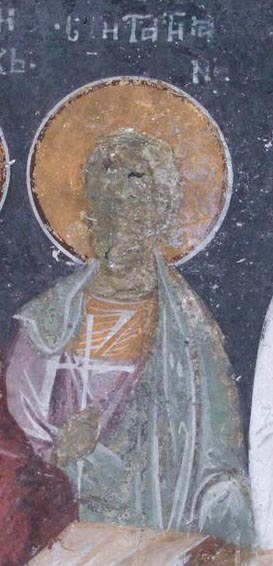
Tation has no fixed individual type. Where he is depicted at all — chiefly in menologion cycles and in the calendar-frescoes of monastic refectories, which give one figure to each day of the year — he appears as a layman-martyr: a young or middle-aged man in tunic and mantle, bare-headed, holding the cross of martyrdom in his right hand, the left open before the breast. A narrative treatment would show the moment on which his notice turns: the saint being dragged from the city gate by soldiers, and signing himself with the Cross as he falls.
The stored image is precisely this type, from the menologion fresco cycle of Gračanica (Serbian, c. 1320) — the layman-martyr in tunic and mantle, the cross in his right hand, the Church Slavonic inscription of his name beside the halo. The paint of the face is abraded, but the identifying inscription is legible in frame, which is what the identity rule requires. The Menologion of Basil II, which supplies miniatures for most minor saints of the calendar, covers only September–February; for this August commemoration the Serbian calendar frescoes supply what the manuscript cannot.
Disputed questions
- The form of the name. The Greek is Τατίων (Tatiōn); the Slavonic and the English calendars give Tation or Tatio, and some Latin martyrologies Tatianus. He is not to be confused with the second-century apologist Tatian the Syrian, author of the Diatessaron, who is no saint of the calendar and who ended his life outside the Church; nor with the virgin-martyr Tatiana of Rome (January 12), whose name is the feminine of the different stem.
- Which Claudiopolis? At least four cities of Asia Minor and Cilicia bore the name in antiquity. The synaxarion's own qualification — Bithynia — fixes this one as the Bithynian Claudiopolis (Bithynium, modern Bolu), and the governor's title in the notice supports it.
- The date of death. "In the reign of Diocletian (284–305)" is what the sources actually say; the round figure 305 printed in the calendars is a terminal date drawn from the reign, not an independently attested year, and should be read as "in the Great Persecution."