
Terence and Neonilla and Their Children
The Holy Martyrs Terence and Neonilla and Their Seven Children
Martyr · Child Martyr · d. c. 250 (traditionally under Decius)
Commemorated 28 October
Terence and Neonilla were a married couple of Syria who, with their seven children, confessed Christ and were put to death together in the persecution of the third century, by tradition under the emperor Decius. Denounced as Christians and brought before the magistrate, the whole family stood firm through a succession of tortures — the iron hook, vinegar and fire, the wild beasts, the cauldron of pitch — from which, the account says, an angel of God delivered them; at the last, when nothing could break them, all nine were beheaded. They are commemorated together on October 28, and stand in the calendar as one of the great household-martyrdoms of the early Church.
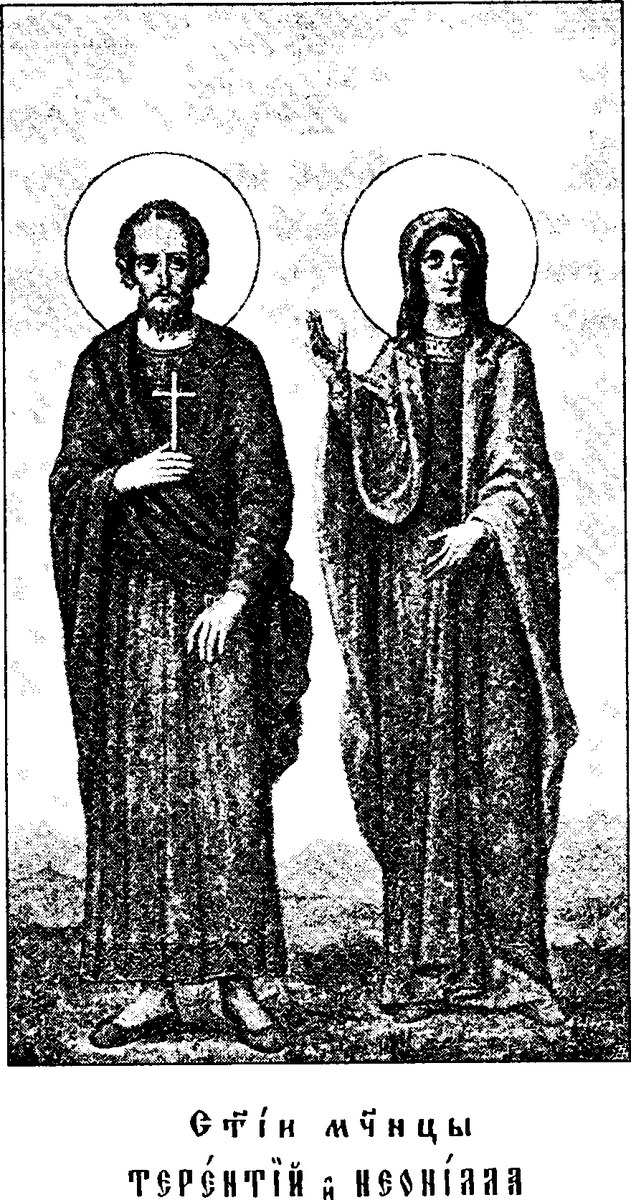
_-_%D0%B8%D0%BA%D0%BE%D0%BD%D0%B0_02282_%D0%A2%D0%B5%D1%80%D0%B5%D0%BD%D1%82%D0%B8%D0%B9_%D0%B8_%D0%9D%D0%B5%D0%BE%D0%BD%D0%B8%D0%BB%D0%BB%D0%B0.png)
Terence (Terentius) and his wife Neonilla came, the synaxarion says, from Syria, and had seven children. The account of their passion is brief and follows the common shape of a family martyrdom: denounced to the authorities as Christians, husband, wife and children together confessed Christ and derided the pagan gods, and for this the whole household was given over to torture. Their sides were torn with iron hooks; vinegar was poured into the open wounds and fire set to them; they were thrown to wild beasts, which — as in the passions of Thecla and Daniel before them — grew gentle and would not touch them; they were cast into a cauldron of boiling pitch, and were not burned. Through it all, the tradition says, they encouraged one another and prayed, and angels loosed their bonds and healed their hurts. When the persecutors saw that no torment could overcome the saints, they beheaded them — the father, mother and all seven children in one company.
The names of the seven children are transmitted with the usual manuscript variance. The Greek synaxarion of the day names them Nitas, Sarbelos, Hierax, Theodoulos, Phokas, Bele and Eunike; the Slavic and OCA tradition gives Sabelus (Sarbelus), Photius (for Phokas), Theodoulus, Vele (Bele), Hierax, Nitus (Nitas) and Eunice. The differences are of spelling and transliteration, not of number: the family is uniformly a pair of parents with seven children, as the Greek epigram of the day sums it up — "with seven children the pair of spouses counted the sword's cutting an honour."
Feast and commemoration
October 28 (church date; Old Calendar civil November 10). The Greek Menaion and the Slavonic Menaion both keep the martyrs on this day, the Greek books listing the seven children by name in the synaxarion notice. The day carries a second and distinct group of martyrs also named for a Terence — Terence (Terentius), Africanus, Maximus, Pompeius and thirty-six others, martyred at Carthage — with whom this family is not to be confused (see below).
Hymns
Troparion — Tone 4
Thy martyrs, O Lord, in their sufferings received incorruptible crowns from Thee our God; for having Thy strength, they laid low the tyrants and shattered the powerless boldness of the demons. By their prayers, O Christ God, save our souls.
Original translation from the Slavonic
Kontakion — Tone 4
The honoured memory of the martyrs is come today, gladdening all creation — of wise Terence and of his consort. Let us then run together with fervour, that we may receive healing; for they have received grace from the Holy Spirit to heal the infirmities and sicknesses of our souls.
Original translation from the Slavonic
Iconography
The martyrs are shown as a family group — Terence and Neonilla with their children ranged about them, all in the martyr's dress, some bearing crosses. The stored image is an engraving from the illustrated Lives of the Saints compiled after Demetrius of Rostov (the October volume, published before 1911): Terence and Neonilla with their children. No early panel icon of the family has been identified.
Disputed questions
- Not to be confused with the Carthaginian Terence group of the same day. The October 28 synaxarion carries two martyr-companies whose leaders share the name Terence: this Syrian household of Terence and Neonilla with their seven children, and the martyrs Terence, Africanus, Maximus, Pompeius and thirty-six others who suffered at Carthage. The two are distinct commemorations and are listed separately in the Greek Menaion. Distinct again is the martyr Terentius among Leontius, Dometius, Terentius and Domninus.
- Not to be confused with the Neonilla (Leonilla) kept on January 16 — the grandmother of the martyr-brothers Peusippus, Elasippus and Mesippus, who converted and suffered with them in the second century. That Neonilla is a distinct saint of a different family, age, and feast day.