
Peusippus, Elasippus, Mesippus and Neonilla
The Holy Martyrs Peusippus, Elasippus and Mesippus, and Neonilla their Grandmother
Martyr · d. c. 175 (under Marcus Aurelius)
Commemorated 16 January
Peusippus, Elasippus and Mesippus were three brothers — the tradition calls them triplets — martyred in the second century, together with their grandmother Neonilla who had raised them in the faith and suffered with them. Orphaned young and brought up by Neonilla, a Christian, the three grew famous as horsemen; on coming to a clear knowledge of Christ they openly renounced the pagan gods, threw down and broke the idols, and confessed the faith. For this they were hung upon a tree and torn, and cast into a fire from which their bodies came unharmed, until they gave up their souls; their grandmother Neonilla was beheaded, and with them suffered a woman named Jonilla and the confessors Neon and Turbo, who recorded and copied the account of their passion and were themselves martyred. Their veneration spread early and widely; the sources place their contest either in Cappadocia or — in the Western tradition that received their relics — in Gaul, at Langres. They are kept on January 16.
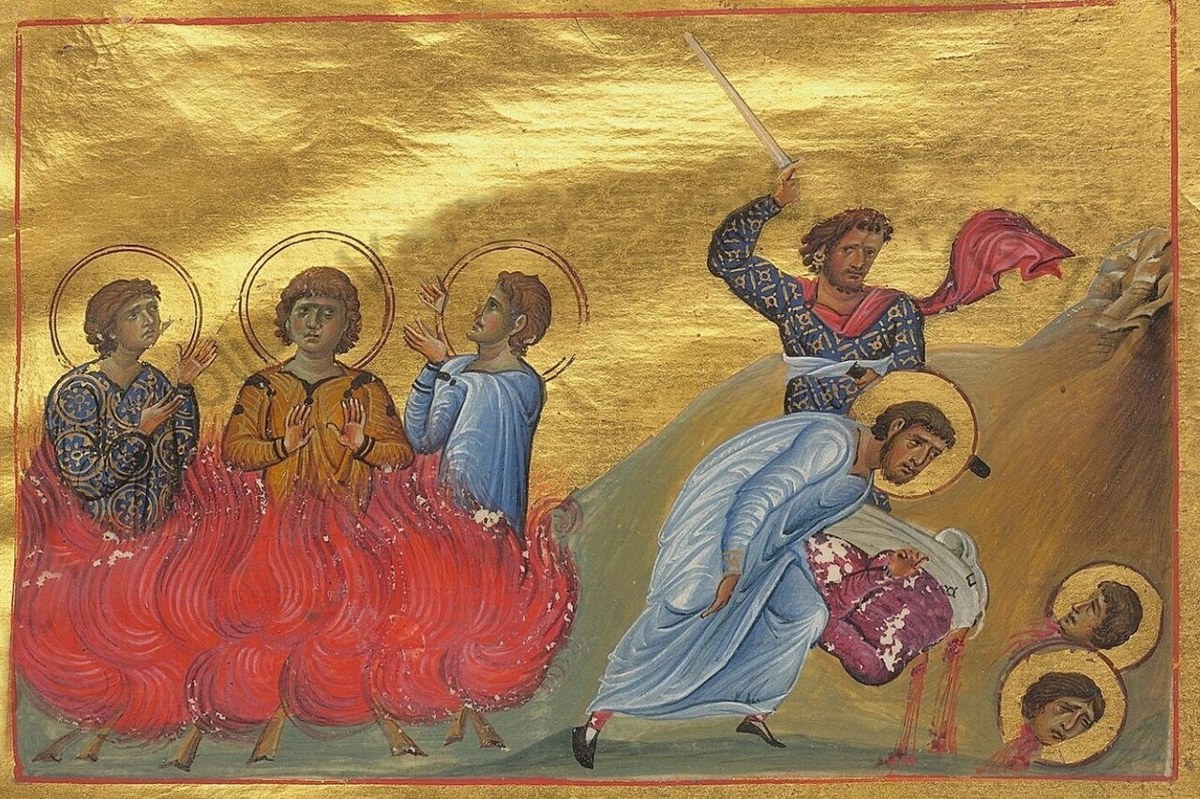

The martyrdom of the three brothers is one of the more widely diffused of the minor passions of the early Church, kept in East and West alike, and its geography is itself part of its history (see Disputed questions). In the common account the brothers — Peusippus, Elasippus and Mesippus — were born at a single birth, orphaned in infancy, and brought up by their grandmother Neonilla (called Leonilla in the Latin and Slavonic tradition), a woman of firm Christian faith who is said to have been baptised, or instructed, by a disciple of Polycarp of Smyrna — a detail that anchors the family to the sub-apostolic generation and to the persecutions under Marcus Aurelius (161–180). The three grew to be renowned riders and men of standing; their very names, compounded with -ippos, "horse," carry the memory of it, and the tradition dwells on their fame as horsemen.
Neonilla laboured for the salvation of her grandsons, and at length brought them to open confession of Christ. Filled with zeal, the brothers went out and overthrew the idols of the pagan cult, breaking the images in the sight of the people. Seized and brought before the magistrate, they refused to sacrifice and confessed Christ boldly. They were hung upon a tree and their bodies raked and torn; then, when torture could not move them, they were thrown into a great fire — from which, the account says, they emerged unharmed, the flames not touching them, and in prayer gave up their souls to God. Their grandmother Neonilla, who had encouraged them to the end and would not deny Christ, was beheaded. With the family the tradition joins a woman named Jonilla (Ionilla), who confessed Christ openly at the sight of their courage and was hung up by the hair, torn, and beheaded; and two men, Neon and Turbo, who wrote down the acts of the martyrs — Neon dying of his scourging, Turbo completing the record and himself crowned with martyrdom.
The date of the martyrdom is placed about the year 175, in the reign of Marcus Aurelius; the century of their repose is the second. Beyond the passion-narrative little is transmitted of them, and the honest measure of their Life is the account of their contest and the wide veneration it earned.
Relics and later cultus
The cultus of the three brothers spread remarkably far for so early and so local a group. In the West they became the patrons of Langres in Gaul (Burgundy), where their relics were venerated and where a great tradition held that they had suffered locally; the transfer of relics westward is variously ascribed, one account bringing them to a nobleman of Langres in the reign of the emperor Zeno (474–491). Their fame reached as far as the Rhineland and beyond — a chapel and cult at Ellwangen in Swabia, among others, preserve their memory — so that the same three martyrs are honoured across Latin Christendom under the Latinised names of their passion. In the Byzantine calendars they are kept on January 16 with their grandmother and companions.
Feast and commemoration
January 16 (church date; New Calendar civil January 16; Old Calendar civil January 29), together with the Veneration of the Chains of the Apostle Peter and Danax the Reader. The Greek Menaion names the three brothers and Neonilla; the Slavonic calendars add the companions Neon, Turbo and Jonilla. In the West the same martyrs are kept (the Roman Martyrology placing them at Langres in Gaul), which accounts for the double geography of the tradition.
Hymns
Troparion — Tone 4
Thy Martyrs, O Lord, in their courageous contest have received from thee, our God, crowns incorruptible; for possessed of thy might, they cast down the tyrants and utterly destroyed the powerless boldness of the demons. By their supplications, O Christ our God, save thou our souls.
Original translation from the Greek
Iconography
The three brothers are shown together as young men, often as beardless riders or soldiers of equal age — the twin-like sameness of the triplets being the point of their portraiture — sometimes with their grandmother Neonilla beside them. The stored image is the miniature for January 16 from the Menologion of Basil II (Constantinople, c. 985; Vatican, Vat. gr. 1613), which depicts the three martyrs together (source, public domain, pd-old-work).
Disputed questions
- Cappadocia or Gaul? The sources divide over where the brothers suffered. The Greek synaxaria and much of the Eastern tradition place the martyrdom in Cappadocia in Asia Minor; the Western tradition, which possessed their relics, places it in Gaul, at Langres in Burgundy, and this is the setting of the Roman Martyrology. Some scholars suppose an originally Eastern (Cappadocian) group whose cultus and supposed acta were transplanted to Gaul with their relics, or conversely a Gaulish group given an Eastern colouring; the Church keeps the memory without resolving the geography, and the entry records both.
- The names and their forms. The three brothers appear under a wide spread of spellings: Greek Πεύσιππος / Σπεύσιππος, Ἐλάσιππος / Ἐλεύσιππος, Μέσιππος / Μελεύσιππος; Latin and Western usage Speusippus, Eleusippus, Meleusippus (also Melasippus, Melapsippus). The grandmother is Neonilla in the Greek, Leonilla in the Latin and Slavonic. The variants denote the same saints; the Greek Menaion forms are used here for the primary name, with the others in alternate_names.
- Not to be confused with the Neonilla kept on October 28 — the wife of the martyr Terence, and their seven children, martyred in Syria under Decius: a distinct saint of a different family and feast.