
Thalelaeus of Syria
Our Venerable Father Thalelaeus the Hermit of Syria, the Ever-Weeping
Venerable · Wonderworker · d. c. 460
Commemorated 27 February — The ever-weeping hermit near Gabala in Syria, described by Theodoret of Cyrrhus
Thalelaeus the Hermit (†c. 460) was a Syrian solitary of the region near Gabala (Jableh) on the coast of Syria, remembered by his contemporary Theodoret of Cyrrhus for two things above all: the extraordinary austerity of his dwelling, and his ceaseless weeping — whence his surname "Epiklautos," the Ever-Weeping. He confined himself for years in a cramped hanging hut in which he could neither stand upright nor lie down, and wept without pause for his own sins and the judgment to come. From this outpost he overthrew a pagan cult that clung to the place, drew the local people to Christ, and became a source of healings. He is not to be confused with the unmercenary Martyr Thalelaeus of Cilicia (kept May 20). He is commemorated on February 27.
.jpg)
Thalelaeus is one of the Syrian ascetics whom Theodoret, Bishop of Cyrrhus, knew in person and set down in his Religious History (the Philotheos Historia, c. 440) — the indispensable eyewitness record of the holy men of fifth-century Syria — and it is to Theodoret that we owe nearly everything that is known of him.
He settled near a place some distance from Gabala, on the Syrian coast, where there stood a shrine of the demons — a pagan cult-site notorious in the district — set among tombs. There, the tradition holds, he first endured the assaults of the unclean spirits and, unmoved, made the very place a station of prayer. For his dwelling he devised an extraordinary austerity: he fashioned a small open cage or hut, suspended between poles, so low and so narrow that a man of his height could not stand erect within it nor stretch out to lie down, so that for years he lived bent double, his knees drawn up to his chest, the weight of his own posture a continual penance. Theodoret, who saw him, records that he asked the hermit why he had chosen so strange a discipline, and that Thalelaeus answered with humility that he punished the body that had sinned, and sought by voluntary hardship now to escape the punishments to come.
Above the austerity of the body stood the mark that gave him his name. Thalelaeus wept continually — not in despair but in compunction, mourning his sins and trembling at the memory of the divine judgment — and the ceaselessness of his tears earned him from the people the surname Epiklautos, "the Ever-Weeping." Asked the cause of his weeping, he spoke of the fear of God and the account each soul must render. His endurance and his gentleness drew the country people to him; through his word and example the pagan cult of the place was uprooted, its shrine destroyed, and a chapel to the holy martyrs raised where the demons had been served. God granted him the working of healings, so that many came to him sick and went away whole. He lived to a great age in this labour and reposed in peace about the year 460.
Feast and commemoration
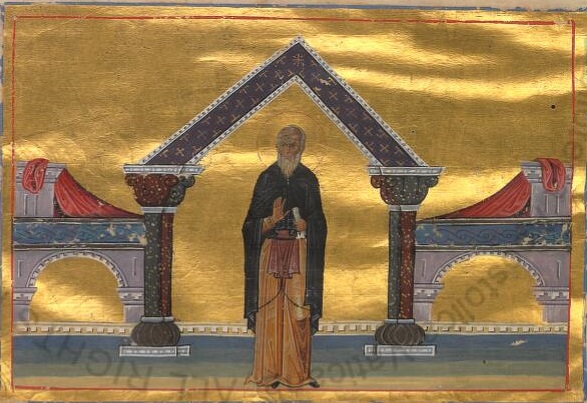
Thalelaeus is kept universally on February 27 (church date; Old Calendar civil March 12), and appears in the Byzantine synaxaria and in the Menologion of Basil II (c. 985), which gives him a miniature and a notice — evidence that his cultus was fixed at Constantinople by the tenth century.
Hymns
Troparion — Tone 8
With the streams of thy tears thou didst make the barren desert to bear; and by thy sighing from the depths thou didst yield fruit a hundredfold in thy labours; and thou becamest a luminary, shining upon the world, O Thalelaeus our venerable Father. Intercede with Christ our God that our souls may be saved.
Original translation from the Greek
Iconography
Thalelaeus is depicted as an aged, bearded hermit, often shown within or beside his singular hanging hut, and — where the iconographer marks his surname — with tears upon his cheeks. The stored image is the miniature for February 27 from the Menologion of Basil II (Constantinople, c. 985; Vatican, Vat. gr. 1613), showing the hermit of Syria (source, public domain, pd-old-work).
Disputed questions
- Not to be confused with the Martyr Thalelaeus the Unmercenary of Aegae in Cilicia, an unmercenary physician martyred under the emperor Numerian (kept May 20) — a wholly different saint of an earlier age and a different type. Some modern calendar notices (including the OCA's February 27 page) blend details of the two, describing the Syrian hermit as "one of the Unmercenary Physicians, a native of Cilicia": these belong properly to the May 20 martyr. The Thalelaeus of February 27 is the weeping hermit of Syria described by Theodoret, †c. 460.