
Thecla of Iconium
The Holy Protomartyr and Equal-to-the-Apostles Thecla
Protomartyr · Martyr · Equal to the Apostles · Virgin · b. c. 30 — d. late 1st century
Commemorated 24 September — Repose at Seleucia in Isauria
Thecla of Iconium (1st century) is honoured by the Orthodox Church as protomartyr among women and equal-to-the-apostles: a noble virgin of Iconium who, hearing the Apostle Paul preach, broke her betrothal to follow Christ, passed unharmed through fire at Iconium and through the beasts at Antioch, and then preached, taught and healed for long decades at Seleucia in Isauria, where the tradition relates that the very rock opened to receive her at the end of her life. Her story is carried by the second-century Acts of Paul and Thecla; her cultus — from her great pilgrimage shrine at Seleucia to Egypt, Milan, and the Aramaic-speaking convent of Maaloula in the Antiochian patriarchate — is among the oldest and widest given to any woman saint.
.jpg)
Origins and early life
The tradition places Thecla's birth at Iconium (modern Konya in Asia Minor), the daughter of a prominent pagan household — her mother Theocleia appears in the story; no father is named — and betrothed in her eighteenth year to Thamyris, a leading young man of the city. Her whole recorded life turns on the arrival of the Apostle Paul, which the narrative sets during his missionary preaching in Lycaonia (the canonical Acts of the Apostles brings Paul to Iconium in Acts 13–14, in the late 40s).
Paul lodged in the house of Onesiphorus and preached "the word of God concerning continence and the resurrection," cast in the Acts of Paul and Thecla as a series of beatitudes on purity of heart and virginity. Thecla, in the house adjoining, sat at her window for three days and nights without food or sleep, held fast — the text is emphatic that she could see only the listeners going in and out, not Paul himself — by the word alone. Her mother and her betrothed, unable to draw her from the window, took fright at this "new desire and fearful passion"; Thamyris denounced Paul to the governor as one who "deprives young men of wives and maidens of husbands," and Paul was imprisoned. Thecla bribed her way into the prison with her bracelets and her silver mirror, and sat at Paul's feet in his chains, kissing them, for three days, until her family found her there.
Trial at Iconium: the pyre quenched
Brought before the governor's tribunal, Paul was scourged and expelled from the city. Thecla, asked why she would not marry according to the law of the Iconians, stood silent, her eyes on Paul; and it was her own mother Theocleia who cried out, "Burn the lawless one!" — that the example might terrify the other women taught by Paul. Condemned to the pyre, Thecla — the narrative notes that she looked for Paul "as a lamb in the wilderness looks about for the shepherd" and saw the Lord in the likeness of Paul, seated among the crowd — signed herself with the Cross and mounted the wood. The fire blazed but did not touch her; a storm of rain and hail broke from a cloud overhead and quenched the flames, and Thecla went out free. She found Paul fasting and praying for her in an open tomb on the road to Daphne, with Onesiphorus and his family, and begged to follow him: "I will cut my hair round about and follow thee wherever thou goest." He would not yet baptize her — "the season is unfavourable, and thou art comely" — but took her with him to Antioch.
Antioch: Alexander and the beasts
At the entrance to Antioch a magnate named Alexander — in the better manuscripts a Syriarch, president of the provincial games — was seized with desire for her and, when Paul disowned any claim to her, tried to take her by force in the open street. Thecla resisted publicly, tearing his cloak and pulling the crown from his head, and for this humiliation of a great man she was condemned to the beasts. The account is remarkable for the solidarity of the city's women, who protest the sentence throughout ("An evil judgment! A godless judgment!"), and for the widowed queen Tryphaena, a kinswoman of the emperor whose dead daughter Falconilla had appeared to her in a dream asking that Thecla pray for her; Tryphaena took the condemned girl into her protection between the spectacles.
In the arena a fierce lioness, set upon her, lay down at her feet and licked them, and then died defending her against a bear and a lion. When more beasts were loosed, Thecla, seeing a great pit of water containing seals (the arena's sea-creatures), cried "In the name of Jesus Christ I baptize myself on the last day!" and threw herself in — the famous self-baptism of the Acts; lightning slew the creatures in the pool, and a cloud of fire veiled her nakedness from the crowd. Bound between bulls that were goaded with hot irons to tear her apart, she remained unharmed when the flame burned through the ropes. Tryphaena fainted at the arena's edge; the games were halted for fear of the imperial house; and the governor, summoning Thecla, asked "Who art thou?" and, at her confession, released her, clothing her again. The women of Antioch cried out with one voice, "One is God, who has delivered Thecla."
Apostolic labours and repose at Seleucia
After a stay in Tryphaena's house, where she instructed the household in the word of God, Thecla sought out Paul at Myra in Lycia, travelling in a man's cloak with an escort of young men and maidservants. There Paul, hearing all, commissioned her: "Go and teach the word of God." The Church's title "equal-to-the-apostles" rests on this commission and on what followed: she returned first to Iconium — Thamyris was dead; her mother she addressed with an appeal to believe — and then settled at Seleucia in Isauria (near modern Silifke on the Cilician coast), where the Acts says she "enlightened many with the word of God" before her repose.
The later chapters of the tradition, attached to the Acts in many manuscripts and elaborated in the fifth-century Life and Miracles of Thecla, describe long decades of ascetic life in a cave on the hill south of Seleucia, a community of virgins gathered about her, and a ministry of healing so effective that the physicians of the city lost their trade. In the received ending, these physicians — attributing her power to her virginity — sent young men to violate her; the aged Thecla (the texts say she was ninety) prayed, and the rock of the mountain opened before her and received her, closing upon her; a fragment of her veil remained in the assailants' hands. The Greek synaxarion keeps this ending in its verses for September 24: "He who once rent the rocks at His Passion, Himself saves thee, Thecla, by rending the rock." A variant transmitted in some manuscripts has her pass beneath the earth from Seleucia to Rome, to lie near Paul — an aetiology for the Roman claim to relics. Because she was twice given over to death for Christ, the Church styles her protomartyr among women — the first woman to suffer for Christ — while confessing that God preserved her through every torment and that she reposed in peace.
Veneration and later cultus
Thecla's cultus is among the most impressive of the early Church, and is the strongest argument that a real first-century figure stands behind the literary Acts.
- Seleucia. Her shrine on the hill of Meriamlik (Ayatekla) south of Silifke became one of the great pilgrimage centres of the East. The Spanish pilgrim Egeria visited it in 384, describing the martyrium, its surrounding wall against Isaurian raiders, and the "monastic cells without number" of men and of women; she read there the whole Acts of Thecla with intense devotion. Gregory of Nazianzus withdrew to "the shrine of the virgin Thecla" for his celebrated retreat after 375. The emperor Zeno, ascribing his recovery of the throne (476) to Thecla's aid, raised over the site a huge basilica whose apse still stands; the anonymous fifth-century Life and Miracles of Thecla, long wrongly ascribed to Basil of Seleucia, collects the healings and interventions of the shrine.
- Egypt. Thecla was immensely popular in Egypt: she appears paired with the martyr Menas on thousands of the pilgrim ampullae of Abu Mena (5th–7th centuries), flanked by the beasts of her contest, and her name was among the commonest given to Coptic Christian women.
- The West. Ambrose of Milan set Thecla beside the Virgin Mary and Agnes as the pattern for consecrated virgins (De virginibus); the ancient Roman prayer for the dying (the commendatio animae) asks that the soul be delivered "as Thou didst deliver Thecla from the three torments"; Milan's early cathedral complex included a great basilica of St. Thecla; Tarragona in Spain keeps her as patroness and claims an arm-relic.
- Methodius of Olympus (†311) makes Thecla the crowning speaker of his Symposium, the leader of the choir of virgins who sings its closing hymn — an early and weighty witness to her standing as first of women ascetics.
The Antiochian tradition: Maaloula
In the Patriarchate of Antioch, Thecla's living centre of veneration is Maaloula, the mountain village north of Damascus that is one of the last places on earth where Western Aramaic, the language of Christ's own milieu, is still spoken. The convent of St. Thecla (Deir Mar Takla), a monastery of the Greek Orthodox Patriarchate of Antioch, stands beneath the cliff at the head of the village; above it, reached by steps, a cave-shrine holds what the local tradition venerates as the saint's tomb, with a sacred spring dripping from the rock. The Antiochian tradition tells the flight and the rock somewhat otherwise than the Seleucia ending: pursued by her persecutors, Thecla came against the mountain wall, prayed, and the mountain split before her, opening the narrow gorge that is the village's landmark — a story folk etymology attaches to the very name Maaloula ("entrance" in Aramaic). Her feast is the village's great festival, and the shrine has for centuries drawn Muslim as well as Christian pilgrims to its spring. During the Syrian war the village was seized in 2013 and the nuns of the convent were held captive from December 2013 until their release in March 2014; the convent, damaged in the fighting, has since been restored and re-inhabited. For the Antiochian faithful Thecla is a patroness of the see itself: the "first martyr among women and equal of the apostles" whose apostolate began on Antiochian ground in the Acts and whose relics and memory remain in Syria.
Hymnographic and literary legacy
The canon of the saint in the Menaion for September 24, in Tone plagal 4, is the work of John the Monk (identified in part of the tradition with John of Damascus) and carries the acrostic "The Protomartyr is divinely glorified." The stichera of the day are ascribed to Anatolius and to Andrew of Jerusalem; the doxastikon at the aposticha addresses her in a phrase that concentrates her whole title: "companion of Paul and fellow-contestant of Stephen … protomartyr of Christ among women." Thecla became the standard of comparison in the hymnography of later women martyrs, who are repeatedly praised as "emulating Thecla." The Acts themselves were translated in antiquity into Syriac, Coptic, Armenian, Arabic, Latin and Slavonic; Symeon Metaphrastes reworked her passion for the tenth-century menologia.
Feast and commemoration
September 24 (church date; Old Calendar civil October 7), kept universally. The styling differs by tradition and is worth recording: the received Greek Menaion titles her "the holy Great-martyr and Equal-to-the-Apostles Thecla," while its own hymns call her repeatedly Protomartyr — first among women — and first-contestant (πρωτόαθλος); the Slavic books and the OCA style her "Protomartyr and Equal-to-the-Apostles." In the Antiochian patriarchate the day is the patronal feast of Maaloula. The Roman tradition anciently kept her on September 23; the Syriac churches also commemorate her, the East Syriac tradition among the "chaste women" remembered after the Nativity.
Hymns
Troparion — Tone 4
Schooled by the words of Paul, O bride of God, Thecla, and made firm in the faith by Peter, O God-called one, thou wast shown forth the protomartyr and first sufferer among women. Thou didst enter the flame as into a place of flowering; beasts and bulls trembled before thee, for thou wast armed with the Cross. Wherefore, O all-praised one, entreat Christ God that our souls may be saved.
Original translation from the Slavonic
Apolytikion — Tone 4
Thy lamb, O Jesus, crieth with a great voice: Thee, my Bridegroom, do I love, and seeking Thee I contend, and I am crucified and buried with Thee in Thy baptism; and I suffer for Thy sake, that I may reign with Thee, and I die for Thee, that I may live in Thee. As a spotless sacrifice, then, receive her who with longing was slain for Thee. By her prayers, since Thou art merciful, save our souls.
Kontakion — Tone 8
Thou didst shine forth with the beauty of virginity, thou wast adorned with the crown of martyrdom, thou art entrusted with apostleship, O virgin, as one glorious; the flame of the fire thou didst turn to dew, and the rage of the bull thou didst tame by thy prayer, O first of contestants.
Original translation from the Greek
Iconography
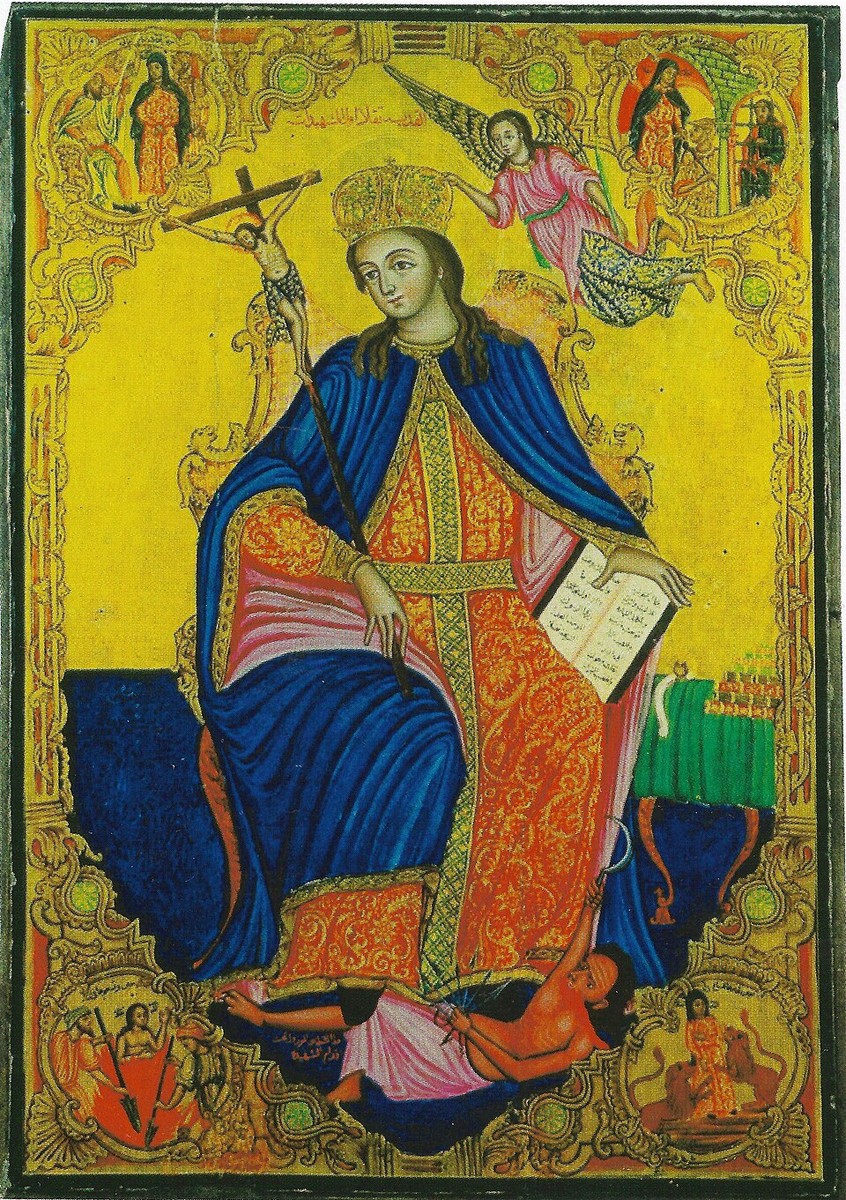
Thecla is depicted as a young woman in the maphorion of a virgin, most often with the cross of martyrdom; her distinctive scenes are the contest cycle — Thecla at the window; Thecla amid the flames with the storm-cloud above; Thecla in the arena between the lioness and the bear; the seals' pool; and the rock closing upon her. She frequently accompanies the Apostle Paul (as in the famous 6th-century Coptic fresco tradition and on the Menas ampullae of Egypt). The stored primary image is a Lebanese icon from the church of St. Simon at Zabbougha — an eloquent witness of her Antiochian cultus — with an Arabic inscription styling her "first of the women martyrs": the crowned saint enthroned, an angel bearing her crown, a cross with the Crucified in her right hand and the open Gospel in her left, her vanquished persecutor beneath her feet, surrounded by border medallions of her contests. The variant is the miniature of the Menologion of Basil II (c. 985, Constantinople; Vatican Library, Vat. gr. 1613, p. 86), which paints her repose: Thecla orant, the mountain split in two about her to receive her.
Disputed questions
- The source and its author. Almost everything narrated of Thecla comes from the Acts of Paul and Thecla, a section of the larger apocryphal Acts of Paul composed in Asia Minor in the second century. Tertullian (On Baptism 17, c. 200) records that the work was composed by a presbyter in Asia, who, convicted of the fabrication, was deposed from his office, though he pleaded he had done it "for love of Paul"; Tertullian cites the case against those who invoked Thecla's example to claim for women the right to teach and to baptize. Jerome repeats the notice. The Acts are not canonical Scripture and were listed among the writings not received; the Church's veneration of Thecla rests not on the book's authority but on her continuous and universal cultus and on the witness of the Fathers — Methodius, Gregory of Nazianzus, Ambrose, John Chrysostom, and the liturgical tradition itself.
- Historicity. Modern scholarship is divided. Many scholars read the Acts as a second-century ascetic romance with no historical core; others argue that the fixed local anchors of the story (Iconium, the Seleucia shrine) and the sheer antiquity and geography of the cult are best explained by a genuine first-century woman convert of Paul's circle around whom the legend crystallised. This entry records the tradition as the Church received it, and the question as scholarship leaves it: open.
- Which Antioch. The Acts do not say whether the Antioch of Alexander and the beasts is Pisidian Antioch (nearer Iconium, and fitting a Syriarch poorly) or Antioch on the Orontes; witnesses and scholars divide, and the Antiochian tradition naturally reads it of the great Antioch of Syria.
- The manner of her end is transmitted in variants: the rock at Seleucia receiving her (the synaxarion's account), the underground passage to Rome, and a simple repose in peace at ninety. All agree she did not die under the executioner — whence the paradox of a "protomartyr" who reposed in peace, which the tradition resolves by counting her double condemnation and willing self-offering as a true martyrdom of intent.
- The rock motif recurs in the passions of other women saints of Asia Minor — notably Ariadne of Phrygia (September 18), whose flight likewise ends in a rock that opens to receive her; the later account is generally judged to be modelled on Thecla's.
- Same-named saints. Later calendars know several other Theclas — among them martyrs of Persia (June 9, November 20) and the Thecla who suffered at Gaza with Timothy and Agapius (August 19) — none of whom is the Iconian protomartyr.