
Theoctistus of Palestine
Our Venerable Father Theoctistus, Fellow-Ascetic of Euthymius the Great
Venerable · d. 467
Commemorated 3 September — Repose
Theoctistus (died 467) was one of the founding fathers of Palestinian desert monasticism, remembered above all as the inseparable companion of Euthymius the Great. Hermits together at the lavra of Pharan, the two withdrew about the year 411 to a cave in the gorge of Wadi Mukellik in the Judean wilderness, which grew into a coenobium that Theoctistus governed for more than half a century. When Euthymius founded his own lavra nearby, every young aspirant — among them the young Sabas the Sanctified — was formed first under Theoctistus's care. He reposed in extreme old age on September 3, mourned by the aged Euthymius and buried in the presence of the Patriarch of Jerusalem.

At Pharan and the withdrawal to the gorge
Theoctistus enters the record as a hermit of the lavra of Pharan, in the desert east of Jerusalem, at the time when Euthymius arrived there from Melitene in Armenia about the year 406. The two men formed a friendship that the historian of Palestinian monasticism, Cyril of Scythopolis, describes in the language of the Psalter and of classical friendship alike: they were of one mind and one soul, and their affection endured unbroken for sixty years. Each year after the octave of Theophany they left Pharan together for the deep desert of Koutila, returning at the feast of Palms — the annual Lenten withdrawal that later became a fixed institution of Palestinian monasticism.
On one such withdrawal, about the fifth year of their companionship (c. 411), they came to the torrent-gorge of Mukellik, a wild ravine descending toward the Dead Sea, and found high in its northern cliff a great cave, accessible only with difficulty. Recognising it as the place appointed for them, they remained, living at first on the wild plants of the ravine, until shepherds pasturing flocks below discovered them and spread word of the two ascetics; villagers then brought them bread, and brethren from Pharan and elsewhere began to gather to them.
Head of the coenobium
As disciples multiplied, the cave was consecrated as a church and a monastery was built against the cliff below it. Euthymius, who loved stillness and would not bear the burden of governance, directed that Theoctistus be superior, and withdrew in time to found his own lavra a few miles to the west; but he committed to Theoctistus the formation of all who came. The arrangement became a school of the desert: Euthymius's lavra received only monks already formed, and every young aspirant was sent first to the coenobium of Theoctistus. So it was that when Sabas — later the Sanctified, founder of the Great Lavra — came to Euthymius as a youth of eighteen about the year 457, Euthymius judged it not fitting for so young a man to live among the anchorites and placed him under Theoctistus, in whose community Sabas received his monastic formation.
Cyril presents Theoctistus as the practical father of this whole monastic family: the steady hegumen who fed, housed, and formed the brotherhood for more than fifty years while his greater-named friend drew the world's eyes, the two operating to the end as one. The monastery of Theoctistus — later known also as Deir Mukellik — endured for centuries after him, and its ruins still cling to the cliff of the wadi (the modern Nahal Og).
Repose
Theoctistus died in deep old age on September 3 of the year 466 or 467. Euthymius, then about ninety years old, came down from his lavra and remained by him through his final illness; Anastasius, Patriarch of Jerusalem, came in person to the funeral, and the old man was buried with honour in his own monastery, in the cave where the two friends' common life had begun. Euthymius followed him in death some six years later.
Feast and commemoration
September 3 (church date; Old Calendar civil September 16), his repose, kept universally in the Byzantine rite; the Menaion joins his service to that of the hieromartyr Anthimus of Nicomedia. He is also remembered wherever the life of Euthymius the Great (January 20) and of Sabas the Sanctified (December 5) is told, as the third figure of that founding generation of the Judean desert.
Hymns
Troparion — Tone 8 (from the common of monastic saints)
With the streams of thy tears thou didst till the barrenness of the desert, and with sighs from the depths thou madest thy labours bear fruit a hundredfold, and becamest a beacon for the whole world, shining with miracles: Theoctistus our venerable father, intercede with Christ God that our souls may be saved.
Original translation from the Greek
Iconography
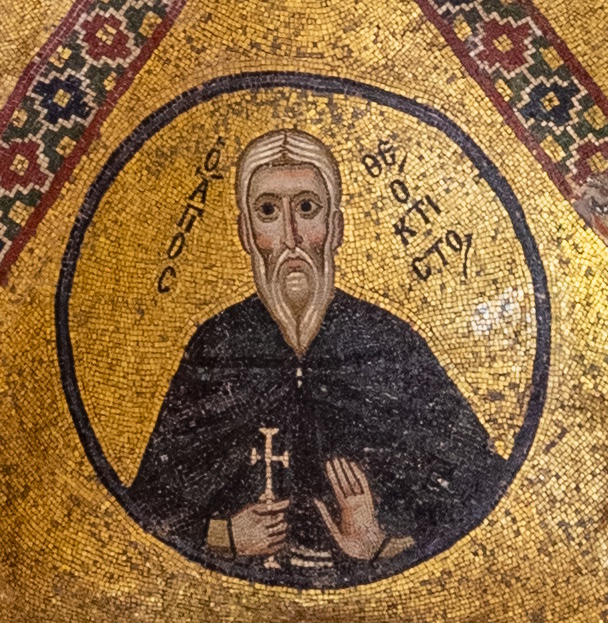
Theoctistus is depicted as an aged desert monk in the dark monastic habit, grey-bearded, holding a cross or scroll, often paired with Euthymius the Great. The stored image is the mosaic medallion of the saint (inscribed Ο ΑΓΙΟΣ ΘΕΟΚΤΙΣΤΟΣ) from the north-west bay of the katholikon of Hosios Loukas in Boeotia (11th century), where he stands in the company of the great monastic fathers — Anthony, Arsenius, Ephraim, Hilarion and their fellows — bearded, cowled in black, clasping a cross.
Disputed questions
- Year of repose. Cyril of Scythopolis's chronology yields September 3 in 466 or 467 depending on how his synchronisms are counted; the calendars commonly print 467 (so the OCA), and some modern treatments 466. The day, September 3, is not in doubt.
- Not to be confused with other saints of the name: Theoctistus, hegumen of Cucumo in Sicily (January 4), or the virgin Theoctista of Lesbos (November 9). A miniature in the Menologion of Basil II circulates online labelled "Theoctistus, bishop hieromartyr"; it belongs to another commemoration and does not depict this saint.