
Theoctista of Lesbos
Our Venerable Mother Theoctista of Lesbos
Venerable · d. c. 881
Commemorated 9 November
Theoctista of Lesbos (9th century) was a nun of the island of Lesbos who, seized in a Saracen pirate raid, escaped on the deserted island of Paros and lived there as a hermitess in extreme asceticism for some thirty-five years, unseen by any human being. A hunter who chanced upon her in the ruined church of the Hundred Doors found an aged woman clothed only in her white hair; at her request he brought her the Holy Gifts the following year, and after she had communed she was found dead. Her story, told by Symeon the Metaphrast, closely echoes that of Mary of Egypt, and she is venerated among the desert-dwelling holy women. She is commemorated on November 9.

Theoctista was born in the town of Methymna on the island of Lesbos. Orphaned young, she was placed by her relatives in a convent and raised among the nuns, and gladly embraced the monastic life, loving the long services and the ascetic round. When she had grown to womanhood there occurred the event that shaped her whole life: at Eastertime she went out from the monastery to visit her married sister in a nearby village, and that night a band of Saracen corsairs — Arab raiders of the kind that harried the Aegean from their base on Crete in the ninth century — fell upon the place and carried off its people, Theoctista among them, to be sold as slaves.
The pirates put in at the island of Paros, then largely deserted, and there, as the captives were held on the shore, Theoctista slipped away and fled inland into the empty wilderness of the island. She was not recaptured. For some thirty-five years — the number the tradition gives — she lived alone in the uninhabited island, sheltering near the ruined basilica of the Hundred Doors (the Panagia Ekatontapyliani), praying without ceasing, her clothing long since worn away so that she was covered only by her own hair grown white, and sustaining herself on wild seeds and herbs, in a solitude and privation that recalls the greatest of the desert ascetics.
Her discovery came through a hunter who had crossed to Paros after game and, entering the old church, was startled to find the aged solitary. She begged him at first to withdraw while she covered herself, then told him her story and made of him a single request: that when he came again to the island he should bring with him a portion of the Holy Gifts, the Body and Blood of Christ, for she had been so long without the Mysteries. The following year the hunter returned with the reserved Eucharist; Theoctista received Holy Communion with tears and thanksgiving, and when the man came back yet again a little later he found her already reposed, her body lying where she had prayed. Wishing a relic of the holy woman, he cut off one of her hands to carry away, but — the tradition relates — his boat could not leave the island until he had brought it back and laid it again with her body; only then was he able to depart and to make her holiness known.
Feast and commemoration
November 9 (church date; Old Calendar civil November 22), kept universally in the Byzantine rite. She is honoured especially on Paros, where the church of the Hundred Doors preserves her memory, and on her native Lesbos.
Hymns
Troparion — Tone 8
In you, O Mother, was the divine image surely preserved: for taking up the Cross, you followed Christ; by your deeds you taught us to despise the flesh, for it passes away, but to care for the soul, a thing immortal. Therefore, O venerable Theoctista, your spirit rejoices with the angels.
Original translation from the Greek
Iconography
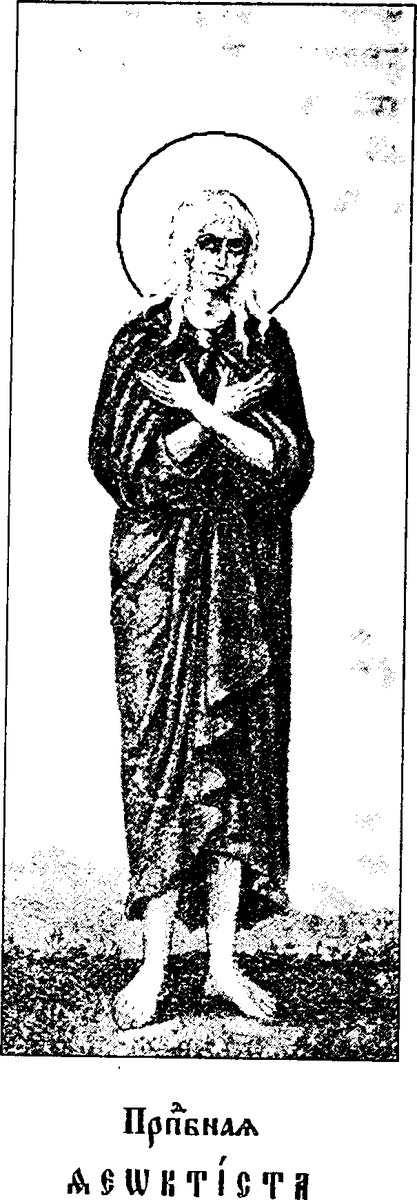
Theoctista is depicted as an emaciated ascetic covered by her long white hair, in the manner of Mary of Egypt and Onuphrius the Great, standing amid the rocks of Paros or before the ruined church of the Hundred Doors, and often shown receiving Holy Communion from the hunter's hand. She belongs to the iconographic family of the naked desert-dwellers.
The stored image is the captioned plate of the illustrated Zhitiya Svyatykh (1903–1911).
Disputed questions
- Not Theoctistus of Palestine. Theoctista (Θεοκτίστη), the ninth-century hermitess of Paros, is a distinct saint from the fifth-century Theoctistus of Palestine (Θεόκτιστος), the male fellow-ascetic of Euthymius the Great commemorated on September 3. The names differ only in gender ending, and the two are easily confused; they share neither era, place, nor sex.
- Resemblance to Mary of Egypt. The Life attributed to Symeon the Metaphrast already remarks on how closely Theoctista's story — the long hidden asceticism, the nakedness clothed in hair, the wild food, the single reception of Communion shortly before death at the hands of a chance visitor — parallels that of Mary of Egypt, and some scholars have regarded the one narrative as shaped upon the other. The Church keeps her as a distinct saint of the Aegean.