
Theodora and Didymus of Alexandria
The Holy Virgin-Martyr Theodora and the Holy Martyr Didymus the Soldier, of Alexandria
Virgin · Martyr · d. 304, at Alexandria
Commemorated 27 May — Martyrdom at Alexandria under Diocletian
Theodora, a Christian virgin of Alexandria, and Didymus, a Christian soldier who saved her honour at the cost of his life, were martyred together in the persecution of Diocletian in the year 304. Condemned for her refusal to marry or to sacrifice, Theodora was sentenced to the brothel — the punishment reserved for consecrated virgins, designed to destroy what the sword could not. Didymus came in among the crowd in his uniform, drove the men out, gave the girl his own military clothing, and sent her away in it while he remained behind in her place. When he was condemned for it, Theodora came of her own will to the place of execution and demanded to die with him; the prefect Eustratius had them both beheaded and their bodies burned. Their passion is one of the most striking of the Diocletianic acts and is very probably the source of the story Ambrose of Milan tells of "the virgin of Antioch."

Alexandria in the persecution
The persecution begun by Diocletian in 303 fell with particular weight on Egypt. Alexandria, the greatest city of the East after Antioch, had a large and confident Christian community and a governor's court capable of processing it. Consecrated virgins occupied an especially exposed position in such a persecution: their profession was a public repudiation not only of the gods but of the family and the civic order, and Roman magistrates had a settled instrument for dealing with it — not death, which Christians welcomed, but the lupanar, the public brothel.
The trial of Theodora
Theodora was arrested and brought before the prefect Eustratius, who put to her the question that Roman law made central: why she refused to marry. Her answer, as the passion preserves it, was that she had given herself to God and had resolved to remain a virgin for the name of Christ. Eustratius argued the law of the state and the duty of women to bear children for the city, and offered her the usual respite: three days to reconsider, with the alternative named openly — if she would neither marry nor sacrifice, she would be sent to the brothel and her virginity taken from her by force.
Theodora asked only that God would keep her, and at the end of the three days held to her confession. The sentence was carried out; she was taken to the public house and handed to the keeper.
Didymus
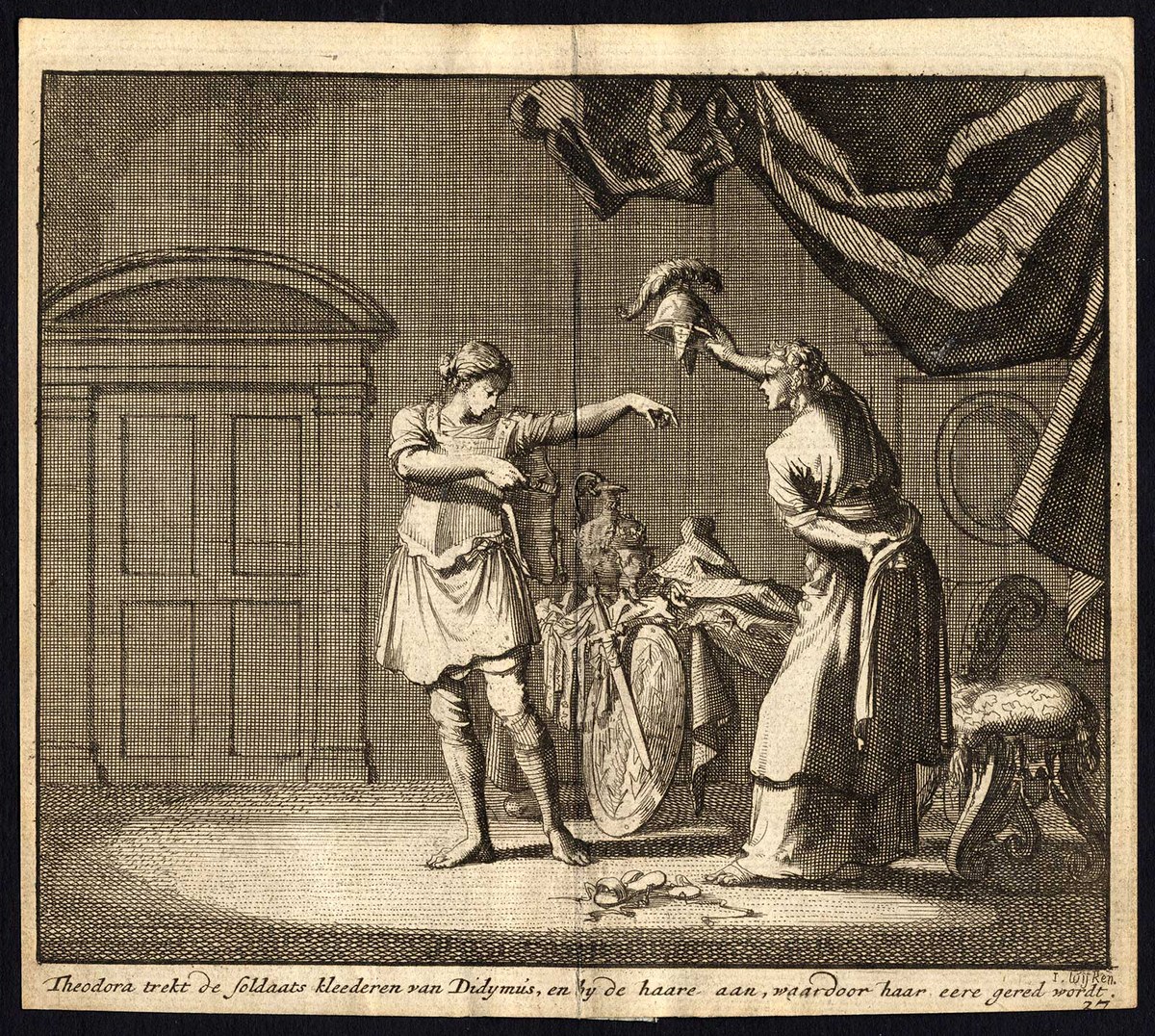
What happened there is the heart of the account. A crowd of dissolute men gathered and began to quarrel over who should be first to go in to her. Into this crowd walked Didymus, a Christian and a soldier, in his military dress. The uniform gave him authority; he used it. He cleared the room, drove the men out — the passion says they fled in fright — and came to Theodora, told her who he was and why he had come, and gave her his own clothes: the soldier's tunic, cloak and cap. Dressed as a soldier and with her head covered, she walked out of the brothel untouched, and Didymus stayed behind in her place.
When the deception was discovered Didymus was seized and brought before Eustratius. He admitted everything without hesitation — that he was a Christian, that he had freed the virgin, that he had given her his clothing to do it — and was sentenced to death.
The martyrdom
Theodora, in hiding, heard that the soldier who had saved her was to die for it, and would not accept the exchange. She came to the place of execution and pushed through to the front, declaring that the sentence belonged to her and asking to die with him — the two of them, the sources note, contending for the crown, each wishing the other to be spared. Eustratius gave them both what they asked. They were beheaded, and afterwards their bodies were burned, in the year 304.
Feast and commemoration
May 27 (church date; Old Calendar civil June 9). They are commemorated together as a pair, and no separate feast of either is kept in the Byzantine books; they follow the two hieromartyrs of the day in the Greek and Slavonic notices, and have no proper canon. The Roman calendar keeps them on April 28. In sermon and catechesis they are the standard Eastern example of the martyrdom of chastity, and Didymus is a favourite instance of the Christian soldier who uses his office for mercy.
Hymns
Troparion — Tone 4
Thy martyrs, O Lord, in their contest received incorruptible crowns from Thee our God; for possessing Thy strength, they cast down their persecutors and shattered the powerless presumption of the demons. By their supplications, O Christ God, save our souls.
Original translation from the Greek
Kontakion — Tone 2
The virgin gave her body to dishonour rather than deny her Bridegroom, and the soldier gave his life to keep her undefiled; and each of them contended to die for the other. Wherefore, O Theodora and Didymus, you were crowned together, and together you intercede for our souls.
Original translation from the Greek
Iconography
The two are painted together, as they are commemorated: Theodora as a young woman with uncovered hair or a maiden's veil, in the long tunic and maphorion of a virgin-martyr, holding the martyr's cross and sometimes a palm; Didymus beside her as a beardless or young-bearded soldier in the short tunic, cloak and belt, occasionally with the chlamys and lance, but as a martyr he holds the cross rather than a weapon. The scene of their passion, where it is painted, shows the exchange of clothes at the door of the brothel — Didymus handing over his cloak while the girl covers her head — or the two of them kneeling side by side before the executioner, which is how the small menologion illustrations render them.
No pre-1900 or otherwise storable image identifiable as these two martyrs by inscription has been located. They are absent from the Menologion of Basil II as available (which in any case covers only September to February and cannot serve a May commemoration), and the nineteenth-century Russian Lives of the Saints plates for May 27 illustrate the two Therapons only.
The stored image is a Western engraving (by 1712) of the exchange of clothes in the brothel — the very act, unique to this pair in the whole calendar, by which the soldier saved the virgin. Stored per §34; an Eastern image remains wanted.
Disputed questions
- Alexandria or Antioch? Ambrose of Milan, writing in the 370s (De virginibus II.4), tells at length the story of a Christian virgin sent to a brothel and rescued by a soldier who exchanged clothes with her, both of them dying together; he sets it at Antioch and names neither. The correspondence with the Greek passion of Theodora and Didymus is close enough that most students of the acts regard them as one tradition, and the Antiochene setting in Ambrose as either a variant or an error of transmission. The Greek and Slavonic synaxaria, and the surviving Latin Passio, are unanimous for Alexandria and for the names, and this entry follows them; but the Antiochene form of the story is of real interest to the Antiochian tradition, in which Ambrose's "virgin of Antioch" has often been read as a local martyr.
- The date. The Byzantine calendars keep them on May 27 (Greek, Slavonic and OCA). The Roman martyrology keeps them on April 28. Neither date is derivable from the passion itself, which gives no day.
- The prefect's name. The Greek acts call him Eustratius; some Latin witnesses give Proculus or Eustratius interchangeably, and the office is variously described as prefect (praefectus Augustalis) or governor. No such prefect of Egypt is securely attested for 304, and the name may be hagiographic.
- Didymus's status. He is called a soldier and nothing more; he is not, on any evidence, an officer, and the assumption that his uniform gave him command over the brothel crowd is the passion's own.
- Theodora of Alexandria the virgin-martyr is not to be confused with Theodora of Alexandria the penitent (†c. 490, September 11), the woman who lived out her repentance disguised as the monk Theodore — a different person of a different century, though the two are constantly exchanged in bibliographies because of the shared name and city, and because both stories turn on a woman in men's clothing.