
Theodora of Alexandria
Our Venerable Mother Theodora of Alexandria
Venerable · d. c. 490
Commemorated 11 September — Repose
Theodora of Alexandria (died c. 490) is one of the most celebrated penitents of the Orthodox calendar: a married woman of Alexandria who, having fallen once into adultery, spent the rest of her life in a repentance so complete that the Church numbers her among the great ascetics. Disguising herself as a man, she entered a men's monastery under the name Theodore; falsely accused of fathering a child, she accepted the disgrace in silence and raised the infant in exile for seven years rather than clear herself. Only at her death did the brethren discover that the slandered "monk Theodore" was a woman, and innocent. She is commemorated on September 11.
.jpg)
The fall
Theodora lived in Alexandria in the later fifth century — the synaxaria place her story in the reign of the emperor Zeno (474–491) — married to a young husband, in a household the sources describe as happy and harmonious. That very harmony, the hagiographers say, provoked the envy of the enemy of salvation. A wealthy man of the city, taken with Theodora's beauty, pursued her long and unsuccessfully, and at last bribed a procuress, who overcame the young woman's resistance with a sophism: a deed done in darkness, which the sun does not see, is hidden from God also. Theodora yielded and betrayed her husband.
Remorse came almost at once, and with violence: she came to herself in horror at what she had done. She went to a well-known abbess and confessed. The abbess did not crush her but set before her the sinful woman of the Gospel who washed the feet of Christ with her tears and was forgiven — and, against the procuress's sophism, the truth that nothing is hidden from God, who knows the deed done in darkness before it is done. Theodora resolved not merely to be forgiven but to expiate: she would give the rest of her life to repentance.
The monk Theodore
Fearing that her husband would seek her out in any women's community, she left her house secretly, cut her hair, put on men's clothing, and presented herself at a men's monastery outside Alexandria — the Greek tradition names the monastery of the Octodecaton, at the eighteenth milestone from the city — calling herself Theodore. The igumen, testing the newcomer's resolve, left her at the gate overnight; in the morning she fell at his knees and begged admission for repentance and labour, and was received.
The monk Theodore became a byword in the community for austerity: all-night prayer on bended knee, extreme fasting, humility, and unquestioning obedience, sustained for eight years. The body once defiled, the synaxarion says, became a vessel of grace and a dwelling of the Holy Spirit.
The false accusation
The saint's great trial began with an errand. Sent to Alexandria to buy provisions, she was blessed by the igumen to lodge on the way, if delayed, at a neighbouring monastery — the sources name the Enaton, the famous monastic settlement at the ninth milestone. Staying at its guest-house at the same time was the daughter of its igumen, who, drawn to the handsome young "monk," attempted to seduce Theodore, not knowing she was propositioning a woman. Refused, the girl sinned with another guest and conceived; and when her pregnancy could no longer be hidden and her father demanded the seducer's name, she named the monk Theodore.
The accusation was reported to Theodore's own igumen. Summoned, the saint answered only, "As God is my witness, I did not do this" — an answer that was literal truth, though she would say nothing more; to prove her innocence outright would have been to reveal her sex and undo her whole repentance. Her igumen, knowing Theodore's life, at first dismissed the charge. But when the child was born, the monks of the Enaton carried the infant to the monastery and reproached its brethren openly; the igumen's confidence broke, and the innocent Theodore was handed the baby and expelled in disgrace.
The years of bearing it
Theodora accepted the slander without a word of self-defence, seeing in the unjust punishment the expiation of the sin that no one knew. She settled in a hut near the monastery and raised the child as her own: shepherds gave her milk for the infant out of pity, and she herself ate wild plants. In this banishment she spent seven years — enduring, the Life adds, assaults of the demons who had engineered her disgrace and now sought to drive her to despair. At last, at the entreaty of the brethren, the igumen received her back into the monastery with the boy, and there she lived a further two years in seclusion, forming the child in the fear of God.
Recognition at death
Sensing her end, Theodora shut herself in her cell with the boy and gave him her last instruction: to love God above all things, to obey the igumen and the brethren, to guard stillness, meekness, and freedom from malice, to flee obscene and idle talk, to love poverty, and never to neglect the common prayer. Then she prayed once more for the forgiveness of her sins, the child praying with her, and died in peace.
The truth was revealed at once. The igumen learned in a vision the spiritual stature of the dead monk — and the secret; and to lift every trace of dishonour from the deceased, he uncovered the saint's breast in the presence of the igumen and brethren of the Enaton, the accusers. The Enaton monks recoiled in terror at the magnitude of their transgression and begged forgiveness with tears before the body. Word reached Theodora's husband, who had never known what had become of his wife: he came, wept over her, and himself received the monastic tonsure in the same monastery, living out his days in her cell. The boy she had raised followed the same path and in time became igumen of that very monastery.
Feast and commemoration
September 11 (church date; Old Calendar civil September 24), her repose, kept universally in the Byzantine rite. The day falls within the afterfeast of the Nativity of the Theotokos, and her service in the Menaion is sung together with that of the feast; she is the principal saint of the day in the Greek, Slavic, and Antiochian calendars alike. In current Greek practice the service of the hieromartyr Autonomus (September 12) is also chanted on this day, September 12 being wholly given to the apodosis of the feast.
Hymns
Troparion — Tone 8 (from the common of a venerable woman)
In thee, O mother, that which is according to the image was preserved with exactness; for taking up the cross, thou didst follow Christ, and by thy deeds thou didst teach us to disregard the flesh, for it passeth away, but to care for the soul, a thing immortal: wherefore thy spirit, O venerable Theodora, rejoiceth with the angels.
Original translation from the Slavonic
Kontakion — Tone 1
Fleeing the night of the passions, O godly-minded one, thou didst draw near in spirit to the Sun of glory, mortifying by asceticism the leapings of the flesh; wherefore thou wast shown forth a pattern for monastics and a raising-up of those fallen in life: therefore we honour thee.
Original translation from the Greek
Kontakion — Tone 2 (Slavic books)
Having worn out thy body with fasting, with unsleeping prayers thou didst entreat the Creator concerning thy sin, that thou mightest receive complete forgiveness; and thou didst receive remission, having shown the way of repentance.
Original translation from the Greek
Iconography
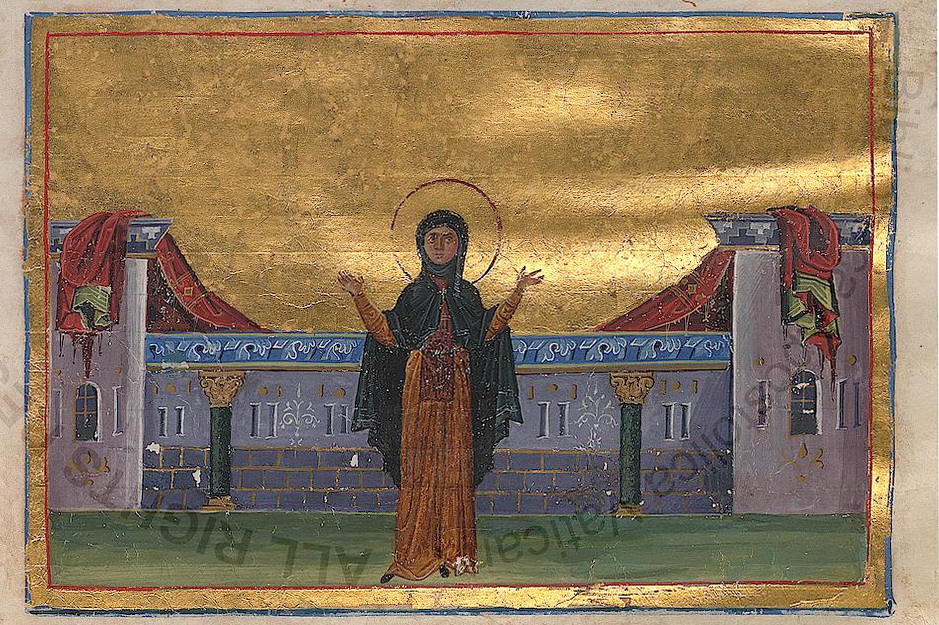
Theodora is painted as a nun in the full dark monastic habit — the identity under which she lived being set aside, the icon shows her as the woman she was — often with the child she raised, or in scenes of her expulsion and vindication. The stored image is her miniature from the Menologion of Basil II (Constantinople, c. 985, Vatican Library, Vat. gr. 1613, p. 51): the saint stands orans in black mantle and veil over an ochre tunic, before the walls and colonnades of a monastery — the penitent at prayer within the men's community that never knew her.
Disputed questions
- Dating. The synaxaria set the story under Zeno (474–491); no more precise year of death is transmitted, and calendars print conventional figures around 480–490. This entry follows the common c. 490.
- Historicity. Theodora's Life belongs to a well-defined group of Byzantine lives of women who lived as monks in men's communities — Mary/Marinos, Euphrosyne of Alexandria, Anastasia the Patrician, Apollinaria, Pelagia — several of them likewise set in Egypt. Modern hagiographical scholarship treats the group, Theodora's Life included, as largely legendary edifying literature, while the Church's calendars have received her without hesitation since at least the tenth century (she stands in the Menologion of Basil II and the Synaxarion of Constantinople, with a full akolouthia in the Menaion). Both facts are recorded here; the Life above is given as the tradition tells it.
- Not to be confused with two other celebrated Theodoras: the virgin-martyr Theodora, martyred with Didymus the soldier (†304), condemned to a brothel under Diocletian and rescued by the soldier, who exchanged clothes with her and was martyred with her (commemorated May 27 in the Byzantine calendars, April 28 in the Roman) — a wholly different saint of the same city; and the venerable Theodora of Thessalonica (†892), commemorated August 29. The empress Theodora, restorer of the icons (February 11), is yet another. Her own monastic alias "Theodore of Alexandria" also invites confusion with the hieromartyr Theodore of Alexandria (commemorated September 12) — a different person entirely.