
Theodore of Alexandria
The Holy Hieromartyr Theodore, Bishop of Alexandria
Hieromartyr · Bishop
Commemorated 12 September
Theodore of Alexandria is remembered in the Byzantine synaxaria as a bishop of that city and a martyr: a bold preacher whom the pagans seized in the midst of his preaching, mocked and abused, and cast into the sea — the Russian tradition says from a cliff — from which he was brought out unharmed, before being beheaded and buried in Alexandria. Nothing else, not even his date, is transmitted. The OCA, against the Greek and Slavic service books, treats him as a lay Christian, distinct from Theodore the Archbishop of Alexandria kept on December 3, with whose thin record his own is easily entangled. He is commemorated on September 12.
.jpg)
The whole surviving record is a synaxarion notice. The Greek Menaion for September 12 commemorates "the holy Hieromartyr Theodore, Bishop of Alexandria," with the verses: "Beheaded by the sword, Theodore partook, true to his name, of the gifts of God" — a play on Theodoros, "gift of God." The Russian calendar fills out the same figure: a bishop of Alexandria and fiery preacher whose boldness drew the hatred of the city's pagans; they seized him as he preached, subjected him to mockery and abuse, and threw him from a cliff into the sea, but the waves carried him to shore unharmed. Brought before the governor, he withstood torture and was beheaded. The OCA's account preserves the same sequence — imprisonment for confessing Christ, torture, the sea ordeal survived, beheading, burial in Alexandria — but strips the episcopal dignity, presenting him as "a simple Christian." Where and when in the age of the persecutions this took place is nowhere transmitted; the fourth-century placement used for indexing here is conventional, not attested.
Feast and commemoration
September 12 (church date; Old Calendar civil September 25), within the leavetaking of the Nativity of the Theotokos, whose festal service dominates the day. The commemoration is universal in the Byzantine rite; the jurisdictional divergence over his rank (bishop or layman) is described above.
Hymns
Troparion — Tone 4 (from the common of martyrs)
Thy martyr, O Lord, in his contest received the incorruptible crown from Thee, our God; for possessing Thy strength he cast down the tyrants and shattered the feeble insolence of the demons. By his intercessions save our souls.
Original translation from the Greek
Iconography
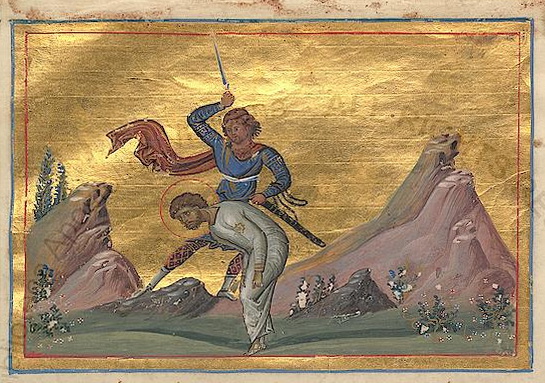
The Menologion of Basil II (c. 985) depicts his martyrdom: a dark-haired, bearded man in a plain white tunic bends beneath the executioner's raised sword in a rocky landscape — lay dress, as noted above, despite the manuscript's own episcopal heading. A second miniature of a "Theodore of Alexandria" in the same manuscript (Vat. gr. 1613, scan 0243) belongs to the December commemoration of the archbishop, and is deliberately not used here.
Disputed questions
- Bishop or layman. The Greek synaxarion and Menaion, and the Russian calendar, style him hieromartyr and bishop of Alexandria; the OCA states expressly that "today's saint was a simple Christian" and not a bishop. This entry follows the Greek and Slavic service books in its classification, and records the OCA's dissent here. It is worth noting that the Menologion of Basil II's miniature for this commemoration shows the martyr beheaded in a plain white tunic, not in episcopal dress — a Byzantine witness of c. 985 that sits more easily with the lay reading than its own synaxarion heading does.
- Relation to Theodore, Archbishop of Alexandria (December 3). The OCA distinguishes the two explicitly. The December Theodore's notice — abuse by the crowd, a crown of thorns, beheading — overlaps suggestively with the September martyr's, and no bishop Theodore of the persecution era appears in the episcopal lists of Alexandria; a duplication of one tradition across two dates is possible but unprovable from the surviving notices. The calendars list them separately, and this collection follows the calendars, recording the question in both entries. (Forward obligation: the December 3 entry, when authored, needs a distinct slug and a reciprocal note.)
- Date. No source consulted transmits a year or even a century; the narrative's persecution setting implies the pre-Constantinian era or the early fourth century. The century: 4 of this entry is a conventional indexing placement and is flagged as such.
- Not to be confused with Theodora of Alexandria (September 11), the venerable woman who lived in a men's monastery under the assumed name "the monk Theodore" and is therefore also found under "Theodore of Alexandria" in some listings; nor with Theodore the Sanctified or the several soldier-martyrs Theodore of the fixed calendar.