
Theodore of Tarsus
Our Father among the Saints Theodore of Tarsus, Archbishop of Canterbury
Bishop · b. c. 602 — d. 690
Commemorated 19 September — Repose at Canterbury
Theodore of Tarsus (c. 602–690) was a Byzantine Greek monk of Cilicia who, at the age of sixty-six, was consecrated by Pope Vitalian as Archbishop of Canterbury (668–690) and became the organiser of the English Church. Arriving in Kent in 669 with his companion Hadrian the African, he made the first visitation of all England, filled and multiplied the vacant sees, held the first council of the whole English Church at Hertford (672), condemned Monothelitism at Hatfield (679), and founded at Canterbury a school where Greek was taught at the edge of the known world. Bede calls him the first archbishop whom the whole Church of the English obeyed; the diocesan structure he built endures. He reposed on September 19, 690.

Origins and early life
Theodore was born about 602 in Tarsus of Cilicia — Paul's city — a Greek by birth and tongue. Bede, the chief witness for his English years, introduces him as "instructed in secular and divine literature, both Greek and Latin." Modern scholarship (above all Bischoff and Lapidge's reconstruction from the Canterbury school-texts) fills in the eastern half of the life Bede passes over: a boyhood in a Tarsus overrun by the Persian wars, study at Antioch and later at Constantinople — the school-texts show first-hand knowledge of Syrian cities, Persian custom, and Constantinopolitan learning — and, somewhere after the Arab conquests of the 630s, migration west to Rome, where he lived as a monk among the eastern monastic colonies. Lapidge has argued that he belonged to the circle of Greek monks around the Lateran in the years of the Monothelite controversy — the milieu of Maximus the Confessor and the Lateran Council of 649 — which would explain the sureness with which he later handled that heresy in England. He remained a simple monk, of the eastern tonsure, until his sixty-sixth year.
The road to Canterbury
In 667 the see of Canterbury stood vacant; the English candidate Wighard, sent to Rome for consecration by the kings of Kent and Northumbria, died there of plague. Pope Vitalian offered the see to Hadrian, an African-born abbot near Naples, who twice declined and finally proposed Theodore. Vitalian consented on condition that Hadrian accompany the Greek to Britain — Bede says frankly, to see that he introduced nothing contrary to the faith after the manner of the Greeks. Theodore first had to wait four months for his hair to grow, so that he could receive the Roman crown tonsure in place of the eastern one he wore; he was consecrated on March 26, 668, and reached Canterbury on May 27, 669, after a year's journey through Gaul — an archbishop of sixty-seven beginning, in Bede's words, the first episcopate that "all the Church of the English consented to obey."
Ministry: the organisation of the English Church
Theodore at once did what no predecessor had done: he visited the whole island wherever the English dwelt, teaching the right rule of life and the canonical celebration of Pascha, ordaining and correcting as he went. Plague had emptied the sees; he filled them. At York he found the succession in knots: Chad, irregularly consecrated while the elected Wilfrid delayed in Gaul, withdrew humbly at Theodore's judgment — and Theodore, struck by his humility, completed his consecration and set him over the Mercians at Lichfield, restoring Wilfrid to York. In 672 (some reckon 673) he summoned the council of Hertford, the first assembly of the entire English Church — and, as historians have noticed, the first all-English assembly of any kind — where ten canons drawn from the ancient councils bound the young Church: fixed Pascha, diocesan boundaries, annual synods, monastic stability, the marriage discipline.
His greatest quarrel came of his greatest policy. Judging the vast diocese of Northumbria unpastorable, in 678 he divided it, with King Ecgfrith's support but without the consent of its bishop; Wilfrid appealed to Rome — the first appeal of an English bishop to the apostolic see — and the dispute ran for years. In his old age Theodore reconciled himself with Wilfrid and wrote to the kings for his restoration. The principle of smaller sees prevailed: East Anglia, Mercia and Northumbria were subdivided in his time, and the map he drew served English church administration for centuries. He also made peace between kings: after the battle of the Trent (679) his mediation between Ecgfrith of Northumbria and Æthelred of Mercia stopped a blood-feud with a wergild and, Bede says, a long peace.
In 679 he presided at the synod of Hatfield, where the English Church confessed the orthodox faith of the five ecumenical councils and the Lateran synod of 649, and condemned Monothelitism — England's contribution, gathered by the papal archchanter John, to the preparation of the Sixth Ecumenical Council then assembling at Constantinople. The Greek of Tarsus had brought the doctrinal battles of his youth to a good end at the world's western edge.
With Hadrian, established beside him as abbot of Sts Peter and Paul, Theodore made Canterbury a school of both tongues: scripture, exegesis in the literal Antiochene manner, computus, astronomy, metre. Bede records that students of theirs still living in his day knew Greek and Latin as well as their mother tongue; Aldhelm was their pupil. The classroom teaching survives: the "Canterbury biblical commentaries" edited from his and Hadrian's lectures, with their casual eyewitness asides on Syrian melons, Persian houses and Constantinopolitan buildings, are the recovered voice of the man himself.
Repose
Theodore died on September 19, 690, aged eighty-eight, having ruled twenty-two years, and was buried in the church of Sts Peter and Paul at Canterbury (later St Augustine's), close to Augustine and the first archbishops, the porticus by then being full — Bede quotes the epitaph verses set over him. His body was said to be found incorrupt; the abbey tradition records the elevation of his relics in the rebuilding of 1091.
Veneration and later cultus
His feast was kept on September 19 in the medieval English kalendars, and the Roman Martyrology carries him on the same day. After the Reformation his shrine perished with St Augustine's Abbey, but the commemoration survives in the Church of England's calendar (September 19). Among the Orthodox he is venerated as a pre-schism father of the West — a Byzantine Greek in communion with the undivided Church who organised a national church that his own city's tradition would have recognised: the OCA carries him on September 19 (verified live), and his veneration is warm among Orthodox of all jurisdictions in the British Isles, where parishes bear his name. He has no ancient Byzantine cultus: the Greek Menaion and the Moscow Patriarchate calendar do not list him (verified live for the day), a jurisdictional footprint recorded honestly here.
Hymnographic and literary legacy
No proper Byzantine hymnography exists; the commons of a hierarch serve (see below). His literary legacy is instead canonical and scholastic: the Penitential of Theodore (Iudicia Theodori), compiled from his rulings by a "disciple of the Northumbrians," became one of the most influential penitential collections of the early medieval West; the Canterbury commentaries and glosses (Bischoff–Lapidge), and the Laterculus Malalianus attributed to him, preserve his teaching; the school he founded formed the generation of Aldhelm and prepared that of Bede.
Feast and commemoration
September 19 (church date; Old Calendar civil October 2), the day of his repose, within the afterfeast of the Elevation of the Cross. The commemoration is carried by the OCA (verified live); it is not in the received Greek Menaion nor on the Moscow Patriarchate calendar for the day (both verified live), and rests historically on the medieval English kalendars and the Roman Martyrology, from which the modern Orthodox veneration of the pre-schism English saints has restored it.
Hymns
Troparion — Tone 4 (from the common of a hierarch)
The truth of thy deeds hath revealed thee to thy flock as a rule of faith, an image of meekness, and a teacher of temperance; therefore by humility thou didst gain the heights, by poverty the riches. O father and hierarch Theodore, intercede with Christ God that our souls may be saved.
Original translation from the Greek
Iconography
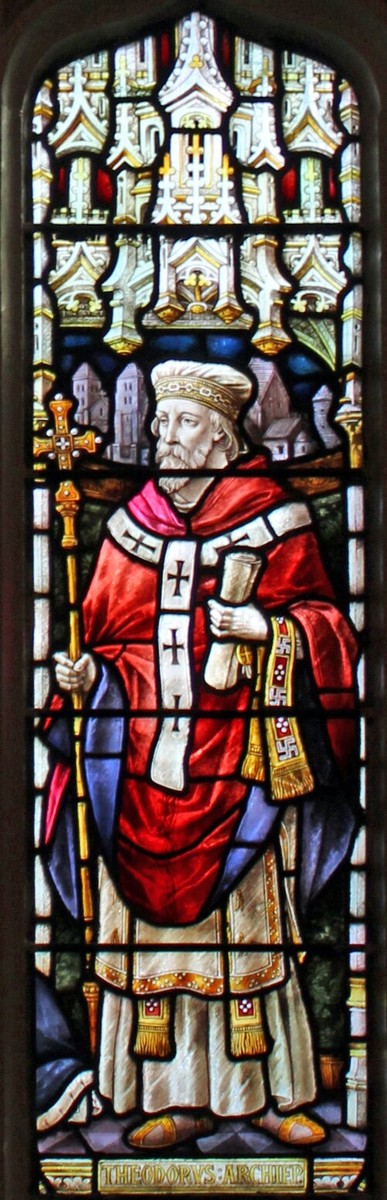
No ancient iconographic tradition of Theodore survives; modern Orthodox icons paint him as an aged hierarch in omophorion, white-bearded, blessing and holding the Gospel, sometimes with the cathedral of Canterbury in his hand. The stored image is an English Gothic Revival stained-glass window from the church of St John the Evangelist, Knotty Ash, Liverpool, inscribed THEODORVS ARCHIEP: the archbishop in red chasuble and pallium marked with crosses, cross-staff in his right hand and a scroll in his left — a Western devotional image, stored under the photographer's free licence, and marked for replacement should a free-licensed Orthodox icon or a pre-modern image of verified identity surface. (A seventh-century lead seal of a "Theodore, metropolitan of Tarsus" on Wikimedia Commons was considered and rejected: Theodore never held the see of Tarsus, and the seal's owner is another man.)
Disputed questions
- The eastern years. Bede says nothing of Theodore's life before Rome; the Antioch–Constantinople education, the flight from the Persian and Arab conquests, and the association with the anti-Monothelite Greek circle in Rome are modern scholarly reconstruction (Bischoff–Lapidge), strong but inferential, and are so flagged.
- Dates of Hertford and Hatfield. Bede's own dating implies 672 for Hertford (September 24) and 679 for Hatfield (September 17); older literature often gives 673 and 680, by a different reading of Bede's year-reckoning.
- Monothelite-era suspicion. Vitalian's instruction that Hadrian watch Theodore's Greek usages (Bede IV.1) is sometimes read as doctrinal distrust of a Greek in the Monothelite years; Theodore's conduct at Hatfield answered it.
- Not to be confused with the September martyrs Theodore of the fixed calendar already in this corpus — Theodore of Alexandria (September 12) and the Theodore of the Nicomedian company of September 5 — nor with the soldier-saints Theodore the Recruit and Theodore the General.