
Theodore the Recruit
The Holy Great-Martyr Theodore the Recruit (Tyron)
Great Martyr · b. late 3rd century — d. c. 306, at Amasea in Pontus
Commemorated 17 February — Martyrdom by fire at Amasea, Saturday of the First Week of Great Lent — the miracle of the kollyva
Theodore the Recruit (†c. 306) — Tyron, "the recruit" or "the conscript," from the Latin tiro — was a young soldier newly enrolled in the Roman legion, stationed at Amasea in Pontus during the persecution of Maximian, and one of the two great warrior-martyrs named Theodore whom the Church honours. Refusing to sacrifice to the gods, and given a stay in which the authorities hoped he would relent, he instead set fire by night to the temple of the Mother of the gods (Cybele/Rhea); arrested and racked, comforted in prison by a vision of Christ, he was at the last burned alive, and gave up his soul in the flames. His body was buried at Euchaita by a pious woman, Eusebia, and Gregory of Nyssa preached his praise at the shrine there. He is famous above all for a posthumous wonder: when Julian the Apostate secretly ordered the food of Constantinople defiled with blood offered to idols during the first week of Lent, Theodore appeared to the archbishop and bade the faithful eat boiled wheat (kollyva) instead — for which the Church keeps his memory each year on the First Saturday of Great Lent, besides his fixed feast on February 17.

The two Theodores
A word is owed at the outset on the pair of martyr-Theodores who stand together in the Byzantine tradition. Theodore the Recruit — Tyron — is the martyr of this entry: the common soldier of Amasea and Euchaita in Pontus, whose cult is the older and better attested, celebrated already in the fourth century by Gregory of Nyssa. Theodore Stratelates — "the general" — is the officer and governor of Heraclea in Thrace, kept on February 8. The shared name, the soldiering, the common association with the shrine-city of Euchaita, and the near-identical iconography (a young warrior-saint in armour, with spear and shield) drew the two together, and a strong current of scholarship holds that Stratelates is in origin a later doublet of the Recruit — the humble tiro of the old cult "promoted" to a general and given a fuller literary passion, with the Recruit's own shrine at Euchaita carried over to him as the resting-place of his relics. The Church, however, keeps the two as distinct saints, with two feasts and two proper offices; this entry tells the passion of the Recruit as the tradition transmits it and records the historical question under Disputed questions (the fuller treatment is given in the Stratelates entry).
The recruit at Amasea
Theodore was a young man of the province of Pontus, newly conscripted into the Roman army — a tiro, a raw recruit, whence his surname Tyron — and enrolled, the tradition says, in the cohort of the Marmaritae under its commander Brincas, quartered at the city of Amasea on the river Iris. His service fell in the years of the last and greatest of the pagan persecutions, under the emperors Maximian and Galerius Maximian (Maximianus), when it was ordered through the legions that every soldier should offer sacrifice to the gods of Rome on pain of death. Theodore, a Christian, made no secret of his faith. When his turn came to sacrifice and he refused, his officers — reluctant, the account suggests, to lose a promising young soldier, and half-hoping he might yet be won over or quietly forget his confession — did not press him at once to death but granted him a stay of some days to reconsider.
The burning of the temple
Theodore used the reprieve not to weigh apostasy but to strike a blow against the idols. Going by night to the temple of the Mother of the gods — Cybele, the Great Mother (Rhea), whose worship was among the most splendid and public of the old cults of Asia Minor — he set it on fire and burned it to the ground, that the whole city might see the powerlessness of the goddess who could not save her own house from the flames. He made no attempt to hide the deed; some tellings have him openly avow it, declaring that he had done it as a Christian, in the strength of Christ, to show the nothingness of the idols. The act was at once a confession and a provocation, and it sealed his martyrdom.
Interrogation, prison, and the vision of Christ
Arrested and brought before the governor (in the accounts, Publius) and the commander Brincas, Theodore was questioned, flattered, and threatened by turns — offered honour and advancement in the army if he would sacrifice, and torment if he would not. He answered with a bold confession of the one God, Father, Son, and Holy Spirit, and mocked the gods of wood and stone whose temple he had burned. He was scourged, and his sides torn with iron claws until the bones showed, yet he bore it singing the psalms. Cast into prison to be starved to death, he was — the tradition holds — fed and comforted by the Lord himself, who appeared to him in the night; and the prison was filled with a light and with the voices of a choir of angels or of the faithful singing with him, so that the guards, looking in, believed a crowd of Christians had somehow gathered to him, and found him alone.
Martyrdom by fire
Neither torture nor imprisonment moving him, the governor condemned Theodore to the death his own deed had foreshadowed: he was to be burned alive. A pyre was built, and Theodore, signing himself with the Cross, went up onto it of his own accord; the flames rose about him, but — the passion relates — did not tear or disfigure him, wrapping him rather like a vault or a sail filled with wind, and in their midst he gave up his spirit to God, his soul going up, a witness saw, like a flash of light. The year is given as about 306. The onlookers marked that his body was left whole and unconsumed in the fire.
Burial at Euchaita
A devout and wealthy Christian woman of the region named Eusebia obtained the martyr's body, wrapped it in fine linen with spices, and carried it to her own estate at Euchaita (Euchaïta), a town in the Pontic hinterland, where she buried it with honour. Over his grave there grew, in the following century, one of the great pilgrimage shrines of Asia Minor; the town took its later name, Theodoroupolis, from the martyr, and the cult of "the Theodores" spread from it through the whole Christian East. It was at this shrine, on the martyr's feast, that Gregory of Nyssa (†c. 395) delivered his famous encomium on Theodore the Recruit — the earliest full witness to the cult, describing the crowds, the martyr's tomb and image, and the wonders wrought there — a sermon that fixes the veneration of the Recruit firmly in the fourth century, a generation or more before the general of Heraclea appears in the record.
The miracle of the kollyva
The wonder for which Theodore is best loved belongs not to his lifetime but to half a century after his death, in the reign of Julian the Apostate (361–363), the emperor who forsook Christ and strove to restore the old gods. In the first week of Great Lent, when the Christians of Constantinople would be fasting most strictly and keeping the market for their simple Lenten fare, Julian — wishing to defile them secretly, so that they should be polluted with the worship of idols unawares — commanded the city eparch to have all the food exposed for sale in the markets sprinkled with the blood of animals sacrificed to the idols. That night, the tradition holds, the martyr Theodore appeared in a vision to the Archbishop of Constantinople, Eudoxius, revealed the emperor's device, and bade him warn the faithful to buy nothing from the market; and when the archbishop asked how the poor, who had no provisions laid by, were to eat, the saint bade them boil the wheat they had in their houses and eat that — kollyva (κόλλυβα), boiled grain — so that the people were preserved from the defilement and Julian's malice came to nothing. In memory of this deliverance the Church keeps, every year on the First Saturday of Great Lent, the commemoration of the miracle of the kollyva, with the blessing of a dish of boiled wheat sweetened with honey and fruit in the martyr's honour — the same kollyva that is offered ever after at the Church's memorials of the dead. This movable commemoration is noted here in prose and is not minted as a dated feast; the fixed feast of the martyr is February 17.
Relics and later cultus
From Euchaita the veneration of Theodore the Recruit spread early and widely. His relics, or portions of them, were in time translated and divided among many churches; a chief portion is said to have been carried to Brindisi in Italy in the middle Byzantine centuries, where the martyr is honoured as a patron, and his head is claimed at Gaeta. In the imperial city his memory was kept in more than one church dedicated to him, and he was numbered among the holy warrior-martyrs (οἱ ἅγιοι στρατηλάται / the military saints) — with George, Demetrius, the general Theodore, Procopius, Mercurius, and the rest — whom the Byzantine army and the Christian East loved as protectors in battle. The eleventh-century bishop of Euchaita, John Mauropous, wrote in honour of the two Theodores of his see and is a chief witness to their twinned veneration. A second Euchaita feast on June 8 is kept in the calendars for the translation of the relics to Euchaita; in the service-books this June commemoration is generally assigned to Theodore Stratelates, whose burial-place Euchaita is said to be — a further mark of how completely the two cults were fused at the one shrine (see Disputed questions).
Feast and commemoration
Theodore the Recruit is commemorated on February 17 (church date; New Calendar civil February 17, Old Calendar civil March 2), the day of his martyrdom by fire at Amasea, kept universally in the Byzantine rite as the feast of a great-martyr. The commemoration for which he is best known, however, is movable: the First Saturday of Great Lent — the Saturday of the first week of the Fast — is dedicated to his memory and to the miracle of the kollyva, with a proper canon (ascribed to John of Damascus) sung at the Friday-evening and Saturday services and the blessing of boiled wheat. Because this Lenten commemoration is fixed by the movable cycle of Pascha, it is noted in prose and not given a dated feast entry; the martyr's fixed feast remains February 17. When February 17 itself falls within the pre-Lenten or Lenten weeks its office is combined with the Triodion. In the calendars and the iconography Theodore the Recruit is regularly named and pictured together with Theodore Stratelates of February 8, the two warrior-Theodores being honoured as a pair.
Hymns
Troparion — Tone 2
Great are the achievements of faith! In the fountain of flame, as at the water of repose, the holy Martyr Theodore rejoiced; for being wholly consumed by fire, he was offered up as sweet bread unto the Trinity. By his prayers, O Christ God, save our souls.
Original translation from the Greek
Kontakion — Tone 8
Having taken the faith of Christ within your heart as a breastplate, you trampled down the powers of the enemy, O greatly-contending one, and were crowned for ever with a heavenly crown, as one invincible.
Original translation from the Greek
Magnification
We magnify you, O holy Great-Martyr Theodore, and we honour your precious sufferings, which you endured for Christ.
Original translation from the Slavonic
Appointed readings
Epistle — 2 Timothy 2:1–10
1Thou therefore, my son, be strong in the grace that is in Christ Jesus. 2And the things that thou hast heard of me among many witnesses, the same commit thou to faithful men, who shall be able to teach others also. 3Thou therefore endure hardness, as a good soldier of Jesus Christ. 4No man that warreth entangleth himself with the affairs of this life; that he may please him who hath chosen him to be a soldier. 5And if a man also strive for masteries, yet is he not crowned, except he strive lawfully. 6The husbandman that laboureth must be first partaker of the fruits. 7Consider what I say; and the Lord give thee understanding in all things. 8Remember that Jesus Christ of the seed of David was raised from the dead according to my gospel: 9Wherein I suffer trouble, as an evil doer, even unto bonds; but the word of God is not bound. 10Therefore I endure all things for the elect’s sakes, that they may also obtain the salvation which is in Christ Jesus with eternal glory.
Gospel — John 15:17–16:2
17These things I command you, that ye love one another. 18If the world hate you, ye know that it hated me before it hated you. 19If ye were of the world, the world would love his own: but because ye are not of the world, but I have chosen you out of the world, therefore the world hateth you. 20Remember the word that I said unto you, The servant is not greater than his lord. If they have persecuted me, they will also persecute you; if they have kept my saying, they will keep yours also. 21But all these things will they do unto you for my name’s sake, because they know not him that sent me. 22If I had not come and spoken unto them, they had not had sin: but now they have no cloke for their sin. 23He that hateth me hateth my Father also. 24If I had not done among them the works which none other man did, they had not had sin: but now have they both seen and hated both me and my Father. 25But this cometh to pass, that the word might be fulfilled that is written in their law, They hated me without a cause. 26But when the Comforter is come, whom I will send unto you from the Father, even the Spirit of truth, which proceedeth from the Father, he shall testify of me: 27And ye also shall bear witness, because ye have been with me from the beginning. 1These things have I spoken unto you, that ye should not be offended. 2They shall put you out of the synagogues: yea, the time cometh, that whosoever killeth you will think that he doeth God service.
Iconography
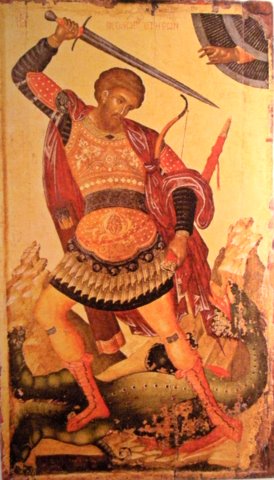
Theodore the Recruit is depicted as a young warrior-saint — beardless or, more often, with dark curling hair and a short pointed beard, in the full panoply of a Roman soldier: cuirass and military cloak (the chlamys), holding a spear and a shield, frequently with a sword at his side, and often bearing the martyr's cross in his hand. He is distinguished from Theodore Stratelates chiefly by inscription and context — the two share the type and are constantly painted as a pair, flanking a doorway or standing together in the warrior-tier of the iconostasis, where the Recruit is commonly shown as the younger, dark-bearded of the two and named Ὁ ἍΓΙΟΣ ΘΕΟΔΩΡΟΣ Ὁ ΤΗΡΩΝ. Narrative cycles show the burning of the temple of the Mother of the gods, the torture with the iron claws, and his own death in the fire; a distinctive later type shows him on horseback slaying a dragon or serpent (a motif shared with George and with the general Theodore). The dish of kollyva blessed on the First Saturday of Lent is his living memorial in the Church's practice.
The stored image is a Cretan panel icon of the second quarter of the fifteenth century, from Candia (Venetian Heraklion), depicting Theodore Tiro alone as a standing soldier-martyr — identified by its inscription as the Recruit, and so distinct from the general (source, public domain, pd-old-work).