
Theodore Stratelates
The Holy Great-Martyr Theodore Stratelates, the Commander
Great Martyr · d. 319, at Heraclea in Thrace
Commemorated 8 February — Martyrdom at Heraclea under Licinius, 8 June — Translation of his relics to Euchaita
Theodore Stratelates (†319) — "the Commander," from the Greek stratelates, a general — was a Roman military officer of the early fourth century, governor and garrison-commander of Heraclea on the Thracian coast of the Black Sea, and one of the two great warrior-martyrs named Theodore whom the Church honours. A Christian in the years of Licinius's persecution, he was so loved by the city that the emperor himself came to him; entrusted with idols of gold and silver to offer in sacrifice, Theodore broke them up and distributed the pieces to the poor, then openly confessed Christ. He was scourged, racked, blinded, and — the tradition holds — crucified, and at the last beheaded on February 8, 319. His faithful servant Varus wrote down the acts of his passion. He is closely associated with, and in the calendars and iconography often paired with, Theodore the Recruit (Tyron), commemorated on February 17; the two Theodores are distinct saints. His relics were translated to his estate at Euchaita, kept as a second feast on June 8.

The two Theodores
Before his own story is told, a word is owed on the pair of martyr-Theodores who stand together in the Byzantine tradition, for their histories were early drawn into one another. Theodore the Recruit — Tyron, "the recruit" or "the conscript," from the Latin tiro — is the martyr of the town of Amasea (or Euchaita) in Pontus, a common soldier of the legion who burned the temple of the Mother of the gods and was burned alive for it, kept on February 17 and again on the first Saturday of Great Lent for the miracle of the kollyva. Theodore Stratelates — "the general" — is the officer and governor of Heraclea in Thrace, kept on February 8. The names, the soldiering, the shared association with Euchaita, and the near-identical iconography (a young warrior-saint in armour, with spear and shield) drew the two together, and a strong current of modern scholarship holds that Stratelates is in origin a doublet of the Recruit — the humble tiro of the older cult "promoted" to a general and given a fuller, more literary passion in the later Byzantine centuries, with Euchaita, the shrine-city of the Recruit, carried over to the general as the resting-place of his relics. The Church, however, keeps them as two, with two feasts, two passions, and two proper offices; this entry follows the Church's usage, telling the passion of the general as the tradition transmits it, and records the scholarly question under Disputed questions.
Officer of Heraclea
Theodore was, the passion relates, a man of noble bearing and rare gifts — brave, eloquent, and beautiful in appearance — who rose in the Roman army to the rank of stratelates, a general officer, and was appointed by the emperor Licinius (308–324) as commander and governor of Heraclea (Herakleia Perinthos) on the Sea of Marmara, in Thrace. He was already a Christian, and he used his office not to persecute but to preach: by the integrity of his rule and the gentleness of his person he drew many of the city to the faith, so that Heraclea became, under its Christian governor, half-won to Christ. The tradition attaches to this period a dragon-slaying — Theodore going out alone to kill a great serpent that had ravaged the country near Euchaita, in the strength of the Cross — a wonder that belongs to the common stock of the warrior-saints and is shared, in other tellings, with the Recruit and with George.
The idols, and the confession before Licinius
Licinius, who had turned from the toleration of the Edict of Milan to a renewed persecution of the Christians in his eastern domains, learned that his own general at Heraclea was a Christian and that the city inclined to the new religion. Rather than move at once against so popular an officer, the emperor is said to have sent to Theodore a great weight of idols of gold and silver — the images of the gods — with orders that he offer public sacrifice upon them and lead the city back to the old worship; by one account Theodore himself, feigning readiness, asked that the images be sent to him that he might honour them in his own house. When they came, he broke the idols in pieces and distributed the gold and silver to the poor of the city — so that the very substance of the false gods was turned into alms — and then, when the fraud upon the false gods was discovered, he stood before the emperor and openly confessed Christ, reproaching the dead images that could not save themselves from being melted down for the needy.
Passion and martyrdom
The emperor's favour turned to fury. Theodore was subjected to a long and terrible succession of tortures, which the passion recounts at length: he was scourged and beaten, his body torn with iron claws and burned with torches, his eyes put out, and at the last he was nailed to a cross and left to die, the executioners adding fresh cruelties — shooting him with arrows, so that his sight and his wounds alike were, the account says, healed in the night by an angel who came to him upon the cross and took him down whole. The sight of the martyr living and unharmed after such torments converted a multitude of the onlookers and soldiers, who confessed Christ and were themselves put to the sword. Theodore, refusing to flee when his fellow-Christians would have risen in arms to save him — restraining them, as the tradition insists, that he might complete his martyrdom and that no blood be shed on his account — gave himself up and was beheaded on February 8 of the year 319. Before his death he charged his servant Varus (Uar), who had recorded the whole passion, to carry his body to his family estate at Euchaita in Pontus, and there it was buried.
Relics and translation
The relics of Theodore were laid, according to his own dying instruction, at Euchaita — the town in the Pontic hinterland that was already the shrine-city of Theodore the Recruit, and that took its later name, Theodoroupolis, from the Theodores it honoured. The translation of his relics to Euchaita is kept by the Church as a second feast on June 8. Euchaita became one of the great pilgrimage centres of Asia Minor, and the cult of "the Theodores" — general and recruit, often invoked and depicted together — spread from it through the whole Byzantine world; the eleventh-century bishop of Euchaita, John Mauropous, wrote in their honour and is one of the chief witnesses to the twinned veneration.
Veneration and later cultus
Theodore Stratelates is, with George, Demetrius, the Recruit, and the others of their company, one of the holy warrior-martyrs (οἱ ἅγιοι στρατηλάται) whom the Byzantine army and the Christian East loved as protectors in battle and patrons of soldiers. Emperors bore his name and built churches to him; his image, a young soldier in the panoply of a Roman officer, stands in the warrior-tier of countless iconostases and on the walls of the fortress-churches of the Byzantine and Slavic worlds. In the Slavic lands his veneration was especially strong — the great twelfth-century church of Theodore Stratelates "on the Brook" in Novgorod, with its famous frescoes, is only the most celebrated of many dedications — and the Russian princely house honoured both Theodores as heavenly commanders. His feast on February 8 is kept universally.
Feast and commemoration
Theodore Stratelates is commemorated on February 8 (church date; New Calendar civil February 8, Old Calendar civil February 21), the day of his beheading at Heraclea, kept universally in the Byzantine rite as the feast of a great-martyr. When it falls in the pre-Lenten or Lenten weeks the martyr's office is combined with the Triodion. A second feast, the translation of his relics to Euchaita, is kept on June 8 (Old Calendar civil June 21). In the calendars and the service-books he is regularly named and pictured together with Theodore the Recruit of February 17, the two warrior-Theodores being honoured as a pair; the Greek and Slavic Menaia appoint him a full festal service with proper apolytikion, kontakion, and canon.
Hymns
Troparion — Tone 4
By true enlistment in the army of the heavenly King thou didst become his most comely commander, O Theodore; for with the weapons of faith thou didst wisely array thyself for battle and didst utterly rout the hordes of the demons, and wast shown to be a victory-bearing champion. Wherefore with faith we ever call thee blessed.
Original translation from the Greek
Kontakion — Tone 2
Having armed thy soul with faith through courage, and wielding the word of God as a spear, thou didst strike down the enemy, O Theodore, glory of the martyrs. With them cease thou never to intercede with Christ our God on behalf of us all.
Original translation from the Greek
Magnification
We magnify thee, O passion-bearer and holy Great-Martyr Theodore, and we honour thy precious sufferings, which thou didst endure for Christ.
Original translation from the Slavonic
Appointed readings
Epistle — 2 Timothy 2:1–10
1Thou therefore, my son, be strong in the grace that is in Christ Jesus. 2And the things that thou hast heard of me among many witnesses, the same commit thou to faithful men, who shall be able to teach others also. 3Thou therefore endure hardness, as a good soldier of Jesus Christ. 4No man that warreth entangleth himself with the affairs of this life; that he may please him who hath chosen him to be a soldier. 5And if a man also strive for masteries, yet is he not crowned, except he strive lawfully. 6The husbandman that laboureth must be first partaker of the fruits. 7Consider what I say; and the Lord give thee understanding in all things. 8Remember that Jesus Christ of the seed of David was raised from the dead according to my gospel: 9Wherein I suffer trouble, as an evil doer, even unto bonds; but the word of God is not bound. 10Therefore I endure all things for the elect’s sakes, that they may also obtain the salvation which is in Christ Jesus with eternal glory.
Gospel — Matthew 10:16–22
16Behold, I send you forth as sheep in the midst of wolves: be ye therefore wise as serpents, and harmless as doves. 17But beware of men: for they will deliver you up to the councils, and they will scourge you in their synagogues; 18And ye shall be brought before governors and kings for my sake, for a testimony against them and the Gentiles. 19But when they deliver you up, take no thought how or what ye shall speak: for it shall be given you in that same hour what ye shall speak. 20For it is not ye that speak, but the Spirit of your Father which speaketh in you. 21And the brother shall deliver up the brother to death, and the father the child: and the children shall rise up against their parents, and cause them to be put to death. 22And ye shall be hated of all men for my name’s sake: but he that endureth to the end shall be saved.
Iconography
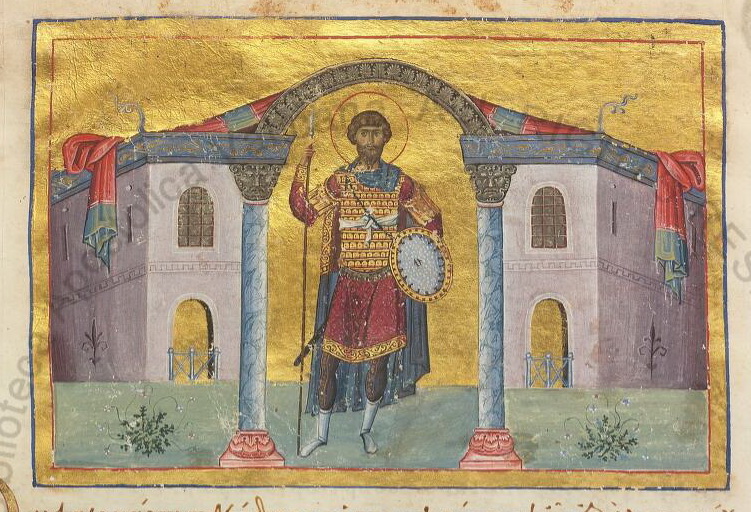
Theodore Stratelates is depicted as a young warrior-saint — beardless or with a short dark beard, in the full panoply of a Roman officer: cuirass and military cloak (the chlamys), holding a spear and a shield, often with a sword at his side, sometimes crowned or mounted. He is distinguished from Theodore the Recruit chiefly by context and inscription, for the two share the type and are frequently painted as a pair, flanking a doorway or standing together in the warrior-tier, the elder-seeming Recruit and the officer-general; where they are named, the inscription Ὁ ἍΓΙΟΣ ΘΕΟΔΩΡΟΣ Ὁ ΣΤΡΑΤΗΛΑΤΗΣ identifies the general. Narrative cycles show the breaking of the idols and the almsgiving, the tortures on the cross, and the beheading. He appears among the military saints in the great Middle-Byzantine programs and, most famously, in the frescoes of his own church at Novgorod.
The stored image is the miniature for February 8 from the Menologion of Basil II (Constantinople, c. 985; Vatican, Vat. gr. 1613), depicting Theodore Stratelates — the warrior-martyr set against the manuscript's gold ground (source, public domain, pd-old-work).
Disputed questions
- Stratelates and the Recruit: one saint or two? The critical question of the two Theodores is whether Theodore Stratelates ("the general") is a historically distinct martyr or a later hagiographic doubling of Theodore the Recruit (Tyron). The considerations for a single origin are weighty: the earliest and best-attested cult, from the fourth century, is that of the Recruit, the humble soldier of Euchaita/Amasea, celebrated already by Gregory of Nyssa; the general appears in the sources considerably later, with a fuller and more novelistic passion, and inherits the Recruit's own shrine-city of Euchaita as the home of his relics — the natural mark of a cult grown by division from an older one. Much modern scholarship accordingly regards Stratelates as a Byzantine literary elaboration of the one Theodore of Euchaita, the tiro raised to a stratelates. The liturgical tradition of the Church, by contrast, has kept two saints, two feasts (February 8 and February 17), two passions, and two proper offices for many centuries, and venerates them as distinct persons who are also companions. This entry follows the Church's usage while recording the historical question honestly: whatever the origin of the two names, the Church honours two Theodores, and the martyr's crown it celebrates is one and the same.
- The place of martyrdom. The passion sets his governorship and death at Heraclea in Thrace under Licinius; his burial and cult are at Euchaita in Pontus. The two-city pattern (death in the West, relics in the eastern shrine) is itself part of the doubling question above.
- Not to be confused with Theodore the Recruit (Tyron) (February 17), the companion warrior-martyr treated above; nor with Theodore the Studite (†826, the great abbot and confessor), Theodore the Branded (the hymnographer-confessor of the icons), Theodore the Sanctified (the disciple of Pachomius), or Theodore of Sykeon (the sixth-century wonderworker-bishop) — all distinct saints of the calendar who share only the common name "gift of God."