
Theodore the Sykeote
Our Venerable Father Theodore the Sykeote, Bishop of Anastasiopolis, the Wonderworker
Venerable · Bishop · Wonderworker · b. first half of the 6th century, at Sykeon in Galatia — d. 22 April 613, at Sykeon (Festugière dates the repose to 623)
Commemorated 22 April — Repose at the monastery of Saint George at Sykeon, 15 June — Translation of the relics from Galatia to Constantinople
Theodore the Sykeote (†22 April 613) was the greatest of the holy men of Galatia: born in the village of Sykeon, the son of an innkeeper, he was given from childhood to the martyr George, at whose hill-shrine above the village he became first a boy-ascetic, then a hidden cave-dweller, then the founder of a monastery whose fame filled Asia Minor. He was ordained priest at eighteen, tonsured a monk at Choziba in the Judaean desert, and was at last dragged from his cave to be made Bishop of Anastasiopolis, a burden he bore for some years before obtaining release from the Patriarch to return to his cell. He stood in an iron cage through the winter fast, weighed down with irons; he stopped plagues, locusts, hail and rivers; he cast out demons across the Galatian countryside; he foretold the throne to Maurice and the coming of ruin upon the empire, and blessed Heraclius on his march east. His Life, written by his disciple George of Sykeon, is one of the richest documents of provincial Byzantine society that survives.

Sykeon: the inn on the imperial road
Theodore was born in the first half of the sixth century at Sykeon, a village of Galatia Prima some twelve miles from the city of Anastasiopolis, through which ran the great highway of the imperial post — the road by which couriers, soldiers, officials and pilgrims passed from Constantinople toward the Persian frontier. On that road, in that village, his family kept an inn: his mother Mary, her mother Elpidia, and Mary's sister Despoinia, three women living by the trade of the road, and, as his biographer states without euphemism, for a time by prostitution as well. His father, Cosmas, was a performer of the Hippodrome at Constantinople, one of the corps who did acrobatic feats upon camels, afterwards employed as a carrier of the emperor's orders; he passed through Sykeon on the imperial service, and he died young.
It is a beginning without parallel among the Byzantine holy men, and the Life does not soften it. Nor does it make the women contemptible: they are shown as capable and independent, keeping the house and its business, disposing of their own money, and in the end all three turning to God — Mary married David, a man of standing at Ancyra; Elpidia founded a convent called Beeia and lived out her days near her grandson's monastery; Despoinia willed her whole property to the monastery and was buried in the church of St Gemellus. Theodore's younger sister Blatta took the veil in the convent of Petris at Ancyra and died after three years.
Before his birth, the tradition says, his mother saw a great bright star standing over her womb; and when, at six years old, plans were laid to put the boy into the imperial service as his father had been, the martyr George appeared to Mary and forbade it, saying that the child had another Lord to serve.
The boy at the shrine of St George
From that time Theodore's whole childhood belonged to the shrine of St George on the rocky hill above Sykeon. At six he was already refusing food at midday in order to fast; he would slip away from his lessons to the oratory; the household found that he had learnt the whole Psalter by heart, and he told them that while he prayed a sweetness had filled his mouth. The Lives report an ascetic elder named Stephen whose abstinence he set himself to copy, eating dry bread through the Great Fast and standing through the services.
At about twelve the bubonic plague — the pestilence that had been travelling the empire since the days of Justinian — fell upon Sykeon, and Theodore with the rest. They carried him dying to the shrine of St John the Baptist near the village and laid him at the threshold of the sanctuary; and, the account says, drops fell from the image of the Saviour in the dome upon the boy's face, and he rose up whole and walked home. In that same year he saw Christ in a vision as a king in glory, bidding him strive; and he began, alone and unbidden, the discipline that he kept for the rest of his life — shutting himself away from the Theophany to Palm Sunday in silence and abstinence.
At fourteen he left the inn for good and went to live at the oratory of St George, eating one prosphoron a day. At fifteen he dug himself a cave beneath the step of the altar, persuaded a deacon to bring him bread and water and to tell no one, and lived there hidden for two years, in the winter standing in the freezing water of the rock. His grandmother Elpidia, when at last the secret came out, was allowed to bring him a little food on Saturdays and Sundays only.
Priest at eighteen, monk at Choziba
The report of the boy in the rock reached Theodosius, Bishop of Anastasiopolis, who came, examined him, and — brushing aside the canons of age — ordained him reader, subdeacon, deacon and priest in quick succession, though he was but eighteen.
Soon after, Theodore went as a pilgrim to the Holy Land. He venerated the wood of the Cross and the Church of the Resurrection, the manger at Bethlehem and the place of the Ascension; he went down to the Jordan where Christ was baptised, and went from monastery to monastery and cell to cell among the fathers of the desert. At the monastery of the Mother of God at Choziba, in the gorge of the Wadi Qelt — the house of George the Chozebite — the archimandrite clothed him at once in the monastic habit; and he returned to Galatia, his biographer says, with his face shining like the face of Moses.
The monastery of Saint George at Sykeon
Around the little oratory on the hill there grew, in the years that followed, a monastery — the house of St George at Sykeon, of which Theodore was father and which became the centre of a whole network of cells and communities across northern Asia Minor. He built there a great hall dedicated to the Archangel Michael, habitable in every season; a small oratory of St John the Baptist on one side and one of the Theotokos on the other; a church worthy of St George with three apses; an oratory of the martyr Plato of Ancyra; and a lodging for catechumens under the patronage of Sergius and Bacchus. When a great block of stone stuck fast in the works, it moved at his word — and, the Life adds with characteristic particularity, bent aside as it came so as not to crush an apple tree.
His disciples are named one by one, and their fates are the best evidence of how far his influence reached: Philoumenos of Mossyna, who became abbot; John the archdeacon of the monastery; Epiphanios; Reparatus, of high birth, who took a small cell in Kolonosos in Lycaonia; Elpidius, called Hesychos, "the silent one," who went to Mount Sinai; Leontius near Permataia, who received the gift of prophecy, foretold the Persian invasion, and died a martyr's death rather than abandon his cell; Theodore of Dracon, afterwards abbot of the monastery of St Autonomus; Stephen, abbot of the monastery of St Theodore by the river Psilis; Evagrius, who went to the Lavra of St Sabbas; Andreas, who settled eight miles off on the hill by Brianeia and stood the winter fast in a wooden cage; and Arsinus, who raised a column at Galenae on the upper Siberis and kept his discipline upon it for forty years.
The iron cage
Theodore's asceticism was of the extreme, deliberately visible kind that the sixth century prized and that the seventh began to distrust. From about his twentieth year he bore iron: rings of fifteen pounds' weight on each foot and others on his hands, a cross and collar of eighteen pounds about his neck, an iron belt of thirty-three pounds, an iron staff surmounted by a cross, and over his hair-tunic a triple corselet of mail weighing fifty pounds. The chains he wore from Pascha until the Nativity.
From the Nativity until Palm Sunday — some twelve weeks — he ate nothing at all on the weekdays, and on Saturdays and Sundays an apple, or a salad of wild greens; never bread. And for that fast he stood in a narrow iron cage which he had made at the village of Mossyna, a standing-place open to the weather on the face of the rock. The villagers, wanting the iron cage for themselves as a relic, built him a wooden one and struck a bargain for the exchange; and every year they came in procession with lights to escort their holy man to his winter station. There, on the Galatian plateau, where the winters are savage, he stood from cockcrow until evening without once leaning on the rails, until the frost fastened the soles of his feet to the boards, and his servant Marinus had to thaw the ice with warm water poured slowly over them. One Pascha, faint with the fast and the glare of the sun, he began to sink; his disciple Philoumenos threw his own cloak over the cage for shade, and Theodore, reviving, ordered it taken away, saying that he was not to be shielded.
Wonders in the Galatian countryside
The Life is above all a record of what the countryside asked of a holy man, and the answers are agricultural, medical, and legal as often as they are spiritual.
Against the pests and the weather. At Mazamia on the upper Siberis a swarm of locusts was eating the summer crop and the vines; Theodore took three locusts into his hand and prayed over them until they died, then led the villagers in procession out onto the plain, and by morning, the Life says, every locust in the district lay dead. At Reake he set four wooden crosses at the four corners of the vineyards, and the hail-cloud that had ruined them never came over that ground again; the grateful villagers sent wine and grapes to the monastery every year after. When the plague broke out again about Ancyra and was killing cattle as well as men, he blessed water for the sprinkling of the beasts, and the dying stopped.
Against the rivers. The Siberis, which ran below Sykeon, was cutting away the arable land; Theodore commanded it in the name of Christ to shift its bed, planted a wooden cross, prayed — and the river moved and stayed moved. At a ford where several men had been drowned he waded in and prayed, and it was safe and easy to cross thereafter. He turned the river Kopas away from the fields of Karuas in the same manner.
Against the demons. Exorcism was the daily work. Some he healed by a word sent through a messenger; a possessed boy, whose demon held out for two days, was freed when the saint touched his forehead with oil from the sanctuary lamp and signed him with the Cross. In the house of a landowner named Theodore Latzeas a digging released a nest of spirits that tormented the whole town; the saint led a procession about the village, tortured the demons with prayer and the sign of the Cross, and sealed the excavation. A boy called Arsinus he cured only after long delay, in the deep ravine of Xerorruax, and (the Life says) with the help of the martyr Christopher. A sorcerer of Mazamia, Theodotus Kourappus, who had shut a demon into a woman and, exposed by the saint, sent first assassins and then a poisoned fish against him, at last burned his books of magic in Theodore's presence and was baptised.
Healings, and the discernment of hidden things. A dumb boy of Ancyra spoke the word "Amen" at his command and was cured — and a doubting deacon named Dometianus, who had scoffed, saw a flame come out of the boy's mouth and fell down trembling. Two lepers were cleansed, one of them the priest Epiphanius Kollouras of Dioskonis, who was healed by borrowing the saint's own tunic. A woman of Kalpinus, possessed at Theodotus's bidding, was freed. The son of one Theodore, treasurer of Heliopolis, who had stolen his father's gold and fled, was held fast on the road near Nicaea and could go no further until he was recognised and brought back. Most striking of all is the tale of the silver chalice and paten which the archdeacon had bought at Constantinople: Theodore, who had misgivings from the first, saw them blacken like tarnished silver at the prayer of the Invocation, and the enquiry that followed found that the metal had been taken from a harlot's chamber-pot. New vessels were provided. In a mortal illness of his own he saw the unmercenary physicians Cosmas and Damian standing by him as doctors, feeling his pulse and speaking with angels who came down; they obtained for him, like Hezekiah, fifteen years more of life for the sake of the souls he had still to labour for.
Bishop of Anastasiopolis
When Timotheus, Bishop of Anastasiopolis, died, the clergy and the landowners of the city went to Paul, Archbishop of Ancyra, and asked for Theodore. He refused from his cave; they carried him out in a litter. Paul ordained him, and reported that a man of vision had seen at that hour a great shining star come down and stand above the church; he was enthroned by the bishop of Kinna. As bishop he built at Anastasiopolis the cathedral church of the Holy Wisdom, and the sick were carried to him on their beds through the streets, and his city was spoken of across the empire.
But the see was a burden he could not carry and keep his soul. The administration of a Byzantine bishopric meant taxes, estates, lawsuits, and the management of the imperial domain that lay within his diocese; his own clergy resisted him; and the Life records, in the saint's own confession, that in the cares of office he had fallen away from what he had gained in the cave. On his third journey to Jerusalem he resolved not to come back at all, but to end his life at the Lavra of St Sabbas, where he stayed from the Nativity until Pascha. There an attempt was made to poison him, and he was preserved (the account says) by three grains given him by the Mother of God. And there St George appeared to him in a dream and sent him back to his flock. He returned; and only afterwards, having gone up to Constantinople and laid the matter before the Patriarch Cyriacus, was he released from the government of the church of Anastasiopolis, keeping the dignity of a bishop and returning to his monastery at Sykeon to live and die a monk.
Emperors, patriarchs, and the prophecy of ruin
The Life is a political document as well as a spiritual one, because everything on the imperial road passed Theodore's door.
Maurice, while still chartularius and returning from the Persian war, turned aside to the saint's cave and was told that he would be emperor; Theodore charged him to honour St George and to remember the poor. When it came to pass (582), Maurice wrote asking his prayers for the empire, and endowed the monastery with two hundred modii of corn a year, with a silver chalice and paten. Later Theodore foretold the emperor's death and the "terrible scourges" that threatened the world — and the murder of Maurice in 602 opened the twenty-six years' Persian war that all but destroyed the eastern provinces.
To the usurper Phocas, whose family he knew well, he would promise prayer only on condition that the killing stopped. When Patriarch Thomas I was terrified by a portent — the great processional crosses striking violently against one another with no human hand — he sent for the Sykeote, who told him at last what it meant: apostasies and waverings in the faith, the invasions of barbarous nations, blood poured out, captivity, the desolation of the churches, the silencing of the services, the overturning of the empire; and Thomas begged the saint to pray that he might die before he saw it. He was taken in 610, and the storm broke.
After the revolt that brought Heraclius to the throne, Theodore interceded to save the life of Domentziolus, Phocas's nephew, and the new emperor asked for the saint's prayers upon his reign. In Lent 613, marching east against the Persians, Heraclius sought his blessing; Theodore blessed him and pressed him to stay and eat, and the emperor, in haste, declined the gifts — which the saint said was a sign of our defeat. That summer Heraclius was beaten at Antioch. With Patriarch Sergius I the saint's relations were good; but the historian Walter Kaegi has observed that Heraclius seems always to have kept a certain reserve toward him.
Repose, relics, and cultus
Theodore reposed at Sykeon on 22 April 613, and was buried at his monastery. His tomb became at once what the hymns of his feast still call it — a Siloam for the faithful, a spring of healing oil and cures; the canon sung on his day speaks of the stream that issues from his coffin and washes away the corruption of the passions.
His relics were carried to Constantinople. The reason given is the Persian war: the capital drew the holy dead within its walls for protection, and the reception of Theodore's body was made an occasion of state, binding the wonderworker's name to the new regime of Heraclius. By the year 1200 the Russian pilgrim Anthony of Novgorod saw them in the monastery of St George of Mangana in Constantinople — the monastery of the martyr to whom Theodore had belonged since childhood. The translation of the relics is kept as a second feast on June 15.
The Life by George of Sykeon
Almost everything known of Theodore comes from a single book: the Life of Theodore the Sykeote written by George, his disciple, a priest of the monastery, in the early 640s. George says plainly how he worked — from what he had seen himself, from the testimony of the saint's contemporaries and schoolfellows, and from what Theodore had told him in their hours alone. The result is one of the most valuable hagiographies of the whole Byzantine millennium, not for its theology but for its detail: the running of a village inn, the price of a day's labour, the plague, the locusts, the sorcerer with his books, the bargain over the iron cage, the archdeacon's shopping trip to the capital, the manners of emperors and of peasants alike. Modern historians use it as a primary source for the reign of Heraclius, for the religious life of rural Anatolia, and — unusually for the period — for the lives of women and of families. It was edited critically by André-Jean Festugière (Vie de Théodore de Sykéôn, Subsidia Hagiographica 48, Brussels 1970) and translated into English, in abridgement, by Elizabeth Dawes with notes by Norman H. Baynes in Three Byzantine Saints (London 1948).
Feast and commemoration
Theodore is kept on April 22 (church date; Old Calendar civil May 5), the day of his repose, and is the principal commemoration of that day in the Greek, Slavic and Antiochian calendars alike; the Greek Menaion gives him the full office, with proper stichera, a proper kontakion and two canons, while the other commemorations of the day — the Apostle Nathanael, the martyr Nearchus — have only their synaxarion notices. He is also honoured in the West: the Roman Martyrology names on this day "at Anastasiopolis, St Theodore, a bishop renowned for miracles."
His feast falls on the eve of St George the Trophy-bearer (April 23), and the placing is felt as fitting rather than accidental: Theodore's whole life was lived under the patronage of the martyr George, who forbade his mother to make him a courier, who sent him back to his see from the Lavra of St Sabbas, whose oratory was his cell and whose name his monastery bore, and in whose monastery at Mangana his relics finally rested.
The translation of his relics from Galatia to Constantinople is commemorated on June 15 (Old Calendar civil June 28), a secondary feast kept especially in the Slavic calendars.
Hymns
Apolytikion — Tone 4
A rule of faith and an image of meekness, a teacher of temperance, hath the truth of thy deeds revealed thee to be unto thy flock: therefore hast thou attained the heights by humility, and riches by poverty. O Father and Hierarch Theodore, intercede with Christ God that our souls may be saved.
Kontakion — Tone 3
Mounted upon the virtues as upon a chariot of fire, O God-bearer, thou didst run up to the dwellings of heaven: an angel keeping company with men, a man dancing in the choir of the angels. Therefore wast thou shown forth a divine vessel of wonders, O Theodore.
Original translation from the Greek
Stichera — Tone 1
Become an initiate of the mysteries of the Word, O father, and shining with the virtues in the radiance of the Spirit, thrice-blessed Theodore, thou bestowest the gifts of healings upon us who draw near on this thy sacred memorial and honour thee.
Original translation from the Greek
Iconography
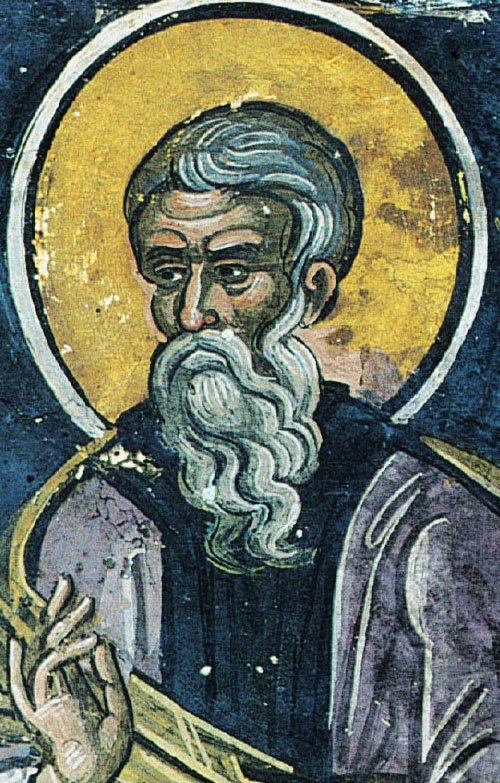
Theodore is painted as an aged monastic father: grey or white-bearded, hollow-cheeked from the long fasts, in the dark tunic and mantle of a monk and often the koukoulion, blessing with the right hand and holding a scroll in the left. Because he resigned his see, the Byzantine painters ordinarily give him the monastic and not the hierarchical dress — no omophorion, no Gospel book — and where a narrative scene is added it is his standing in the iron cage upon the rock, or the martyr George appearing to him. He belongs iconographically with the "cage-dwellers" and stylites of Asia Minor rather than with the hierarchs.
The stored image is a detail of a painted image of 1547, published in the saints' calendar of the Polish Orthodox Church and there identified as Theodore the Sykeote, Bishop of Anastasiopolis: an aged father with a long forked grey beard against a gold nimbus, in a dark inner garment and violet mantle, the right hand raised in blessing and a scroll in the left. The crop preserves no legible inscription, so the identification rests on that jurisdictional attribution rather than on an epigraph read here; a Byzantine image with an inscription would be an upgrade.
Disputed questions
- The year of his repose. The day, 22 April, is fixed by the synaxarion verse itself ("on the twenty-second the tomb hid the Sykeote"). The year is not. Most modern scholarship, following the chronology of the imperial episodes, places his death in 613 — after his blessing of Heraclius in the Lent of that year. Festugière, reading the Life as running to the thirteenth year of Heraclius, puts it in 623. The OCA synaxarion, which ties his death closely to that of Patriarch Thomas, gives 610. The three positions are recorded, not resolved; 613 is used here as the majority reading.
- When the relics were translated. Kaegi and others take the Life and the circumstances of the Persian war to mean that the body was brought to Constantinople almost at once, under Heraclius. The OCA notice is more cautious: the transfer from Galatia to Constantinople happened "no later than the ninth century," the first firm witness being Anthony of Novgorod in 1200. Either way, June 15 keeps the memory of the translation.
- Where Sykeon was. Anastasiopolis was the old Galatian town of Lagania, refounded and renamed under the emperor Anastasius I, and Sykeon lay some twelve miles from it; the sites are placed by modern topography in the district of Beypazarı (Kayabükü) west of Ankara, but the identification is inferential, resting on the road system and the course of the Siberis.
- Venerable or hierarch? The Greek books head his day Ὅσιος — venerable — and not hierarch, though he was a consecrated bishop, because he resigned the see and died a monk; the apolytikion appointed for him is nevertheless the hierarch's hymn "Κανόνα πίστεως," and in printed editions of the Menaion the name of St Nicholas frequently stands unaltered in that text, a plain sign that no proper apolytikion of the Sykeote was ever composed. He is classified here as venerable, bishop and wonderworker together.
- Not to be confused with Theodore Trichinas (April 20), the hair-shirt ascetic of Constantinople, whose feast falls two days before his and who is likewise a venerable wonderworker of Asia Minor; nor with the many soldier-martyrs of the name.