
George the Great Martyr
The Holy, Glorious and Right-victorious Great-martyr George the Trophy-bearer and Wonderworker
Great Martyr · Wonderworker · b. c. 275–280 — d. 303
Commemorated 23 April — Martyrdom at Nicomedia, 3 November — Dedication of the church of St George at Lydda, where his body was laid, 10 November — The breaking on the wheel — Giorgoba, the great feast of the Georgian Church, 26 November — Dedication of the church of St George at Kiev (1051) — Russian usage
George the Trophy-bearer (†303) is the most universally venerated of the martyrs of the East, honoured from Ethiopia to England as Μεγαλομάρτυς and Τροπαιοφόρος — "great-martyr" and "trophy-bearer," the soldier who carried off the prize. Born in Cappadocia of a martyred father and a Palestinian mother from Lydda, he rose young to the rank of comes in the guard of Diocletian, and when the persecuting edict was published at Nicomedia in 303 he gave away his goods, freed his slaves, and denounced the emperor's decree to his face before the council. There followed the long cycle of tortures for which his passion is famous — the spiked wheel, the pit of quicklime, the red-hot iron shoes, the poison of the magician Athanasius — through which the martyr was preserved, so that the sorcerer himself, and the Empress Alexandra, and many of the court confessed Christ. He was beheaded on 23 April 303 and buried at Lydda (Diospolis) in Palestine, where his shrine became one of the great pilgrimage places of Christendom. To him the later tradition attached the celebrated miracle of the dragon, and he is the patron of Georgia, England, Greece, Ethiopia, Portugal and Catalonia, of the city of Beirut and of Christian soldiers everywhere.

Origins: Cappadocia and Lydda
George was born in Cappadocia, in the last quarter of the third century, into a family of rank and of Christian faith. The tradition names his father Gerontius, an officer of the Roman army — in some recensions a senator or a man of the military nobility — who suffered martyrdom for Christ while George was still a boy; and his mother Polychronia, a native of Lydda in Palestine, who is herself commemorated on the same day as a martyr in the Slavic and Greek synaxaria. Widowed, Polychronia returned with her son to her own country, where she held lands, and there brought him up "in strict piety," as the synaxarion has it: so that George belongs by birth to Asia Minor and by upbringing to Palestine, and both regions have claimed him. Lydda, where his mother's estates lay and where his body would be laid, is the anchor of the whole tradition; the Latin sources, which often place the martyrdom itself there, style him simply Georgius Diospolitanus.
Soldier of the emperor
Grown to manhood, George followed his father's calling and entered the army. The accounts agree in describing him as of great physical beauty and courage, distinguished in campaign, and rapidly promoted: tribune while still young, and then, by the emperor's own favour, comes (κόμης, "count") — a rank in the imperial guard which set him among the officers immediately about the person of Diocletian. He was, on the tradition's reckoning, not yet thirty. The name itself became a subject of pious wordplay: Γεώργιος, "the husbandman," the tiller of the earth who tilled instead the field of the soul, an image the kontakion of his feast turns on.
The setting is the court of Diocletian at Nicomedia in Bithynia, the administrative capital of the East, at the moment when the Tetrarchy resolved upon the last and greatest of the persecutions. The synaxarion presents the decision as taken in council: the emperor, alarmed at the spread of Christianity, laid the matter before his senate and his governors and gave them a free hand against the Christians, promising the resources of the state to whoever should press the work hardest. This is the historical Great Persecution of 303, opened at Nicomedia with the destruction of the cathedral church and the publication of the edicts against the Scriptures, the clergy, and finally against all who refused sacrifice.
The confession before the council
George's response is the hinge of the whole account, and it is not the response of a man discovered but of a man who chooses. Knowing what the edict meant, he distributed his wealth to the poor, set his household slaves at liberty, and went of his own accord into the assembly where the emperor sat with his council. There, in the hearing of the court, he declared himself: "I am the servant of Christ my God, and trusting in him I have come among you of my own will, to bear witness to the truth." Asked what truth was, he answered that the Truth was Christ himself, whom they persecuted; and he told the emperor to his face that his gods were nothing, and that the throne which fought against heaven would not stand.
Diocletian, who had loved the young officer and had raised him, is remembered as having tried first persuasion and the promise of higher honours, and only afterwards the whole apparatus of the state's cruelty. The passion insists on this: the martyr's constancy was tested less by pain than by favour, and the offer of advancement was renewed at every stage of his torments.
The cycle of tortures
The long cycle of tortures is the most famous feature of George's passion, and it is the feature that most clearly marks the account as hagiography grown in the telling (see Disputed questions). The tradition transmits them in a sequence which the icons faithfully reproduce:
- The spears that bent. When the guards moved to drive him from the hall with their lances, the iron is said to have softened and turned aside from his body like lead. He was taken to prison, stretched in the stocks, and a heavy stone laid on his breast.
- The wheel. Diocletian ordered him bound upon a great wheel set over a frame of boards stuck with blades and iron spikes, which as it turned cut the martyr's naked body to pieces. He was left for dead; an angel appeared, and he was found whole, standing and giving thanks. This torment gives the Georgian Church its second feast of the saint (see Feast and commemoration), and gives the icon its wheel.
- The pit of quicklime. He was cast into a deep pit and unslaked lime poured over him and the pit filled in, for three days; when they dug him out to collect his bones, he was alive and unharmed.
- The red-hot iron shoes. Sandals of iron, heated white and set with nails driven inward, were forced on his feet, and he was scourged through the city at a run — "run well, George, and finish thy course," the mockers cried; and the following morning he came before the emperor sound.
- The scourging with ox-hide thongs, until, the passion says, the flesh came away in pieces and the ground was soaked with his blood; and, in some recensions, the beating with hammers, the salt rubbed into his wounds, and the drawing on the rack.
Through all of it he was neither broken nor silenced, and the effect on the onlookers is the point of the narrative: at each deliverance new witnesses believed. Two of the officers of the guard, Anatolius and Protoleon, who had been secret Christians, confessed openly at the sight of his sufferings and were beheaded at once; they are commemorated with him on 23 April. So too were Glycerius, a farmer whose ox George healed, and Valerius, Donatus and Therinus, whose names the Greek synaxarion joins to his.
Athanasius the magician and the raising of the dead
Concluding that so obstinate a body must be protected by sorcery, the emperor sent for the celebrated magician Athanasius, who undertook either to break the Christian's will by enchantment or to destroy him by drugs. Two cups were given to George: one to rob him of his reason, one to kill. He signed them with the cross, drank both, and was unharmed.
Athanasius then demanded a sign, and — the account continues — the emperor bade the martyr raise a dead man from a tomb near by, that they might see whether his God had any power over death. George prayed aloud, asking not for himself but for the bystanders: "Lord, show these who stand here that thou alone art God over all the world." There was an earthquake, the grave opened, and the dead man came out alive and fell at his feet. At this Athanasius the magician cast himself down and confessed Christ as the almighty God; Diocletian, enraged, ordered him and the raised man beheaded on the spot, and George returned to prison — where, the passion adds, the crowds came secretly to him and were baptised, and the sick were healed by his touch through the bars.
The Empress Alexandra
The most celebrated of the conversions wrought by the martyr's endurance was that of the emperor's own wife. On the last day, with the court assembled in the great temple of Apollo for a final attempt to make George sacrifice, the saint went up to the idol, made over it the sign of the cross, and asked it whether it wished to receive sacrifice as God — at which, the tradition says, a voice from within confessed itself a demon, and the images fell and were shattered throughout the temple, the priests and the mob falling upon the martyr in fury.
At that moment the Empress Alexandra, who had followed the whole contest, forced her way through the crowd, cried out "O God of George, help me, for thou alone art almighty!" and fell at the martyr's feet confessing Christ. Diocletian, beside himself, condemned them both to the sword the same hour. The passion relates that as they were led out the empress asked to rest, sat down against a wall, and there gave up her soul to God — so that her martyrdom, in the received account, was accomplished without the executioner. She is commemorated with her husband's victim as Alexandra the Empress; the difficulties of her history are set out in her own entry.
The beheading at Nicomedia
George was brought to the place of execution outside the city. He prayed — the tradition preserves the substance of his last prayer: for the forgiveness of his persecutors, for the peace of the Church, and that God would hear those who should call upon his own name in their afflictions, a petition to which the whole later cultus of intercession is referred — and then, in the words of the synaxarion, "bowed his neck beneath the sword and received the crown of martyrdom." The date is given as 23 April 303. His servant, according to the passion, had been charged to carry his body to Lydda, to the place of his mother's people; and there it was laid.
Relics and the shrine at Lydda
The tomb at Lydda, the Greek Diospolis, in the Palestinian coastal plain, is the oldest and firmest datum of the whole tradition and the point from which the cult radiated. A church over the martyr's grave is ascribed to the age of Constantine; by the sixth century pilgrims to the Holy Land record Diospolis as the place "where Saint George was martyred and where his body lies," and the dedication of that church on 3 November entered the Byzantine calendar as a second feast of the saint, kept to this day. The building was destroyed and raised again more than once — in the Persian and Arab invasions, by Saladin's order after the Crusades, and again in later centuries; the present Greek Orthodox church of St George at Lod was rebuilt in 1870–72, largely with Russian alms, on the ruins of the crusader church, and the sarcophagus venerated as the martyr's is shown in its crypt.
Portions of the relics travelled early and widely: a head venerated at San Giorgio in Velabro in Rome, another at Ferrara, an arm at Venice, fragments in nearly every great treasury of East and West, and — most numerously — in the monasteries of Greece and the Levant, where relics of St George are among the commonest of all. The Church has never treated the dispersal as a difficulty: the martyr is understood to be present wherever he is invoked.
The early cult, and the Antiochian witness
The historical bedrock beneath the legend is the cult, which is early, sudden and enormous. Its epigraphic traces are thickest not in Cappadocia but in the country between Damascus and the Hauran, in the patriarchal territory of Antioch: the inscriptions of Shaqqa and the dedicatory inscription of the martyrium at Ezra'a (Zorava) of the year 515, which speaks of a shrine of "the holy and triumphant martyr George" raised over what had been a place of demons — evidence that by the beginning of the sixth century George was already a great name in Syria. In the Arabic-speaking Church he is Mar Jiryis (Mar Girgis), and the most thronged of his shrines is the Antiochian monastery of St George al-Humayra (Deir Mar Jiryis) in the Valley of the Christians (Wadi al-Nasara) near Homs, whose feast gathers pilgrims from the whole of Syria and Lebanon. In popular Levantine piety — Christian and Muslim alike — he is assimilated to al-Khadr / al-Khidr, "the Green One," the immortal deliverer of the Qur'anic and folk tradition, and his shrines at Lod, Homs and Beirut are visited by both. The Greek tradition further localises the miracle of the dragon on the coast at Beirut, whose bay still bears the saint's name; and it was at Antioch, in 1098, that the crusading army believed itself to have seen George and Demetrius riding at its head — the vision which, more than any other single event, carried the eastern warrior-saint into the devotion of the Latin West.
The dragon
The story by which the world knows George is not part of his passion at all. The miracle of the dragon is a posthumous miracle, one of a collection of Miracula which grew around the shrine, and it is late: no trace of it appears in the Greek or Latin passions of antiquity, and its earliest known written form is an eleventh-century Georgian text, from which — or in parallel with which — Greek versions spread, reaching the Latin West in the twelfth century and achieving its final popularity in the thirteenth-century Golden Legend of James of Voragine.
In the received form, a city — the Greek versions name Lasia, and locate it variously in Libya, in Syria, or at Beirut; the eastern accounts most often on the Lebanese coast — was terrorised by a serpent living in a lake or marsh, which poisoned the air and devoured the people, who appeased it by lot with their children. When at last the lot fell on the king's own daughter and she was set out at the water's edge, the saint appeared on horseback, signed himself with the cross, and overthrew the monster with his lance; and — a detail the icons love — he did not kill it outright, but bound it with the maiden's girdle so that she led it into the city like a dog on a lead, before it was destroyed and the whole people, the number is given as twenty-five thousand men besides women and children, were baptised.
The Church has always read this as it reads such narratives: as an image of the victory of Christ over the devil worked through his martyr, the serpent of Eden and of the Apocalypse overthrown, the delivered maiden the human soul or the Church herself. That the tale is allegorical in origin, and demonstrably later than the martyr by seven centuries, is not concealed in the Orthodox tradition; the synaxaria narrate it among the miracles, distinct from the passion, and the Greek editors of the miracle-collections treat it as such.
Other miracles
The Greek Miracles of St George, a collection of about a dozen narratives copied in the menologia and edited in modern times from the manuscripts, gathers the material on which his reputation as wonderworker rests. Among the best known:
- The Saracen and the icon. A Saracen entering the church at Ramla (or Lydda) mocked the picture of the saint and shot an arrow at it — or, in other tellings, struck it with his spear; the shaft turned back upon him and his hand was withered and swelled, until, taught by a priest, he did penance, was healed, and was baptised, himself dying a martyr afterwards at the hands of his own people.
- The widow's column. A poor widow of Ramla, having nothing but a marble pillar to give towards the building of the martyr's church, prayed over it and set it on the shore; the saint appeared to the builders and the column was found at Lydda before the ship that carried the rest, and was set in the place he had marked.
- The youth of Mytilene. A boy carried off by Saracen pirates from Mytilene in Lesbos was serving as cup-bearer at the table of his captor when his parents, keeping the saint's feast at home, prayed for him; the martyr appeared, set the boy on his horse, and brought him back into the church in the midst of the festival, still holding the cup of wine he had been carrying. From this miracle the islanders keep to this day a custom peculiar to Lesbos of blessing boiled wheat (kolyva) on the saint's feast and distributing it as "St George's cake" — wheat used, unusually, not as a memorial for the dead but as a thank-offering for a deliverance. The same miracle is told elsewhere of a youth of Paphlagonia, and the two versions are variants of one story.
- The healing of Glycerius's ox, in the passion itself; and the countless local deliverances of captives, prisoners and the sick which earned him the title the apolytikion gives him first of all: liberator of captives.
Patron of nations
No other martyr has been adopted by so many peoples.
- Georgia honours him as its especial patron and keeps the wheel-feast of 10 November as Giorgoba, its greatest national commemoration; the tradition holds him a kinsman of Nina, the Enlightener of Georgia, who taught the Georgians his veneration. (The derivation of the country's western name from the saint is a folk etymology of crusader date — the name comes rather through Persian Gurğ — but the devotion it reflects is real, and hundreds of Georgian churches bear his name.)
- Greece keeps him as patron of the army and of innumerable villages; Ai Giorgi is the commonest of all Greek church dedications.
- Russia received him early: Yaroslav the Wise, baptised George, founded the Yuriev monastery at Novgorod and built the church at Kiev whose dedication on 26 November is his fourth feast; the mounted martyr became the emblem of Moscow and thence of the Russian state, and gave his name to the imperial military Order of St George and to "Yuri's day" in the peasant year.
- England adopted him from the crusades: the Synod of Oxford of 1222 raised his day to a feast, and Edward III placed his new Order of the Garter (1348) under the martyr's protection, after which George displaced the older English patrons.
- Ethiopia (where his churches and his image are everywhere), the Copts of Egypt (Mari Girgis), Portugal, Aragon and Catalonia (Sant Jordi), Genoa, Lithuania, Beirut, Lod and Cappadocia all claim him; and he is the patron of soldiers, of horsemen, of shepherds and of the flocks.
Hymnographic and literary legacy
George's passion is among the most widely translated texts of Christian antiquity, surviving in Greek, Latin, Syriac, Coptic, Arabic, Ethiopic, Armenian, Georgian, Old Slavonic and Old English recensions — an index of the cult's reach and, at the same time, of the tradition's fluidity. Encomia on the martyr were composed by Byzantine preachers, among them Andrew of Crete, and the office of 23 April in the Menaion is one of the fullest of the fixed year, with two canons, proper stichera at the Praises and at "Lord, I have cried," and a doxastikon of great solemnity. Later devotion added a widely used Akathist to the Trophy-bearer, and the Slavic tradition an immense body of popular verse and spiritual song about Egoriy the Brave.
Feast and commemoration
23 April (church date; Old Calendar civil 6 May), a feast of the highest rank short of the Great Feasts, kept with an all-night vigil throughout the Orthodox world and in the Antiochian usage among the principal patronal feasts of the whole patriarchate. The day falls always within the Lenten–Paschal season, and the propers of the martyr are therefore sung together with those of the Triodion or, more often, of the Pentecostarion — the Paschal canon and the Paschal stichera framing the service of the Trophy-bearer, whose triumph the office reads as a participation in the Resurrection. Where 23 April falls in Holy Week or on Pascha itself, the entire feast is transferred to Bright Monday; in Greek practice, when it falls before Pascha it is commonly kept on Bright Monday in any case, and 23 April is then observed with the Lenten office.
Three further commemorations are kept:
- 3 November — the dedication of the church of St George at Lydda, in which his body was laid; an ancient Byzantine commemoration, reinforced in Russian usage by the memory of the church's rebuilding in 1870–72. That day is not yet authored in this corpus.
- 10 November — the breaking on the wheel (Slavonic kolesovanie), the second and in Georgia the greater of his feasts: Giorgoba, kept by the Church of Georgia (which follows the Old Calendar, so that it falls on 23 November civil) as a national festival. Not yet authored.
- 26 November — the dedication of the church of St George before the gates of Holy Wisdom at Kiev, built by Yaroslav the Wise and consecrated about 1051; the "autumn St George's day" (Юрьев день) of the Russian year, a Russian and Ukrainian, not universal, observance. Not yet authored.
Commemorated with him on 23 April are the soldier-martyrs Anatolius and Protoleon, converted at the sight of his tortures; Athanasius the former magician and the man raised from the dead; Glycerius the farmer; Valerius, Donatus and Therinus; his mother Polychronia; the empress Alexandra; and, in Bulgarian and Greek usage, the New Martyr Lazarus of Bulgaria (†1802) — all of whom, save Alexandra, are deferred to a later pass (see the day file). Two days earlier, on 21 April, the calendar keeps three more of the converts of his passion, the palace servants Isaac, Apollos and Quadratus, who confessed Christ at his interrogation and rebuked the emperor to his face: Quadratus was beheaded, and Isaac and Apollos left in prison to die of hunger.
He is paired in the calendar, the hymns and the icons with Demetrius of Thessalonica (26 October), the two great-martyrs of the soldier type framing the campaigning half of the year; and with Theodore Stratelates and Theodore the Recruit he completes the company of warrior-martyrs whom the East sets at the head of its armies.
Hymns
Apolytikion — Tone 4
As the deliverer of captives and defender of the poor, physician of the sick and champion of kings, O Trophy-bearer and Great-martyr George, intercede with Christ God that our souls may be saved.
Kontakion — Tone 4
Tilled by God, thou wast shown forth as the most honoured husbandman of true religion, gathering for thyself the sheaves of the virtues; for having sown in tears, thou reapest with rejoicing, and having contended even unto blood, thou hast won Christ. By thine intercessions, O holy one, thou grantest to all forgiveness of their offences.
Original translation from the Greek
Appointed readings
Epistle — Acts 12:1–11
1Now about that time Herod the king stretched forth his hands to vex certain of the church. 2And he killed James the brother of John with the sword. 3And because he saw it pleased the Jews, he proceeded further to take Peter also. (Then were the days of unleavened bread.) 4And when he had apprehended him, he put him in prison, and delivered him to four quaternions of soldiers to keep him; intending after Easter to bring him forth to the people. 5Peter therefore was kept in prison: but prayer was made without ceasing of the church unto God for him. 6And when Herod would have brought him forth, the same night Peter was sleeping between two soldiers, bound with two chains: and the keepers before the door kept the prison. 7And, behold, the angel of the Lord came upon him, and a light shined in the prison: and he smote Peter on the side, and raised him up, saying, Arise up quickly. And his chains fell off from his hands. 8And the angel said unto him, Gird thyself, and bind on thy sandals. And so he did. And he saith unto him, Cast thy garment about thee, and follow me. 9And he went out, and followed him; and wist not that it was true which was done by the angel; but thought he saw a vision. 10When they were past the first and the second ward, they came unto the iron gate that leadeth unto the city; which opened to them of his own accord: and they went out, and passed on through one street; and forthwith the angel departed from him. 11And when Peter was come to himself, he said, Now I know of a surety, that the Lord hath sent his angel, and hath delivered me out of the hand of Herod, and from all the expectation of the people of the Jews.
Gospel — John 15:17–16:2
17These things I command you, that ye love one another. 18If the world hate you, ye know that it hated me before it hated you. 19If ye were of the world, the world would love his own: but because ye are not of the world, but I have chosen you out of the world, therefore the world hateth you. 20Remember the word that I said unto you, The servant is not greater than his lord. If they have persecuted me, they will also persecute you; if they have kept my saying, they will keep yours also. 21But all these things will they do unto you for my name’s sake, because they know not him that sent me. 22If I had not come and spoken unto them, they had not had sin: but now they have no cloke for their sin. 23He that hateth me hateth my Father also. 24If I had not done among them the works which none other man did, they had not had sin: but now have they both seen and hated both me and my Father. 25But this cometh to pass, that the word might be fulfilled that is written in their law, They hated me without a cause. 26But when the Comforter is come, whom I will send unto you from the Father, even the Spirit of truth, which proceedeth from the Father, he shall testify of me: 27And ye also shall bear witness, because ye have been with me from the beginning. 1These things have I spoken unto you, that ye should not be offended. 2They shall put you out of the synagogues: yea, the time cometh, that whosoever killeth you will think that he doeth God service.
Iconography
George is the archetypal warrior-saint of Christian art, and his image is among the most fixed and most reproduced in the whole iconographic tradition. He is always young and beardless, with a dense cap of dark curling hair — the one physical trait every school preserves — and appears in three principal types.
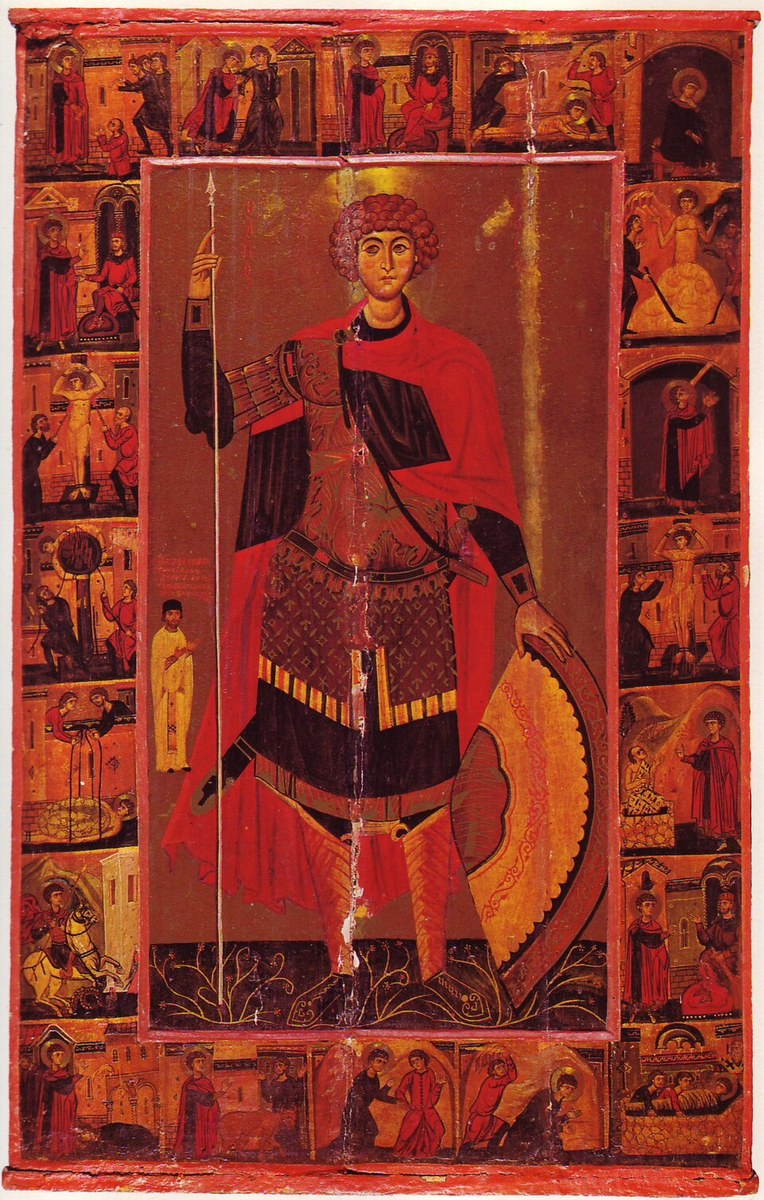
In the standing type, the oldest, he is shown in the thorax and pteruges of a Roman officer, or else in the chlamys of a court dignitary, holding lance and shield, or the martyr's cross and the palm; frequently he is paired frontally with Demetrius, or with the two Theodores, in the tier of soldier-saints that runs along the walls of Byzantine churches. In the martyrdom type he is bound upon the bladed wheel, or led in the iron shoes, or beheaded. In the equestrian type, which from the eleventh century became his signature image, he rides a white horse — Demetrius's is red — his red cloak flying behind him, and drives his lance into the dragon coiling beneath the hooves; often the king's daughter stands at the side leading the beast by her girdle, the walls of the delivered city rise behind, and above, in a segment of heaven, the hand of God or an angel descends with the crown. A further Russian development, the "Black George," shows him on a black horse. Vita-icons surround the central figure with a border of small scenes of the passion and the miracles.
The primary stored image is the great vita icon of the first half of the thirteenth century from the Monastery of St Catherine at Sinai: the martyr stands full-length in gilded scale armour and a broad red mantle, spear in his right hand and a great gold-rimmed shield at his left, his curled hair haloed, with a small kneeling donor-figure in white beside his spear; twenty scenes of his passion and miracles fill the frame — the trial, the wheel, the pit, the scourging, the beheading, and at the lower left the mounted saint with his lance.
The second stored image gives the equestrian type in its most celebrated form: a Novgorod panel of the fifteenth century (Tretyakov Gallery, Moscow), inscribed in Slavonic ЧЮДО СТГО ГЕѠРГИЯ Ѡ ЗМИИ — "the Miracle of Saint George concerning the Serpent." The saint, in golden armour with a great red cloak swept up behind him, turns on a white horse and drives his slender black lance down into the mouth of the red serpent that writhes along the rocky ground; his shield hangs behind his shoulder, and in the upper corner the hand of blessing appears from the segment of heaven. Its economy of means — three colours, an almost empty gold field — is characteristic of the Novgorod school at its height.
Disputed questions
- Historicity. That a martyr named George suffered under the Great Persecution and was buried at Lydda is accepted by critical scholarship as well as by the Church: the cult is too early, too geographically anchored and too sudden to have been invented, and the Syrian inscriptions of the fifth and sixth centuries are independent of any literary text. What is not recoverable is his biography. His rank, his parents' names, the scene at Nicomedia and the sequence of tortures all come from a passion whose earliest strata are already legendary, and none of it can be corroborated. The honest position — and it is the Church's own, stated at the highest level in the West as early as the fifth century — is that George is certainly a martyr and that the details of his martyrdom are known to God alone.
- The censure of the Acta Georgii. The Decretum Gelasianum (the Decretum de libris recipiendis, associated with Pope Gelasius I, †496, and in its transmitted form of the early sixth century) names the passio Georgii among writings not to be received, "written by heretics or by simpletons" — while affirming that the martyrs themselves are honoured. This is an unusually blunt early verdict on a hagiographical text, and it was earned. The oldest recension of the Acta, preserved in a fifth-century Greek palimpsest at Vienna and in Coptic and Syriac versions, does not put George before Diocletian at all: his persecutor is a fantastic "Dadianus, king of the Persians" with seventy tributary kings, and the martyr is tortured for seven years, dying and being raised three times before his final death. The later Greek and Latin recensions — the form the synaxaria and the Menaion transmit — are a rationalising rewrite which replaced Dadianus with the historical Diocletian, cut the multiple deaths, and reduced the tortures to a single credible sequence. The received account is therefore not the earliest but the most sober of the versions; the wildest material was pruned by the tradition itself.
- Nicomedia or Lydda. The Byzantine account tries and beheads George at Nicomedia, before Diocletian, and has the body carried to Lydda for burial. A strong Latin and Palestinian strand instead places the martyrdom itself at or near Lydda/Diospolis. The two cannot be harmonised; this entry follows the Byzantine and Antiochian usage, which the calendar and the hymns presuppose, and records the alternative.
- The date of his repose. 23 April 303 is the received date and coheres with the opening of the Great Persecution at Nicomedia in February–April of that year. Some witnesses give 304, and the year cannot be fixed with certainty.
- The dragon. Not an ancient element of the tradition: unattested before the eleventh century, first in Georgian, and reaching the West in the twelfth. Its materials are older and wider than Christianity — the hero who delivers the princess from the water-monster is told of Perseus (at Joppa, a few miles from Lydda) and of many others — and its Christian meaning is allegorical from the start. The tradition preserves it as a miracle of the glorified martyr rather than as an episode of his life, and nothing in the Church's veneration of George depends on it.
- Not to be confused with the many other Georges of the calendar, several of whom are entered in this corpus: George of Amastris (bishop, 9th c.), George the Chozebite, George of Maleon, George of Mytilene (†c. 816), George of Vladimir (†1238) and George the New of Sofia (†1515) — the last a new-martyr whose service borrows freely from the Great-martyr's.